The Poetical Works of John Milton, by John Milton
Transcriber's Notes: This e-text contains all of Milton's poems in English andItalian. Poems in Latin have washable toy food setsbeen omitted. The original spelling, capitalisation and punctuation havebeen retained as far as possible. Characters not in the ANSIstandard set have been replaced by their nearest equivalent. TheAE & OE digraphs have been transcribed as two letters.Accented letters in the Italian poems have been replaced by theunaccented letter. No italics have been retained. Footnotes have been moved to the end of the poem to which theyrefer; in Paradise Lost and Paradise Regained they have beenmoved to the end of the book. CONTENTS PREFACE by the Rev. H. C.Beeching, M. A. THE STATIONER TO THEREADER. MISCELLANEOUSPOEMS. ON THE MORNING OF CHRISTSNATIVITY. THE PASSION. ON TIME. UPON THECIRCUMCISION. AT A SOLEMNMUSICK. AN EPITAPH ON THEMARCHIONESS OF WINCHESTER. SONG ON MAYMORNING. ON SHAKESPEAR.1630. ON THE UNIVERSITYCARRIER. ANOTHER ON THESAME. L'ALLEGRO. IL PENSEROSO. SONNETS. ARCADES. LYCIDAS. A MASK PRESENTED AtLUDLOW-Castle, 1634. &c. POEMS ADDED IN THE 1673EDITION. ANNO AETATIS 17. ON THEDEATH OF A FAIR INFANT DYING OF A COUGH. ANNO AETATIS 19. AT AVACATION EXERCISE IN THE COLLEDGE THE FIFTH ODE OF HORACE.LIB. I. SONNETS. ON THE NEW FORCERS OFCONSCIENCE UNDER THE LONG PARLIAMENT. ON THE LORD GEN. FAIRFAXAT THE SEIGE OF COLCHESTER. TO THE LORD GENERALLCROMWELL MAY 1652. TO SR HENRY VANE THEYOUNGER. TO MR. CYRIACK SKINNERUPON HIS BLINDNESS. PSAL. I. Done into Verse,1653. PSAL. II Done Aug. 8.1653. Terzetti. PSAL. III. Aug. 9.1653 PSAL. IV. Aug.10.1653. PSAL. V. Aug.12.1653. PSAL. VI Aug. 13.1653. PSAL. VII. Aug. 14.1653. PSAL. VIII. Aug. 14.1653. APRIL, 1648. J. M. NINEOF THE PSALMS DONE INTO METRE, PSAL. LXXX. PSAL. LXXXI. PSAL. LXXXII. PSAL. LXXXIII. PSAL. LXXXIV. PSAL LXXXV. PSAL. LXXXVI. PSAL. LXXXVII PSAL. LXXXVIII COLLECTION OF PASSAGESTRANSLATED IN THE PROSE WRITINGS. [From Of Reformation inEngland, 1641.] [From Reason of ChurchGovernment, 1641.] [From Apology forSmectymnuus, 1642.] [From Areopagitica,1644.] [From Tetrachordon,1645.] [From The Tenure of Kingsand Magistrates, 1649.] [From History of Britain,1670.] PARADISELOST. ON Paradise Lost. THE VERSE. BOOK I. BOOK II. BOOK III. BOOK IV. BOOK V. BOOK VI. BOOK VII. BOOK VIII. BOOK IX. BOOK X. BOOK XI. BOOK XII. PARADISEREGAIN'D. The First Book. The Second Book. The Third Book. The Fourth Book. SAMSONAGONISTES Of that sort of DramaticPoem which is call'd Tragedy. The Argument. APPENDIX. ON TIME This edition of Milton's Poetry is a reprint, as careful asEditor and Printers have been able to make it, from the earliestprinted copies of the several poems. First the 1645 volume of theMinor Poems has been printed entire; then follow in order thepoems added in the reissue of 1673; the Paradise Lost, from theedition of 1667; and the Paradise Regain'd and Samson Agonistesfrom the edition of 1671. The most interesting portion of the book must be reckoned thefirst section of it, which reproduces for the first time thescarce small octavo of 1645. The only reprint of the Minor Poemsin the old spelling, so far as I know, is the one edited byMitford, but that followed the edition of 1673, which iscomparatively uninteresting since it could not have had Milton'soversight as it passed through the press. We know that it was setup from a copy of the 1645 edition, because it reproduces somepointless eccentricities such as the varying form of the chorusto Psalm cxxxvi; but while it corrects the errata tabulated inthat edition it commits many more blunders of its own. It isvaluable, however, as the editio princeps of ten of the sonnetsand it contains one important alteration in the Ode on theNativity. This and all other alterations will be found notedwhere they occur. I have not thought it necessary to note meredifferences of spelling between the two editions but a word mayfind place here upon their general character. Generally it may besaid that, where the two editions differ, the later spelling isthat now in use. Thus words like goddess, darkness, usuallywritten in the first edition with one final s, have two, while onthe other hand words like vernall, youthfull, and monosyllableslike hugg, farr, lose their double letter. Many monosyllables,e.g. som, cours, glimps, wher, vers, aw, els, don, ey, ly, sowritten in 1645, take on in 1673 an e mute, while words likeharpe, windes, onely, lose it. By a reciprocal change ayr andcipress become air and cypress; and the vowels in daign, vail,neer, beleeve, sheild, boosom, eeven, battail, travailer, andmany other words are similarly modernized. On the other handthere are a few cases where the 1645 edition exhibits thespelling which has succeeded in fixing itself, as travail (1673,travel) in the sense of labour; and rob'd, profane, human, floodand bloody, forest, triple, alas, huddling, are found where the1673 edition has roab'd, prophane, humane, floud and bloudy,forrest, tripple, alass and hudling. Indeed the spelling in thislater edition is not untouched by seventeenth centuryinconsistency. It retains here and there forms like shameles,cateres, (where 1645 reads cateress), and occasionally reverts tothe older-fashioned spelling of monosyllables without the mute e.In the Epitaph on the Marchioness of Winchester, it reads—'And som flowers and some bays.' But undoubtedly the impression onthe whole is of a much more modern text. In the matter of small or capital letters I have followed theold copy, except in one or two places where a personificationseemed not plainly enough marked to a modern reader without acapital. Thus in Il Penseroso, l. 49, I print Leasure, althoughboth editions read leasure; and in the Vacation Exercise, l. 71,Times for times. Also where the employment or omission of acapital is plainly due to misprinting, as too frequently in the1673 edition, I silently make the correction. Examples are, notesfor Notes in Sonnet xvii. l. 13; Anointed for anointed in Psalmii. l.12. In regard to punctuation I have followed the old printersexcept in obvious misprints, and followed them also, as far aspossible, in their distribution of roman and italic type and inthe grouping of words and lines in the various titles. To followthem exactly was impossible, as the books are so very differentin size. At this point the candid reader may perhaps ask what advantageis gained by presenting these poems to modern readers in thedress of a bygone age. If the question were put to me I shouldprobably evade it by pointing out that Mr. Frowde is issuing anedition based upon this, in which the spelling is frankly that ofto-day. But if the question were pressed, I think a sufficientanswer might be found. To begin with, I should point out thateven Prof. Masson, who in his excellent edition argues the pointand decides in favour of modern spelling, allows that there arepeculiarities of Milton's spelling which are really significant,and ought therefore to be noted or preserved. But who is todetermine exactly which words are spelt according to the poet'sown instructions, and which according to the printer's whim? Itis notorious that in Paradise Lost some words were spelt upon adeliberate system, and it may very well happen that in the volumeof minor poems which the poet saw through the press in 1645,there were spellings no less systematic. Prof. Masson makes agreat point of the fact that Milton's own spelling, exhibited inthe autograph manuscript of some of the minor poems preserved inTrinity College, Cambridge, does not correspond with that of theprinted copy. [Note: This manuscript, invaluable to all studentsof Milton, has lately been facsimiled under the superintendenceof Dr. Aldis Wright, and published at the Cambridge Universitypress]. This is certainly true, as the reader may see for himselfby comparing the passage from the manuscript given in theappendix with the corresponding place in the text. Milton's ownspelling revels in redundant e's, while the printer of the 1645book is very sparing of them. But in cases where the spellingaffects the metre, we find that the printed text and Milton'smanuscript closely correspond; and it is upon its value indetermining the metre, quite as much as its antiquarian interest,that I should base a justification of this reprint. Take, forinstance, such a line as the eleventh of Comus, which Prof.Masson gives as:— A reader not learned in Miltonic rhythms will certainly readthis But the 1645 edition reads: and so does Milton's manuscript. Again, in line 597, Prof.Masson reads: But the 1645 text and Milton's manuscript read self-consum'd;after which word there is to be understood a metrical pause tomark the violent transition of the thought. Again in the second line of the Sonnet to a Nightingale Prof.Masson has: but the early edition, which probably follows Milton'sspelling though in this case we have no manuscript to compare,reads 'Warbl'st.' So the original text of Samson, l. 670, has'temper'st.' The retention of the old system of punctuation may be lessdefensible, but I have retained it because it may now and then beof use in determining a point of syntax. The absence of a comma,for example, after the word hearse in the 58th line of theEpitaph on the Marchioness of Winchester, printed by Prof. Massonthus:— but in the 1645 edition:— goes to prove that for here must be taken as 'fore. Of the Paradise Lost there were two editions issued duringMilton's lifetime, and while the first has been taken as ourtext, all the variants in the second, not being simple misprints,have been recorded in the notes. In one respect, however, in thedistribution of the poem into twelve books instead of ten, it hasseemed best, for the sake of practical convenience, to follow thesecond edition. A word may be allowed here on the famouscorrection among the Errata prefixed to the first edition: 'Lib.2. v. 414, for we read wee.' This correction shows not only thatMilton had theories about spelling, but also that he found means,though his sight was gone, to ascertain whether his rules hadbeen carried out by his printer; and in itself this factjustifies a facsimile reprint. What the principle in the use ofthe double vowel exactly was (and it is found to affect the othermonosyllabic pronouns) it is not so easy to discover, thoughroughly it is clear the reduplication was intended to markemphasis. For example, in the speech of the Divine Son after thebattle in heaven (vi. 810-817) the pronouns which the voice wouldnaturally emphasize are spelt with the double vowel: In the Son's speech offering himself as Redeemer (iii.227-249) where the pronoun all through is markedly emphasized, itis printed mee the first four times, and afterwards me; but it isnoticeable that these first four times the emphatic word does notstand in the stressed place of the verse, so that a carelessreader might not emphasize it, unless his attention werespecially led by some such sign: In the Hymn of Creation (v.160-209) where ye occurs fourteentimes, the emphasis and the metric stress six times out of sevencoincide, and the pronoun is spelt yee; where it is unemphatic,and in an unstressed place, it is spelt ye. Two lines areespecially instructive: Speak yee who best can tell, ye Sons of light (l. 160); and In v. 694 it marks, as the voice by its emphasis would mark inreading, a change of subject: An examination of other passages, where there is noantithesis, goes to show that the lengthened form of the pronounis most frequent before a pause (as vii. 95); or at the end of aline (i. 245, 257); or when a foot is inverted (v. 133); or whenas object it precedes its verb (v. 612; vii. 747), or as subjectfollows it (ix. 1109; x. 4). But as we might expect undercircumstances where a purist could not correct his own proofs,there are not a few inconsistencies. There does not seem, forexample, any special emphasis in the second wee of the followingpassage: On the other hand, in the passage (iii. 41) in which the poetspeaks of his own blindness: where, if anywhere, we should expect mee, we do not find it,though it occurs in the speech eight lines below. It should beadded that this differentiation of the pronouns is not found inany printed poem of Milton's before Paradise Lost, nor is itfound in the Cambridge autograph. In that manuscript the constantforms are me, wee, yee. There is one place where there is adifference in the spelling of she, and it is just possible thatthis may not be due to accident. In the first verse of the songin Arcades, the MS. reads: and in the third verse: This use of the double vowel is found a few times in ParadiseRegain'd: in ii. 259 and iv. 486, 497 where mee begins a line,and in iv. 638 where hee is specially emphatic in the concludinglines of the poem. In Samson Agonistes it is more frequent (e.g.lines 124, 178, 193, 220, 252, 290, 1125). Another word thespelling of which in Paradise Lost will be observed to vary isthe pronoun their, which is spelt sometimes thir. The spelling inthe Cambridge manuscript is uniformly thire, except once when itis thir; and where their once occurs in the writing of anamanuensis the e is struck through. That the difference is notmerely a printer's device to accommodate his line may be seen bya comparison of lines 358 and 363 in the First Book, where theshorter word comes in the shorter line. It is probable that thelighter form of the word was intended to be used when it wasquite unemphatic. Contrast, for example, in Book iii. l.59: Hisown works and their works at once to view with line 113: Thirmaker and thir making and thir Fate. But the use is notconsistent, and the form thir is not found at all till the 349thline of the First Book. The distinction is kept up in theParadise Regain'd and Samson Agonistes, but, if possible, witheven less consistency. Such passages, however, as ParadiseRegain'd, iii. 414-440; Samson Agonistes, 880-890, are certainlyspelt upon a method, and it is noticeable that in the chorusesthe lighter form is universal. Paradise Regain'd and Samson Agonistes were published in 1671,and no further edition was called for in the remaining threeyears of the poet's lifetime, so that in the case of these poemsthere are no new readings to record; and the texts were socarefully revised, that only one fault (Paradise Regain'd, ii.309) was left for correction later. In these and the other poemsI have corrected the misprints catalogued in the tables ofErrata, and I have silently corrected any other unless it mightbe mistaken for a various reading, when I have called attentionto it in a note. Thus I have not recorded such blunders asLethian for Lesbian in the 1645 text of Lycidas, line 63; orhallow for hollow in Paradise Lost, vi. 484; but I have notedcontent for concent, in At a Solemn Musick, line 6. In conclusion I have to offer my sincere thanks to all whohave collaborated with me in preparing this Edition; to theDelegates of the Oxford Press for allowing me to undertake it anddecorate it with so many facsimiles; to the Controller of thePress for his unfailing courtesy; to the printers and printer'sreader for their care and pains. Coming nearer home I cannot butacknowledge the help I have received in looking over proof-sheetsfrom my sister, Mrs. P. A. Barnett, who has ungrudgingly put atthe service of this book both time and eyesight. In taking leaveof it, I may be permitted to say that it has cost more of boththese inestimable treasures than I had anticipated. The lastproof reaches me just a year after the first, and the progress ofthe work has not in the interval been interrupted. In tenui laboret tenuis gloria. Nevertheless I cannot be sorry it wasundertaken. H. C. B. YATTENDON RECTORY, November 8, 1899. Transcriber's note: Facsimile of Title page of 1645 editionfollows: Transcriber's note: Facsimile of Title page of 1673 editionfollows: It is not any Private respect of gain, Gentle Reader, for theslightest Pamphlet is now adayes more vendible then the Works oflearnedest men; but it is the love I have to our own Languagethat hath made me diligent to collect, and set forth such Peecesin Prose and Vers as may renew the wonted honour and esteem ofour tongue: and it's the worth of these both English and Latinpoems, not the flourish of any prefixed encomions that can invitethee to buy them, though these are not without the highestCommendations and Applause of the learnedst Academicks, bothdomestic and forrein: And amongst those of our own Countrey, theunparalleled attestation of that renowned Provost of Eaton, SirHenry Wootton: I know not thy palat how it relishes suchdainties, nor how harmonious thy soul is; perhaps more trivialAirs may please thee better. But howsoever thy opinion is spentupon these, that incouragement I have already received from themost ingenious men in their clear and courteous entertainment ofMr. Wallers late choice Peeces, hath once more made me adventureinto the World, presenting it with these ever-green, and not tobe blasted Laurels. The Authors more peculiar excellency in thesestudies, was too well known to conceal his Papers, or to keep mefrom attempting to sollicit them from him. Let the event guide itself which way it will, I shall deserve of the age, by bringinginto the Light as true a Birth, as the Muses have brought forthsince our famous Spencer wrote; whose Poems in these English onesare as rarely imitated, as sweetly excell'd. Reader, if thou artEagle-eied to censure their worth, I am not fearful to exposethem to thy exactest perusal. Thine to Command HUMPH. MOSELEY. Transcriber's note: Facsimile of Title page of Lycidasfollows: Transcriber's note: Facsimile of Title page of Comusfollows: Part Latin, part English. The Latin speeches ended, theEnglish thus began. Wherein all but what is in a different Character, are the verywords of the Text, translated from the Original. The Printer to the Reader. Courteous Reader, there was no Argument at first intended tothe Book, but for the satisfaction of many that have desired it,I have procur'd it, and withall a reason of that which stumbledmany others, why the Poem Rimes not. S. Simmons. Notes: The Printer to the Reader] Added in 1668 to the copiesthen remaining of the first edition, amended in 1669, and omittedin 1670. I have procur'd it, and.... not. 1669] is procured.1668. THE measure is English Heroic Verse without Rime as that ofHomer in Greek, and of Virgil in Latin; Rime being no necessaryAdjunct or true Ornament of Poem or good Verse, in longer Worksespecially, but the Invention of a barbarous Age, to set offwretched matter and lame Meeter; grac't indeed since by the useof some famous modern Poets, carried away by Custom, but much tothir own vexation, hindrance, and constraint to express manythings otherwise, and for the most part worse then else theywould have exprest them. Not without cause therefore some bothItalian and Spanish Poets of prime note have rejected Rime bothin longer and shorter Works, as have also long since our bestEnglish Tragedies, as a thing of it self, to all judicious eares,triveal and of no true musical delight: which consists only inapt Numbers, fit quantity of Syllables, and the sense variouslydrawn out from one Verse into another, not in the jingling soundof like endings, a fault avoyded by the learned Ancients both inPoetry and all good Oratory This neglect then of Rime so littleis to be taken for a defect though it may seem so perhaps tovulgar Readers, that it rather is to be esteem'd an example set,the first in English, of ancient liberty recover'd to Heroic Poemfrom the troublesom and modern bondage of Rimeing. Note: The Verse] Added in 1668 to the copies then remaining ofthe first edition; together with the Argument. In the secondedition (1674) the Argument, with the necessary adjustment to thedivision made in Books vii and x, was distributed through theseveral books of the poem, as it is here printed. THE ARGUMENT. THIS first Book proposes first in brief the whole Subject,Mans disobedience, and the loss thereupon of Paradise wherein hewas plac't: Then touches the prime cause of his fall, theSerpent, or rather Satan in the Serpent; who revolting from God,and drawing to his side many Legions of Angels, was by thecommand of God driven out of Heaven with all his Crew into thegreat Deep. Which action past over, the Poem hasts into the midstof things, presenting Satan with his Angels now fallen into Helldescrib'd here, not in the Center (for Heaven and Earth may besuppos'd as yet not made, certainly not yet accurst) but in aplace of utter darknesse, fitliest call'd Chaos: Here Satan withhis Angels lying on the burning Lake, thunder-struck andastonisht, after a certain space recovers, as from confusion,calls up him who next in Order and Dignity lay by him; theyconfer of thir miserable fall. Satan awakens all his Legions, wholay till then in the same manner confounded; They rise, thirNumbers, array of Battel, thir chief Leaders nam'd according tothe Idols known afterwards in Canaan and the Countries adjoyning.To these Satan directs his Speech, comforts them with hope yet ofgaining Heaven, but tells them lastly of a new World and new kindof Creature to be created, according to an ancient Prophesie orreport in Heaven; for that Angels were long before this visibleCreation, was the opinion of many ancient Fathers. To find outthe truth of this Prophesie, and what to determin thereon herefers to a full councell. What his Associates thence attempt.Pandemonium the palace of Satan rises, suddenly built out of theDeep: The infernal Peers there sit in Counsel. THE ARGUMENT. The Consultation begun, Satan debates whether another Battelbe to be hazarded for the recovery of Heaven: some advise it,others dissuade: A third proposal is prefer'd, mention'd beforeby Satan, to search the truth of that Prophesie or Tradition inHeaven concerning another world, and another kind of creatureequal or much inferiour to themselves, about this time to becreated: Thir doubt who shall be sent on this difficult search:Satan thir cheif undertakes alone the voyage, is honourd andapplauded. The Councel thus ended, the rest betake them severalwayes and to several imployments, as thir inclinations lead them,to entertain the time till Satan return. He passes on his Journeyto Hell Gates, finds them shut, and who sat there to guard them,by whom at length they are op'nd, and discover to him the greatGulf between Hell and Heaven; with what difficulty he passesthrough, directed by Chaos the Power of that place, to the sightof this new World which he sought. Note: who shall be sent] who should be sent 1669. THE ARGUMENT. God sitting on his Throne sees Satan flying towards thisworld, then newly created; shews him to the Son who sat at hisright hand; foretells the success of Satan in perverting mankind;clears his own Justice and Wisdom from all imputation, havingcreated Man free and able enough to have withstood his Tempter;yet declares his purpose of grace towards him, in regard he fellnot of his own malice, as did Satan, but by him seduc't. The Sonof God renders praises to his father for the manifestation of hisgracious purpose towards Man; God again declares, that Gracecannot be extended towards Man without the satisfaction of divineJustice; Man hath offended the majesty of God by aspiring toGodhead, and therefore with all his progeny devoted to death mustdye, unless some one can be found sufficient to answer for hisoffence, and undergoe his Punishment. The Son of God freelyoffers himself a Ransome for Man: the Father accepts him, ordainshis incarnation, pronounces his exaltation above all in Heavenand Earth, commands all the Angels to adore him; they obey, amidhymning to their Harps in full Quire, celebrate the Father andthe Son.. Mean while Satan alights upon the bare convex of thisWorlds outermost Orb; where wandring he first finds a place sincecall'd The Lymbo of Vanity, what persons and things fly upthither; thence comes to the Gate of Heaven, describ'd ascendingby stairs and the waters above the Firmament that flow about it:His passage thence to the Orb of the Sun; he finds there Urielthe Regent of that Orb, but first changes himself into the shapeof a meaner Angel; and pretending a zealous desire to behold thenew Creation and Man whom God had plac't here, inquires of himthe place of his habitation, and is directed; alights first onMount Niphates. THE ARGUMENT. Satan now in prospect of Eden, and nigh the place where hemust now attempt the bold enterprize which he undertook aloneagainst God and Man, falls into many doubts with himself, andmany passions, fear, envy, and despare; but at length confirmshimself in evil, journeys on to Paradise, whose outward prospectand scituation is described, overleaps the bounds, sits in theshape of a Cormorant on the tree of life, as highest in theGarden to look about him. The Garden describ'd; Satans firstsight of Adam and Eve; his wonder at thir excellent form andhappy state but with resolution to work thir fall; overhears thirdiscourse, thence gathers that the Tree of knowledge wasforbidden them to eat of, under penalty of death; and thereonintends to found his temptation, by seducing them to transgress:then leaves them a while to know further of thir state by someother means. Mean while Uriel descending on a Sunbeam warnsGabriel, who had in charge the Gate of Paradise, that some evilspirit had escap'd the Deep, and past at Noon by his Sphere inthe shape of a good Angel down to Paradise, discovered after byhis furious gestures in the Mount. Gabriel promises to find himout ere morning. Night coming on, Adam and Eve discourse of goingto thir rest: thir Bower describ'd; thir Evening worship. Gabrieldrawing forth his Bands of Night-watch to walk the round ofParadise, appoints two strong Angels to Adams Bower, least theevill spirit should be there doing some harm to Adam or Evesleeping; there they find him at the ear of Eve, tempting her ina dream, and bring him, though unwilling, to Gabriel; by whomquestion'd he scornfully answers, prepares resistance, buthinder'd by a Sign from Heaven, flies out of Paradise.THE POETICAL WORKS OF JOHN MILTON
By John Milton
Fifty engravings by Gustave Dorehave been provided in "Paradise Lost"
PREFACE by the Rev. H. C. Beeching, M. A.
Amongst the enthroned gods on sainted seats.
Amongst th' enthroned gods
Amongst the enthron'd gods
It shall be in eternal restless change Self-fed and self-consumed. If this fail, The pillared firmament is rottenness, &c.
Warblest at eve when all the woods are still
And some flowers, and some bays For thy hearse to strew thy ways,
And som Flowers, and som Bays, For thy Hears to strew the ways,
Stand onely and behold Gods indignation on these Godless pourd By mee; not you but mee they have despis'd, Yet envied; against mee is all thir rage, Because the Father, t'whom in Heav'n supream Kingdom and Power and Glorie appertains, Hath honourd me according to his will. Therefore to mee thir doom he hath assign'd.
Behold mee then, mee for him, life for life I offer, on mee let thine anger fall; Account mee man.
Fountains and yee, that warble, as ye flow, Melodious murmurs, warbling tune his praise (l. 195).
So spake the false Arch-Angel, and infus'd Bad influence into th' unwarie brest Of his Associate; hee (i. e. the associate) together calls,&c.
Freely we serve. Because wee freely love, as in our will To love or not; in this we stand or fall (v. 538).
Thus with the Year Seasons return, but not to me returns Day, &c.
This, this is shee;
This, this is she alone.
POEMS OF Mr John Milton, BOTH ENGLISH and LATIN Compos'd at several times. ——————————————— Printed by his true copies. ——————————————— The SONGS were set in Musick by Mr. HENRY LAWES Gentleman of the KINGS Chappel, and one of His MAIESTIES Private Musick. ————Baccare frontem Cingite, ne vace noceat mala lingua futuro, Virgil, Eclog. 7. ————————————————————- Printed, and Publish'd according to ORDER. ————————————————————- LONDON, Printed by Ruth Raworth for Humphrey Moseley, and are to be sold at the signe of the Princes Arms in S. Pauls Church-yard. 1645.
POEMS, &c. UPON Several Occasions. ————————————— BY Mr. John Milton: ————————————— Both ENGLISH and LATIN &c. Composed at several times. ————————————— With a small tractate of EDUCATION To Mr. HARTLIB ————————————— ————————————— LONDON. Printed for Tho. Dring at the Blew Anchor next Mitre Court over against Fetter Lane in Fleet-street. 1673.
THE STATIONER TO THE READER.
MISCELLANEOUS POEMS.
ON THE MORNING OF CHRISTS NATIVITY. Compos'd 1629. I This is the Month, and this the happy morn Wherin the Son of Heav'ns eternal King, Of wedded Maid, and Virgin Mother born, Our great redemption from above did bring; For so the holy sages once did sing, That he our deadly forfeit should release, And with his Father work us a perpetual peace. II That glorious Form, that Light unsufferable, And that far-beaming blaze of Majesty, Wherwith he wont at Heav'ns high Councel-Table, 10 To sit the midst of Trinal Unity, He laid aside; and here with us to be, Forsook the Courts of everlasting Day, And chose with us a darksom House of mortal Clay. III Say Heav'nly Muse, shall not thy sacred vein Afford a present to the Infant God? Hast thou no vers, no hymn, or solemn strein, To welcom him to this his new abode, Now while the Heav'n by the Suns team untrod, Hath took no print of the approching light, 20 And all the spangled host keep watch in squadrons bright? IV See how from far upon the Eastern rode The Star-led Wisards haste with odours sweet, O run, prevent them with thy humble ode, And lay it lowly at his blessed feet; Have thou the honour first, thy Lord to greet, And joyn thy voice unto the Angel Quire, From out his secret Altar toucht with hallow'd fire.
The Hymn. I IT was the Winter wilde, While the Heav'n-born-childe, 30 All meanly wrapt in the rude manger lies; Nature in aw to him Had doff't her gawdy trim, With her great Master so to sympathize: It was no season then for her To wanton with the Sun her lusty Paramour. II Only with speeches fair She woo'd the gentle Air To hide her guilty front with innocent Snow, And on her naked shame, 40 Pollute with sinfull blame, The Saintly Vail of Maiden white to throw, Confounded, that her Makers eyes Should look so near upon her foul deformities. III But he her fears to cease, Sent down the meek-eyd Peace, She crown'd with Olive green, came softly sliding Down through the turning sphear His ready Harbinger, With Turtle wing the amorous clouds dividing, 50 And waving wide her mirtle wand, She strikes a universall Peace through Sea and Land. IV No War, or Battails sound Was heard the World around, The idle spear and shield were high up hung; The hooked Chariot stood Unstain'd with hostile blood, The Trumpet spake not to the armed throng, And Kings sate still with awfull eye, As if they surely knew their sovran Lord was by. 60 V But peacefull was the night Wherin the Prince of light His raign of peace upon the earth began: The Windes with wonder whist, Smoothly the waters kist, Whispering new joyes to the milde Ocean, Who now hath quite forgot to rave, While Birds of Calm sit brooding on the charmed wave. VI The Stars with deep amaze Stand fit in steadfast gaze, 70 Bending one way their pretious influence, And will not take their flight, For all the morning light, Or Lucifer that often warned them thence; But in their glimmering Orbs did glow, Until their Lord himself bespake, and bid them go. VII And though the shady gloom Had given day her room, The Sun himself with-held his wonted speed, And hid his head for shame, 80 As his inferior flame, The new enlightened world no more should need; He saw a greater Sun appear Then his bright Throne, or burning Axletree could bear. VIII The Shepherds on the Lawn, Or ere the point of dawn, Sate simply chatting in a rustic row; Full little thought they than, That the mighty Pan Was kindly com to live with them below; 90 Perhaps their loves, or els their sheep, Was all that did their silly thoughts so busie keep. IX When such Musick sweet Their hearts and ears did greet, As never was by mortal finger strook, Divinely-warbled voice Answering the stringed noise, As all their souls in blisfull rapture took: The Air such pleasure loth to lose, With thousand echo's still prolongs each heav'nly close. 100 X Nature that heard such sound Beneath the hollow round of Cynthia's seat the Airy region thrilling, Now was almost won To think her part was don And that her raign had here its last fulfilling; She knew such harmony alone Could hold all Heav'n and Earth in happier union. XI At last surrounds their sight A globe of circular light, 110 That with long beams the shame faced night arrayed The helmed Cherubim And sworded Seraphim, Are seen in glittering ranks with wings displaid, Harping in loud and solemn quire, With unexpressive notes to Heav'ns new-born Heir. XII Such Musick (as 'tis said) Before was never made, But when of old the sons of morning sung, While the Creator Great His constellations set, 120 And the well-ballanc't world on hinges hung, And cast the dark foundations deep, And bid the weltring waves their oozy channel keep. XIII Ring out ye Crystall sphears, Once bless our human ears, (If ye have power to touch our senses so) And let your silver chime Move in melodious time; And let the Base of Heav'ns deep Organ blow, 130 And with your ninefold harmony Make up full consort to th'Angelike symphony. XIV For if such holy Song Enwrap our fancy long, Time will run back, and fetch the age of gold, And speckl'd vanity Will sicken soon and die, And leprous sin will melt from earthly mould, And Hell it self will pass away And leave her dolorous mansions to the peering day. 140 XV Yea Truth, and Justice then Will down return to men, Th'enameld Arras of the Rain-bow wearing, And Mercy set between Thron'd in Celestiall sheen, With radiant feet the tissued clouds down stearing, And Heav'n as at som festivall, Will open wide the gates of her high Palace Hall. XVI But wisest Fate sayes no, This must not yet be so, 150 The Babe lies yet in smiling Infancy, That on the bitter cross Must redeem our loss; So both himself and us to glorifie: Yet first to those ychain'd in sleep, The Wakeful trump of doom must thunder through the deep, XVII With such a horrid clang As on Mount Sinai rang While the red fire, and smouldring clouds out brake: The aged Earth agast 160 With terrour of that blast, Shall from the surface to the center shake; When at the worlds last session, The dreadfull Judge in middle Air shall spread his throne. XVIII And then at last our bliss Full and perfect is, But now begins; for from this happy day Th'old Dragon under ground In straiter limits bound, Not half so far casts his usurped sway, 170 And wrath to see his Kingdom fail, Swindges the scaly Horrour of his foulded tail. XIX The Oracles are dumm, No voice or hideous humm Runs through the arched roof in words deceiving. Apollo from his shrine Can no more divine, With hollow shreik the steep of Delphos leaving. No nightly trance, or breathed spell, Inspire's the pale-ey'd Priest from the prophetic cell. 180 XX The lonely mountains o're, And the resounding shore, A voice of weeping heard, and loud lament; From haunted spring, and dale Edg'd with poplar pale The parting Genius is with sighing sent, With flowre-inwov'n tresses torn The Nimphs in twilight shade of tangled thickets mourn. XXI In consecrated Earth, And on the holy Hearth, 190 The Lars, and Lemures moan with midnight plaint, In Urns, and Altars round, A drear, and dying sound Affrights the Flamins at their service quaint; And the chill Marble seems to sweat, While each peculiar power forgoes his wonted seat. XXII Peor, and Baalim, Forsake their Temples dim, With that twise-batter'd god of Palestine, And mooned Ashtaroth, 200 Heav'ns Queen and Mother both, Now sits not girt with Tapers holy shine, The Libyc Hammon shrinks his horn, In vain the Tyrian Maids their wounded Thamuz mourn. XXIII And sullen Moloch fled, Hath left in shadows dred, His burning Idol all of blackest hue, In vain with Cymbals ring, They call the grisly king, In dismall dance about the furnace Blue; 210 And Brutish gods of Nile as fast, Isis and Orus, and the Dog Anubis hast. XXIV Nor is Osiris seen In Memphian grove or green, Trampling the unshower'd grass with lowings loud; Nor can he be at rest Within his sacred chest, Naught but profoundest Hell can be his shroud: In vain with timbrel'd anthems dark The sable-stoled sorcerers bear his worshipp'd ark. XXV He feels from Juda's land The dreaded Infant's hand, The rays of Bethlehem blind his dusky eyn; Nor all the gods beside Longer dare abide, Not Typhon huge ending in snaky twine: Our Babe, to show his Godhead true, Can in his swaddling bands control the damned crew. XXVI So when the Sun in bed, Curtain'd with cloudy red, Pillows his chin upon an orient wave, The flocking shadows pale Troop to th'infernal jail, Each fetter'd ghost slips to his several grave, And the yellow-skirted fays Fly after the night-steeds, leaving their moon-lov'd maze. XXVII But see, the Virgin blest Hath laid her Babe to rest: Time is our tedious song should here have ending. Heav'n's youngest-teemed star, Hath fix'd her polish'd car, Her sleeping Lord with handmaid lamp attending; And all about the courtly stable, Bright-harness'd Angels sit in order serviceable.
THE PASSION.
I ERE-while of Musick, and Ethereal mirth, Wherwith the stage of Ayr and Earth did ring, And joyous news of heav'nly Infants birth, My muse with Angels did divide to sing; But headlong joy is ever on the wing, In Wintry solstice like the shortn'd light Soon swallow'd up in dark and long out-living night. II For now to sorrow must I tune my song, And set my Harpe to notes of saddest wo, Which on our dearest Lord did sease er'e long, Dangers, and snares, and wrongs, and worse then so, 10 Which he for us did freely undergo. Most perfect Heroe, try'd in heaviest plight Of labours huge and hard, too hard for human wight. III He sov'ran Priest stooping his regall head That dropt with odorous oil down his fair eyes, Poor fleshly Tabernacle entered, His starry front low-rooft beneath the skies; O what a Mask was there, what a disguise! Yet more; the stroke of death he must abide, 20 Then lies him meekly down fast by his Brethrens side. IV These latter scenes confine my roving vers, To this Horizon is my Phoebus bound, His Godlike acts, and his temptations fierce, And former sufferings other where are found; Loud o're the rest Cremona's Trump doth sound; Me softer airs befit, and softer strings Of Lute, or Viol still, more apt for mournful things. Note: 22 latter] latest 1673. V Befriend me night best Patroness of grief, Over the Pole thy thickest mantle throw, 30 And work my flatterd fancy to belief, That Heav'n and Earth are colour'd with my wo; My sorrows are too dark for day to know: The leaves should all be black wheron I write, And letters where my tears have washt a wannish white. VI See see the Chariot, and those rushing wheels, That whirl'd the Prophet up at Chebar flood, My spirit som transporting Cherub feels, To bear me where the Towers of Salem stood, Once glorious Towers, now sunk in guiltles blood; 40 There doth my soul in holy vision sit In pensive trance, and anguish, and ecstatick fit. VII Mine eye hath found that sad Sepulchral rock That was the Casket of Heav'ns richest store, And here though grief my feeble hands up-lock, Yet on the softned Quarry would I score My plaining vers as lively as before; For sure so well instructed are my tears, They would fitly fall in order'd Characters. VIII I thence hurried on viewles wing, 50 Take up a weeping on the Mountains wilde, The gentle neighbourhood of grove and spring Would soon unboosom all their Echoes milde, And I (for grief is easily beguild) Might think th'infection of my sorrows bound, Had got a race of mourners on som pregnant cloud. Note: This subject the Author finding to be above the yeers he had, when he wrote it, and nothing satisfi'd with what was begun, left it unfinish'd.
ON TIME.
FLY envious Time, till thou run out thy race, Call on the lazy leaden-stepping hours, Whose speed is but the heavy Plummets pace; And glut thy self with what thy womb devours, Which is no more then what is false and vain, And meerly mortal dross; So little is our loss, So little is thy gain. For when as each thing bad thou hast entomb'd, And last of all, thy greedy self consum'd, 10 Then long Eternity shall greet our bliss With an individual kiss; And Joy shall overtake us as a flood, When every thing that is sincerely good And perfectly divine, With Truth, and Peace, and Love shall ever shine About the supreme Throne Of him, t'whose happy-making sight alone, When once our heav'nly-guided soul shall clime, Then all this Earthy grosnes quit, 20 Attir'd with Stars, we shall for ever sit, Triumphing over Death, and Chance, and thee O Time. Note: See the appendix for the manuscript version.
UPON THE CIRCUMCISION.
YE flaming Powers, and winged Warriours bright, That erst with Musick, and triumphant song First heard by happy watchful Shepherds ear, So sweetly sung your Joy the Clouds along Through the soft silence of the list'ning night; Now mourn, and if sad share with us to bear Your fiery essence can distill no tear, Burn in your sighs, and borrow Seas wept from our deep sorrow, He who with all Heav'ns heraldry whileare 10 Enter'd the world, now bleeds to give us ease; Alas, how soon our sin Sore doth begin His Infancy to sease! O more exceeding love or law more just? Just law indeed, but more exceeding love! For we by rightfull doom remediles Were lost in death, till he that dwelt above High thron'd in secret bliss, for us frail dust Emptied his glory, ev'n to nakednes; 20 And that great Cov'nant which we still transgress Intirely satisfi'd, And the full wrath beside Of vengeful Justice bore for our excess, And seals obedience first with wounding smart This day, but O ere long Huge pangs and strong Will pierce more neer his heart.
AT A SOLEMN MUSICK.
BLEST pair of Sirens, pledges of Heav'ns joy, Sphear-born harmonious Sisters, Voice, and Vers, Wed your divine sounds, and mixt power employ Dead things with inbreath'd sense able to pierce, And to our high-rais'd phantasie present, That undisturbed Song of pure content, Ay sung before the saphire-colour'd throne To him that sits theron With Saintly shout, and solemn Jubily, Where the bright Seraphim in burning row 10 Their loud up-lifted Angel trumpets blow, And the Cherubick host in thousand quires Touch their immortal Harps of golden wires, With those just Spirits that wear victorious Palms, Hymns devout and holy Psalms Singing everlastingly; That we on Earth with undiscording voice May rightly answer that melodious noise; As once we did, till disproportion'd sin Jarr'd against natures chime, and with harsh din 20 The fair musick that all creatures made To their great Lord, whose love their motion sway'd In perfect Diapason, whilst they stood In first obedience, and their state of good. O may we soon again renew that Song, And keep in tune with Heav'n, till God ere long To his celestial consort us unite, To live with him, and sing in endles morn of light. Note: 6 content] Manuscript reads concent as does the Second Edition; so that content is probably a misprint.
AN EPITAPH ON THE MARCHIONESS OF WINCHESTER.
THIS rich Marble doth enterr The honour'd Wife of Winchester, A Vicounts daughter, an Earls heir, Besides what her vertues fair Added to her noble birth, More then she could own from Earth. Summers three times eight save one She had told, alas too soon, After so short time of breath, To house with darknes, and with death. 10 Yet had the number of her days Bin as compleat as was her praise, Nature and fate had had no strife In giving limit to her life. Her high birth, and her graces sweet, Quickly found a lover meet; The Virgin quire for her request The God that sits at marriage feast; He at their invoking came But with a scarce-wel-lighted flame; 20 And in his Garland as he stood, Ye might discern a Cipress bud. Once had the early Matrons run To greet her of a lovely son, And now with second hope she goes, And calls Lucina to her throws; But whether by mischance or blame Atropos for Lucina came; And with remorsles cruelty, Spoil'd at once both fruit and tree: 30 The haples Babe before his birth Had burial, yet not laid in earth, And the languisht Mothers Womb Was not long a living Tomb. So have I seen som tender slip Sav'd with care from Winters nip, The pride of her carnation train, Pluck't up by som unheedy swain, Who onely thought to crop the flowr New shot up from vernall showr; 40 But the fair blossom hangs the head Side-ways as on a dying bed, And those Pearls of dew she wears, Prove to be presaging tears Which the sad morn had let fall On her hast'ning funerall. Gentle Lady may thy grave Peace and quiet ever have; After this thy travail sore Sweet rest sease thee evermore, 50 That to give the world encrease, Shortned hast thy own lives lease; Here besides the sorrowing That thy noble House doth bring, Here be tears of perfect moan Weept for thee in Helicon, And som Flowers, and som Bays, For thy Hears to strew the ways, Sent thee from the banks of Came, Devoted to thy vertuous name; 60 Whilst thou bright Saint high sit'st in glory, Next her much like to thee in story, That fair Syrian Shepherdess, Who after yeers of barrennes, The highly favour'd Joseph bore To him that serv'd for her before, And at her next birth much like thee, Through pangs fled to felicity, Far within the boosom bright of blazing Majesty and Light, 70 There with thee, new welcom Saint, Like fortunes may her soul acquaint, With thee there clad in radiant sheen, No Marchioness, but now a Queen.
SONG ON MAY MORNING.
Now the bright morning Star, Dayes harbinger, Comes dancing from the East, and leads with her The Flowry May, who from her green lap throws The yellow Cowslip, and the pale Primrose. Hail bounteous May that dost inspire Mirth and youth, and warm desire, Woods and Groves, are of thy dressing, Hill and Dale, doth boast thy blessing. Thus we salute thee with our early Song, And welcom thee, and wish thee long. 10
ON SHAKESPEAR. 1630.
WHAT needs my Shakespear for his honour'd Bones, The labour of an age in piled Stones, Or that his hallow'd reliques should be hid Under a Star-ypointing Pyramid? Dear son of memory, great heir of Fame, What need'st thou such weak witnes of thy name? Thou in our wonder and astonishment Hast built thy self a live-long Monument. For whilst to th'shame of slow-endeavouring art, Thy easie numbers flow, and that each heart 10 Hath from the Leaves of thy unvalu'd Book, Those Delphick lines with deep impression took, Then thou our fancy of it self bereaving, Dost make us Marble with too much conceaving; And so Sepulcher'd in such pomp dost lie, That Kings for such a Tomb would wish to die. Notes: On Shakespear. Reprinted 1632 in the second folio Shakespeare: Title] An epitaph on the admirable dramaticke poet W. Shakespeare 1 needs] neede 6 weak] dull 8 live-long] lasting 10 heart] part 13 it] her
ON THE UNIVERSITY CARRIER WHO SICKN'D IN THE TIME OF HISVACANCY, BEING FORBID TO GO TO LONDON, BY REASON OF THEPLAGUE.
HERE lies old Hobson, Death hath broke his girt, And here alas, hath laid him in the dirt, Or els the ways being foul, twenty to one, He's here stuck in a slough, and overthrown. 'Twas such a shifter, that if truth were known, Death was half glad when he had got him down; For he had any time this ten yeers full, Dodg'd with him, betwixt Cambridge and the Bull. And surely, Death could never have prevail'd, Had not his weekly cours of carriage fail'd; 10 But lately finding him so long at home, And thinking now his journeys end was come, And that he had tane up his latest Inne, In the kind office of a Chamberlin Shew'd him his room where he must lodge that night, Pull'd off his Boots, and took away the light: If any ask for him, it shall be sed, Hobson has supt, and 's newly gon to bed.
ANOTHER ON THE SAME.
HERE lieth one who did most truly prove, That he could never die while he could move, So hung his destiny never to rot While he might still jogg on, and keep his trot, Made of sphear-metal, never to decay Untill his revolution was at stay. Time numbers motion, yet (without a crime 'Gainst old truth) motion number'd out his time: And like an Engin mov'd with wheel and waight, His principles being ceast, he ended strait. 10 Rest that gives all men life, gave him his death, And too much breathing put him out of breath; Nor were it contradiction to affirm Too long vacation hastned on his term. Meerly to drive the time away he sickn'd, Fainted, and died, nor would with Ale be quickn'd; Nay, quoth he, on his swooning bed out-stretch'd, If I may not carry, sure Ile ne're be fetch'd, But vow though the cross Doctors all stood hearers, For one Carrier put down to make six bearers. 20 Ease was his chief disease, and to judge right, He di'd for heavines that his Cart went light, His leasure told him that his time was com, And lack of load, made his life burdensom That even to his last breath (ther be that say't) As he were prest to death, he cry'd more waight; But had his doings lasted as they were, He had bin an immortall Carrier. Obedient to the Moon he spent his date In cours reciprocal, and had his fate 30 Linkt to the mutual flowing of the Seas, Yet (strange to think) his wain was his increase: His Letters are deliver'd all and gon, Onely remains this superscription.
L'ALLEGRO.
HENCE loathed Melancholy Of Cerberus, and blackest midnight born, In Stygian Cave forlorn 'Mongst horrid shapes, and shreiks, and sights unholy, Find out som uncouth cell, Where brooding darknes spreads his jealous wings, And the night-Raven sings; There under Ebon shades and low-brow'd Rocks, As ragged as thy Locks, In dark Cimmerian desert ever dwell. 10 But com thou Goddes fair and free, In Heav'n ycleap'd Euphrosyne, And by men, heart-easing Mirth, Whom lovely Venus at a birth With two sister Graces more To Ivy-crowned Bacchus bore; Or whether (as som Sager sing) The frolick Wind that breathes the Spring, Zephir with Aurora playing, As he met her once a Maying, 20 There on Beds of Violets blew, And fresh-blown Roses washt in dew, Fill'd her with thee a daughter fair, So bucksom, blith, and debonair. Haste thee nymph, and bring with thee Jest and youthful Jollity, Quips and Cranks, and wanton Wiles, Nods, and Becks, and Wreathed Smiles, Such as hang on Hebe's cheek, And love to live in dimple sleek; 30 Sport that wrincled Care derides, And Laughter holding both his sides. Com, and trip it as ye go On the light fantastick toe, And in thy right hand lead with thee, The Mountain Nymph, sweet Liberty; And if I give thee honour due, Mirth, admit me of thy crue To live with her, and live with thee, In unreproved pleasures free; 40 To hear the Lark begin his flight, And singing startle the dull night, From his watch-towre in the skies, Till the dappled dawn doth rise; Then to com in spight of sorrow, And at my window bid good morrow, Through the Sweet-Briar, or the Vine, Or the twisted Eglantine. While the Cock with lively din, Scatters the rear of darknes thin, 50 And to the stack, or the Barn dore, Stoutly struts his Dames before, Oft list'ning how the Hounds and horn Chearly rouse the slumbring morn, From the side of som Hoar Hill, Through the high wood echoing shrill. Som time walking not unseen By Hedge-row Elms, on Hillocks green, Right against the Eastern gate, Wher the great Sun begins his state, 60 Rob'd in flames, and Amber light, The clouds in thousand Liveries dight. While the Plowman neer at hand, Whistles ore the Furrow'd Land, And the Milkmaid singeth blithe, And the Mower whets his sithe, And every Shepherd tells his tale Under the Hawthorn in the dale. Streit mine eye hath caught new pleasures Whilst the Lantskip round it measures, 70 Russet Lawns, and Fallows Gray, Where the nibling flocks do stray, Mountains on whose barren brest The labouring clouds do often rest: Meadows trim with Daisies pide, Shallow Brooks, and Rivers wide. Towers, and Battlements it sees Boosom'd high in tufted Trees, Wher perhaps som beauty lies, The Cynosure of neighbouring eyes. 80 Hard by, a Cottage chimney smokes, From betwixt two aged Okes, Where Corydon and Thyrsis met, Are at their savory dinner set Of Hearbs, and other Country Messes, Which the neat-handed Phillis dresses; And then in haste her Bowre she leaves, With Thestylis to bind the Sheaves; Or if the earlier season lead To the tann'd Haycock in the Mead, 90 Som times with secure delight The up-land Hamlets will invite, When the merry Bells ring round, And the jocond rebecks sound To many a youth, and many a maid, Dancing in the Chequer'd shade; And young and old com forth to play On a Sunshine Holyday, Till the live-long day-light fail, Then to the Spicy Nut-brown Ale, 100 With stories told of many a feat, How Faery Mab the junkets eat, She was pincht, and pull'd she sed, And he by Friars Lanthorn led Tells how the drudging Goblin swet, To ern his Cream-bowle duly set, When in one night, ere glimps of morn, His shadowy Flale hath thresh'd the Corn That ten day-labourers could not end, Then lies him down the Lubbar Fend. 110 And stretch'd out all the Chimney's length, Basks at the fire his hairy strength; And Crop-full out of dores he flings, Ere the first Cock his Mattin rings. Thus don the Tales, to bed they creep, By whispering Windes soon lull'd asleep. Towred Cities please us then, And the busie humm of men, Where throngs of Knights and Barons bold, In weeds of Peace high triumphs hold, 120 With store of Ladies, whose bright eies Rain influence, and judge the prise Of Wit, or Arms, while both contend To win her Grace, whom all commend. There let Hymen oft appear In Saffron robe, with Taper clear, And pomp, and feast, and revelry, With mask, and antique Pageantry, Such sights as youthfull Poets dream On Summer eeves by haunted stream. 130 Then to the well-trod stage anon, If Jonsons learned Sock be on, Or sweetest Shakespear fancies childe, Warble his native Wood-notes wilde, And ever against eating Cares, Lap me in soft Lydian Aires, Married to immortal verse Such as the meeting soul may pierce In notes, with many a winding bout Of lincked sweetnes long drawn out, 140 With wanton heed, and giddy cunning, The melting voice through mazes running; Untwisting all the chains that ty The hidden soul of harmony. That Orpheus self may heave his head From golden slumber on a bed Of heapt Elysian flowres, and hear Such streins as would have won the ear Of Pluto, to have quite set free His half regain'd Eurydice. 150 These delights, if thou canst give, Mirth with thee, I mean to live. Notes: 33 Ye] You 1673 104 And he by] And by the 1673
IL PENSEROSO.
Hence vain deluding joyes, The brood of folly without father bred, How little you bested, Or fill the fixed mind with all your toyes; Dwell in som idle brain And fancies fond with gaudy shapes possess, As thick and numberless As the gay motes that people the Sun Beams, Or likest hovering dreams The fickle Pensioners of Morpheus train. 10 But hail thou Goddess, sage and holy, Hail divinest Melancholy Whose Saintly visage is too bright To hit the Sense of human sight; And therefore to our weaker view, Ore laid with black staid Wisdoms hue. Black, but such as in esteem, Prince Memnons sister might beseem, Or that Starr'd Ethiope Queen that strove To set her beauties praise above 20 The Sea Nymphs, and their powers offended. Yet thou art higher far descended, Thee bright-hair'd Vesta long of yore, To solitary Saturn bore; His daughter she (in Saturns raign, Such mixture was not held a stain) Oft in glimmering Bowres, and glades He met her, and in secret shades Of woody Ida's inmost grove, While yet there was no fear of Jove. 30 Com pensive Nun, devout and pure, Sober, stedfast, and demure, All in a robe of darkest grain, Flowing with majestick train, And sable stole of Cipres Lawn, Over thy decent shoulders drawn. Com, but keep thy wonted state, With eev'n step, and musing gate, And looks commercing with the skies, Thy rapt soul sitting in thine eyes: 40 There held in holy passion still, Forget thy self to Marble, till With a sad Leaden downward cast, Thou fix them on the earth as fast. And joyn with thee calm Peace, and Quiet, Spare Fast, that oft with gods doth diet, And hears the Muses in a ring, Ay round about Joves Altar sing. And adde to these retired Leasure, That in trim Gardens takes his pleasure; 50 But first, and chiefest, with thee bring, Him that yon soars on golden wing, Guiding the fiery-wheeled throne, The Cherub Contemplation, And the mute Silence hist along, 'Less Philomel will daign a Song, In her sweetest, saddest plight, Smoothing the rugged brow of night, While Cynthia checks her Dragon yoke, Gently o're th'accustom'd Oke; 60 Sweet Bird that shunn'st the noise of folly Most musical!, most melancholy! Thee Chauntress oft the Woods among I woo to hear thy eeven-Song; And missing thee, I walk unseen On the dry smooth-shaven Green, To behold the wandring Moon, Riding neer her highest noon, Like one that had bin led astray Through the Heav'ns wide pathles way; 70 And oft, as if her head she bow'd, Stooping through a fleecy cloud. Oft on a Plat of rising ground, I hear the far-off Curfeu sound, Over som wide-water'd shoar, Swinging slow with sullen roar; Or if the Ayr will not permit, Som still removed place will fit, Where glowing Embers through the room Teach light to counterfeit a gloom 80 Far from all resort of mirth, Save the Cricket on the hearth, Or the Belmans drowsie charm, To bless the dores from nightly harm: Or let my Lamp at midnight hour, Be seen in som high lonely Towr, Where I may oft out-watch the Bear, With thrice great Hermes, or unsphear The spirit of Plato to unfold What Worlds, or what vast Regions hold 90 The immortal mind that hath forsook Her mansion in this fleshly nook: And of those Daemons that are found In fire, air, flood, or under ground, Whose power hath a true consent With planet or with Element. Som time let Gorgeous Tragedy In Scepter'd Pall com sweeping by, Presenting Thebs, or Pelops line, Or the tale of Troy divine. 100 Or what (though rare) of later age, Ennobled hath the Buskind stage. But, O sad Virgin, that thy power Might raise Musaeus from his bower, Or bid the soul of Orpheus sing Such notes as warbled to the string, Drew Iron tears down Pluto's cheek, And made Hell grant what Love did seek. Or call up him that left half told The story of Cambuscan bold, 110 Of Camball, and of Algarsife, And who had Canace to wife, That own'd the vertuous Ring and Glass, And of the wondrous Hors of Brass, On which the Tartar King did ride; And if ought els, great Bards beside, In sage and solemn tunes have sung, Of Turneys and of Trophies hung; Of Forests, and inchantments drear, Where more is meant then meets the ear. 120 Thus night oft see me in thy pale career, Till civil-suited Morn appeer, Not trickt and frounc't as she was wont, With the Attick Boy to hunt, But Cherchef't in a comly Cloud, While rocking Winds are Piping loud, Or usher'd with a shower still, When the gust hath blown his fill, Ending on the russling Leaves, With minute drops from off the Eaves. 130 And when the Sun begins to fling His flaring beams, me Goddes bring To arched walks of twilight groves, And shadows brown that Sylvan loves Of Pine, or monumental Oake, Where the rude Ax with heaved stroke, Was never heard the Nymphs to daunt, Or fright them from their hallow'd haunt. There in close covert by som Brook, Where no profaner eye may look, 140 Hide me from Day's garish eie, While the Bee with Honied thie, That at her flowry work doth sing, And the Waters murmuring With such consort as they keep, Entice the dewy-feather'd Sleep; And let som strange mysterious dream, Wave at his Wings in Airy stream, Of lively portrature display'd, Softly on my eye-lids laid. 150 And as I wake, sweet musick breath Above, about, or underneath, Sent by som spirit to mortals good, Or th'unseen Genius of the Wood. But let my due feet never fail, To walk the studious Cloysters pale, And love the high embowed Roof With antick Pillars massy proof, And storied Windows richly dight, Casting a dimm religious light. 160 There let the pealing Organ blow, To the full voic'd Quire below, In Service high, and Anthems cleer, As may with sweetnes, through mine ear, Dissolve me into extasies, And bring all Heav'n before mine eyes. And may at last my weary age Find out the peacefull hermitage, The Hairy Gown and Mossy Cell, Where I may sit and rightly spell 170 Of every Star that Heav'n doth shew, And every Herb that sips the dew; Till old experience do attain To somthing like prophetic strain. These pleasures Melancholy give, And I with thee will choose to live.
SONNETS.
I O Nightingale, that on yon bloomy Spray Warbl'st at eeve, when all the Woods are still, Thou with fresh hope the Lovers heart dost fill, While the jolly hours lead on propitious May, Thy liquid notes that close the eye of Day, First heard before the shallow Cuccoo's bill Portend success in love; O if Jove's will Have linkt that amorous power to thy soft lay, Now timely sing, ere the rude Bird of Hate Foretell my hopeles doom in som Grove ny: 10 As thou from yeer to yeer hast sung too late For my relief; yet hadst no reason why, Whether the Muse, or Love call thee his mate, Both them I serve, and of their train am I. II Donna leggiadra il cui bel nome honora L'herbosa val di Rheno, e il nobil varco, Ben e colui d'ogni valore scarco Qual tuo spirto gentil non innamora, Che dolcemente mostra si di fuora De suoi atti soavi giamai parco, E i don', che son d'amor saette ed arco, La onde l' alta tua virtu s'infiora. Quando tu vaga parli, O lieta canti Che mover possa duro alpestre legno, 10 Guardi ciascun a gli occhi ed a gli orecchi L'entrata, chi di te si truova indegno; Gratia sola di su gli vaglia, inanti Che'l disio amoroso al cuor s'invecchi. III Qual in colle aspro, al imbrunir di sera L'avezza giovinetta pastorella Va bagnando l'herbetta strana e bella Che mal si spande a disusata spera Fuor di sua natia alma primavera, Cosi Amor meco insu la lingua snella Desta il fior novo di strania favella, Mentre io di te, vezzosamente altera, Canto, dal mio buon popol non inteso E'l bel Tamigi cangio col bel Arno 10 Amor lo volse, ed io a l'altrui peso Seppi ch' Amor cosa mai volse indarno. Deh! foss' il mio cuor lento e'l duro seno A chi pianta dal ciel si buon terreno. Canzone. Ridonsi donne e giovani amorosi M' occostandosi attorno, e perche scrivi, Perche tu scrivi in lingua ignota e strana Verseggiando d'amor, e come t'osi? Dinne, se la tua speme sia mai vana E de pensieri lo miglior t' arrivi; Cosi mi van burlando, altri rivi Altri lidi t' aspettan, & altre onde Nelle cui verdi sponde Spuntati ad hor, ad hor a la tua chioma 10 L'immortal guiderdon d 'eterne frondi Perche alle spalle tue soverchia soma? Canzon dirotti, e tu per me rispondi Dice mia Donna, e'l suo dir, e il mio cuore Questa e lingua di cui si vanta Amore. IV Diodati, e te'l diro con maraviglia, Quel ritroso io ch'amor spreggiar solea E de suoi lacci spesso mi ridea Gia caddi, ov'huom dabben talhor s'impiglia. Ne treccie d'oro, ne guancia vermiglia M' abbaglian si, ma sotto nova idea Pellegrina bellezza che'l cuor bea, Portamenti alti honesti, e nelle ciglia Quel sereno fulgor d' amabil nero, Parole adorne di lingua piu d'una, 10 E'l cantar che di mezzo l'hemispero Traviar ben puo la faticosa Luna, E degil occhi suoi auventa si gran fuoco Che l 'incerar gli oreechi mi fia poco. V Per certo i bei vostr'occhi Donna mia Esser non puo che non fian lo mio sole Si mi percuoton forte, come ci suole Per l'arene di Libia chi s'invia, Mentre un caldo vapor (ne senti pria) Da quel lato si spinge ove mi duole, Che forsi amanti nelle lor parole Chiaman sospir; io non so che si sia: Parte rinchiusa, e turbida si cela Scosso mi il petto, e poi n'uscendo poco 10 Quivi d' attorno o s'agghiaccia, o s'ingiela; Ma quanto a gli occhi giunge a trovar loco Tutte le notti a me suol far piovose Finche mia Alba rivien colma di rose. VI Giovane piano, e semplicetto amante Poi che fuggir me stesso in dubbio sono, Madonna a voi del mio cuor l'humil dono Faro divoto; io certo a prove tante L'hebbi fedele, intrepido, costante, De pensieri leggiadro, accorto, e buono; Quando rugge il gran mondo, e scocca il tuono, S 'arma di se, e d' intero diamante, Tanto del forse, e d' invidia sicuro, Di timori, e speranze al popol use 10 Quanto d'ingegno, e d' alto valor vago, E di cetra sonora, e delle muse: Sol troverete in tal parte men duro Ove amor mise l 'insanabil ago. VII How soon hath Time the suttle theef of youth, Stoln on his wing my three and twentith yeer! My hasting dayes flie on with full career, But my late spring no bud or blossom shew'th, Perhaps my semblance might deceive the truth, That I to manhood am arriv'd so near, And inward ripenes doth much less appear, That som more timely-happy spirits indu'th. Yet be it less or more, or soon or slow. It shall be still in strictest measure eev'n, 10 To that same lot, however mean, or high, Toward which Time leads me, and the will of Heav'n; All is, if I have grace to use it so, As ever in my great task Masters eye.
VIII Captain or Colonel, or Knight in Arms, Whose chance on these defenceless dores may sease, If ever deed of honour did thee please, Guard them, and him within protect from harms, He can requite thee, for he knows the charms That call Fame on such gentle acts as these, And he can spred thy Name o're Lands and Seas, What ever clime the Suns bright circle warms. Lift not thy spear against the Muses Bowre, The great Emathian Conqueror bid spare 10 The house of Pindarus, when Temple and Towre Went to the ground: And the repeated air Of sad Electra's Poet had the power To save th' Athenian Walls from ruine bare. Notes: Camb. autograph supplies title, When the assault was intended to the city. 3 If deed of honour did thee ever please, 1673. IX Lady that in the prime of earliest youth, Wisely hath shun'd the broad way and the green, And with those few art eminently seen, That labour up the Hill of heav'nly Truth, The better part with Mary and with Ruth, Chosen thou hast, and they that overween, And at thy growing vertues fret their spleen, No anger find in thee, but pity and ruth. Thy care is fixt and zealously attends To fill thy odorous Lamp with deeds of light, And Hope that reaps not shame. Therefore be sure Thou, when the Bridegroom with his feastfull friends Passes to bliss at the mid hour of night, Hast gain'd thy entrance, Virgin wise and pure. Note: 5 with Ruth] the Ruth 1645. X Daughter to that good Earl, once President Of Englands Counsel, and her Treasury, Who liv'd in both, unstain'd with gold or fee, And left them both, more in himself content, Till the sad breaking of that Parlament Broke him, as that dishonest victory At Chaeronea, fatal to liberty Kil'd with report that Old man eloquent, Though later born, then to have known the dayes Wherin your Father flourisht, yet by you 10 Madam, me thinks I see him living yet; So well your words his noble vertues praise, That all both judge you to relate them true, And to possess them, Honour'd Margaret. Note: Camb. autograph supplies title, To the Lady Margaret Ley.
ARCADES.
Part of an entertainment presented to the Countess Dowager of Darby at Harefield, by som Noble persons of her Family, who appear on the Scene in pastoral habit, moving toward the seat of State with this Song. I. SONG. LOOK Nymphs, and Shepherds look, What sudden blaze of majesty Is that which we from hence descry Too divine to be mistook: This this is she To whom our vows and wishes bend, Heer our solemn search hath end. Fame that her high worth to raise, Seem'd erst so lavish and profuse, We may justly now accuse 10 Of detraction from her praise, Less then half we find exprest, Envy bid conceal the rest. Mark what radiant state she spreds, In circle round her shining throne, Shooting her beams like silver threds, This this is she alone, Sitting like a Goddes bright, In the center of her light. Might she the wise Latona be, 20 Or the towred Cybele, Mother of a hunderd gods; Juno dare's not give her odds; Who had thought this clime had held A deity so unparalel'd? As they com forward, the genius of the Wood appears, and turning toward them, speaks. GEN. Stay gentle Swains, for though in this disguise, I see bright honour sparkle through your eyes, Of famous Arcady ye are, and sprung Of that renowned flood, so often sung, Divine Alpheus, who by secret sluse, 30 Stole under Seas to meet his Arethuse; And ye the breathing Roses of the Wood, Fair silver-buskind Nymphs as great and good, I know this quest of yours, and free intent Was all in honour and devotion ment To the great Mistres of yon princely shrine, Whom with low reverence I adore as mine, And with all helpful service will comply To further this nights glad solemnity; And lead ye where ye may more neer behold 40 What shallow-searching Fame hath left untold; Which I full oft amidst these shades alone Have sate to wonder at, and gaze upon: For know by lot from Jove I am the powr Of this fair wood, and live in Oak'n bowr, To nurse the Saplings tall, and curl the grove With Ringlets quaint, and wanton windings wove. And all my Plants I save from nightly ill, Of noisom winds, and blasting vapours chill. And from the Boughs brush off the evil dew, 50 And heal the harms of thwarting thunder blew, Or what the cross dire-looking Planet smites, Or hurtfull Worm with canker'd venom bites. When Eev'ning gray doth rise, I fetch my round Over the mount, and all this hallow'd ground, And early ere the odorous breath of morn Awakes the slumbring leaves, or tasseld horn Shakes the high thicket, haste I all about, Number my ranks, and visit every sprout With puissant words, and murmurs made to bless, 60 But els in deep of night when drowsines Hath lockt up mortal sense, then listen I To the celestial Sirens harmony, That sit upon the nine enfolded Sphears, And sing to those that hold the vital shears, And turn the Adamantine spindle round, On which the fate of gods and men is wound. Such sweet compulsion doth in musick ly, To lull the daughters of Necessity, And keep unsteddy Nature to her law, 70 And the low world in measur'd motion draw After the heavenly tune, which none can hear Of human mould with grosse unpurged ear; And yet such musick worthiest were to blaze The peerles height of her immortal praise, Whose lustre leads us, and for her most fit, If my inferior hand or voice could hit Inimitable sounds, yet as we go, What ere the skill of lesser gods can show, I will assay, her worth to celebrate, 80 And so attend ye toward her glittering state; Where ye may all that are of noble stemm Approach, and kiss her sacred vestures hemm.
2. SONG. O're the smooth enameld green Where no print of step hath been, Follow me as I sing, And touch the warbled string. Under the shady roof Of branching Elm Star-proof, Follow me, 90 I will bring you where she sits Clad in splendor as befits Her deity. Such a rural Queen All Arcadia hath not seen.
3. SONG. Nymphs and Shepherds dance no more By sandy Ladons Lillied banks. On old Lycaeus or Cyllene hoar, Trip no more in twilight ranks, Though Erynanth your loss deplore, 100 A better soyl shall give ye thanks. From the stony Maenalus, Bring your Flocks, and live with us, Here ye shall have greater grace, To serve the Lady of this place. Though Syrinx your Pans Mistres were, Yet Syrinx well might wait on her. Such a rural Queen All Arcadia hath not seen. Note: 22 hunderd] Milton's own spelling here is hundred. But in the Errata to Paradise Lost (i. 760) he corrects hundred to hunderd.
JUSTA EDOVARDO KING naufrago, ab Amicis Moerentibus, amoris & mneias chaein —————————————————————————————— —————————————————————————————— Sirecte calculam ponas, ubique naufragium est. Pet. Arb. —————————————————————————————— —————————————————————————————— CANTABRIGIAE: Apud Thomam Buck, & Rogerum Daniel, celeberrimae Academiae typographos. 1638.
LYCIDAS.
In this Monody the Author bewails a learned Friend, unfortunatly drown'd in his Passage from Chester on the Irish Seas, 1637. And by occasion foretels the ruine of our corrupted Clergy then in their height. YET once more, O ye Laurels, and once more Ye Myrtles brown, with Ivy never-sear, I com to pluck your Berries harsh and crude, And with forc'd fingers rude, Shatter your leaves before the mellowing year. Bitter constraint, and sad occasion dear, Compels me to disturb your season due: For Lycidas is dead, dead ere his prime Young Lycidas, and hath not left his peer: Who would not sing for Lycidas? he knew Himself to sing, and build the lofty rhyme. 10 He must not flote upon his watry bear Unwept, and welter to the parching wind, Without the meed of som melodious tear. Begin then, Sisters of the sacred well, That from beneath the seat of Jove doth spring, Begin, and somwhat loudly sweep the string. Hence with denial vain, and coy excuse, So may som gentle Muse With lucky words favour my destin'd Urn, 20 And as he passes turn, And bid fair peace be to my sable shrowd. For we were nurst upon the self-same hill, Fed the same flock by fountain, shade, and rill. Together both, ere the high Lawns appear'd Under the opening eye-lids of the morn, We drove a field and both together heard What time the Gray-fly winds her sultry horn, Batt'ning our flocks with the fresh dews of night, Oft till the Star that rose, at Ev'ning, bright 30 Toward Heav'ns descent had slop'd his westering wheel. Mean while the Rural ditties were not mute, Temper'd to th'Oaten Flute; Rough Satyrs danc'd, and Fauns with clov'n heel, From the glad sound would not be absent long, And old Damoetas lov'd to hear our song. But O the heavy change, now thou art gon, Now thou art gon, and never must return! Thee Shepherd, thee the Woods, and desert Caves, With wilde Thyme and the gadding Vine o'regrown, 40 And all their echoes mourn. The Willows, and the Hazle Copses green, Shall now no more be seen, Fanning their joyous Leaves to thy soft layes. As killing as the Canker to the Rose, Or Taint-worm to the weanling Herds that graze, Or Frost to Flowers, that their gay wardrop wear, When first the White thorn blows; Such, Lycidas, thy loss to Shepherds ear. Where were ye Nymphs when the remorseless deep 50 Clos'd o're the head of your lov'd Lycidas? For neither were ye playing on the steep, Where your old Bards, the famous Druids ly, Nor on the shaggy top of Mona high, Nor yet where Deva spreads her wisard stream: Ay me, I fondly dream! Had ye bin there—for what could that have don? What could the Muse her self that Orpheus bore, The Muse her self, for her inchanting son Whom Universal nature did lament, 60 When by the rout that made the hideous roar, His goary visage down the stream was sent, Down the swift Hebrus to the Lesbian shore. Alas! What boots it with uncessant care To tend the homely slighted Shepherds trade, And strictly meditate the thankles Muse, Were it not better don as others use, To sport with Amaryllis in the shade, Or with the tangles of Neaera's hair? Fame is the spur that the clear spirit doth raise 70 (That last infirmity of Noble mind) To scorn delights, and live laborious dayes: But the fair Guerdon when we hope to find, And think to burst out into sudden blaze. Comes the blind Fury with th'abhorred shears, And slits the thin spun life. But not the praise, Phoebus repli'd, and touch'd my trembling ears; Fame is no plant that grows on mortal soil, Nor in the glistering foil Set off to th'world, nor in broad rumour lies, 80 But lives and spreds aloft by those pure eyes, And perfet witnes of all judging Jove; As he pronounces lastly on each deed, Of so much fame in Heav'n expect thy meed. O Fountain Arethuse, and thou honour'd floud, Smooth-sliding Mincius, crown'd with vocall reeds, That strain I heard was of a higher mood: But now my Oate proceeds, And listens to the Herald of the Sea That came in Neptune's plea, 90 He ask'd the Waves, and ask'd the Fellon winds, What hard mishap hath doom'd this gentle swain? And question'd every gust of rugged wings That blows from off each beaked Promontory, They knew not of his story, And sage Hippotades their answer brings, That not a blast was from his dungeon stray'd, The Ayr was calm, and on the level brine, Sleek Panope with all her sisters play'd. It was that fatall and perfidious Bark 100 Built in th'eclipse, and rigg'd with curses dark, That sunk so low that sacred head of thine. Next Camus, reverend Sire, went footing slow, His Mantle hairy, and his Bonnet sedge, Inwrought with figures dim, and on the edge Like to that sanguine flower inscrib'd with woe. Ah; Who hath reft (quoth he) my dearest pledge? Last came, and last did go, The Pilot of the Galilean lake, Two massy Keyes he bore of metals twain, 110 (The Golden opes, the Iron shuts amain) He shook his Miter'd locks, and stern bespake, How well could I have spar'd for thee, young swain, Anow of such as for their bellies sake, Creep and intrude, and climb into the fold? Of other care they little reck'ning make, Then how to scramble at the shearers feast, And shove away the worthy bidden guest. Blind mouthes! that scarce themselves know how to hold A Sheep-hook, or have learn'd ought els the least 120 That to the faithfull Herdmans art belongs! What recks it them? What need they? They are sped; And when they list, their lean and flashy songs Grate on their scrannel Pipes of wretched straw, The hungry Sheep look up, and are not fed, But swoln with wind, and the rank mist they draw, Rot inwardly, and foul contagion spread: Besides what the grim Woolf with privy paw Daily devours apace, and nothing sed, But that two-handed engine at the door, 130 Stands ready to smite once, and smite no more. Return Alpheus, the dread voice is past, That shrunk thy streams; Return Sicilian Muse, And call the Vales, and bid them hither cast Their Bels, and Flourets of a thousand hues. Ye valleys low where the milde whispers use, Of shades and wanton winds, and gushing brooks, On whose fresh lap the swart Star sparely looks, Throw hither all your quaint enameld eyes, That on the green terf suck the honied showres, 140 And purple all the ground with vernal flowres. Bring the rathe Primrose that forsaken dies. The tufted Crow-toe, and pale Gessamine, The white Pink, and the Pansie freakt with jeat, The glowing Violet. The Musk-rose, and the well attir'd Woodbine. With Cowslips wan that hang the pensive hed, And every flower that sad embroidery wears: Bid Amaranthus all his beauty shed, And daffadillies fill their cups with tears, 150 And strew the Laureat Herse where Lycid lies. For so to interpose a little ease, Let our frail thoughts dally with false surmise. Ah me! Whilst thee the shores, and sounding Seas Wash far away, where ere thy bones are hurl'd Whether beyond the stormy Hebrides. Where thou perhaps under the whelming tide Visit'st the bottom of the monstrous world; Or whether thou to our moist vows deny'd, Sleep'st by the fable of Bellerus old, 160 Where the great vision of the guarded Mount Looks toward Namancos and Bayona's hold; Look homeward Angel now, and melt with ruth. And, O ye Dolphins, waft the haples youth. Weep no more, woful Shepherds weep no more, For Lycidas your sorrow is not dead, Sunk though he be beneath the watry floar, So sinks the day-star in the Ocean bed, And yet anon repairs his drooping head, And tricks his beams, and with new spangled Ore, 170 Flames in the forehead of the morning sky: So Lycidas sunk low, but mounted high, Through the dear might of him that walk'd the waves Where other groves, and other streams along, With Nectar pure his oozy Lock's he laves, And hears the unexpressive nuptiall Song, In the blest Kingdoms meek of joy and love. There entertain him all the Saints above, In solemn troops, and sweet Societies That sing, and singing in their glory move, 180 And wipe the tears for ever from his eyes. Now Lycidas the Shepherds weep no more; Hence forth thou art the Genius of the shore, In thy large recompense and shalt be good To all that wander in that perilous flood. Thus sang the uncouth Swain to th'Okes and rills, While the still morn went out with Sandals gray, He touch'd the tender stops of various Quills, With eager thought warbling his Dorick lay: And now the Sun had stretch'd out all the hills, 190 And now was dropt into the Western bay; At last he rose, and twitch'd his Mantle blew: To morrow to fresh Woods, and Pastures new. Notes: 64 uncessant] Manuscript reads incessant, so that uncessant is probably a misprint; though that spelling is retained in the Second Edition. 82 perfet] So in Comus, line 203. In both these places the manuscript has perfect, as elsewhere where the word occurs. In the Solemn Music, line 23, where the First Edition reads perfect, the second reads perfet. 149 Amaranthus] Amarantus
A MASKE PRESENTED At Ludlow Castle, 1634: On Michalemasse night, before the RIGHT HONORABLE, IOHN Earle of Bridgewater, Viscount Brackly, Lord President of WALES, and one of His MAIESTIES most honorable Privie Counsell. —————————————————————————————— Eheu quid volui misero mihi! floribus austrum Perditus ————————— —————————————————————————————— LONDON Printed for HYMPHREY ROBINSON at the signe of the Three Pidgeons in Pauls Church-yard. 1637.
To the Right Honourable, John Lord Vicount Bracly, Son and Heir apparent to the Earl of Bridgewater, &c.
My LORD, This Poem, which receiv'd its first occasion of Birth from your Self, and others of your Noble Family, and much honour from your own Person in the performance, now returns again to make a finall Dedication of it self to you. Although not openly acknowledg'd by the Author, yet it is a legitimate off-spring, so lovely, and so much desired, that the often Copying of it hath tired my Pen to give my several friends satisfaction, and brought me to a necessity of producing it to the publike view; and now to offer it up in all rightfull devotion to those fair Hopes, and rare endowments of your much-promising Youth, which give a full assurance, to all that know you, of a future excellence. Live sweet Lord to be the honour of your Name, and receive this as your own, from the hands of him, who hath by many favours been long oblig'd to your most honour'd Parents, and as in this representation your attendant Thyrsis, so now in all reall expression Your faithfull, and most humble Servant H. LAWES.
Note: Dedication to Vicount Bracly: Omitted in 1673.
The Copy of a Letter writt'n by Sir HENRY WOOTTON, to the Author, upon the following Poem.
From the Colledge, this 13. of April, 1638. SIR, It was a special favour, when you lately bestowed upon me here, the first taste of your acquaintance, though no longer then to make me know that I wanted more time to value it, and to enjoy it rightly; and in truth, if I could then have imagined your farther stay in these parts, which I understood afterwards by Mr. H. I would have been bold in our vulgar phrase to mend my draught (for you left me with an extreme thirst) and to have begged your conversation again, joyntly with your said learned Friend, at a poor meal or two, that we might have banded together som good Authors of the antient time: Among which, I observed you to have been familiar. Since your going, you have charg'd me with new Obligations, both for a very kinde Letter from you dated the sixth of this Month, and for a dainty peece of entertainment which came therwith. Wherin I should much commend the Tragical part, if the Lyrical did not ravish me with a certain Dorique delicacy in your Songs and Odes, wherunto I must plainly confess to have seen yet nothing parallel in our Language: Ipsa mollities. But I must not omit to tell you, that I now onely owe you thanks for intimating unto me (how modestly soever) the true Artificer. For the work it self I had view'd som good while before, with singular delight, having receiv'd it from our common Friend Mr. R. in the very close of the late R's Poems, Printed at Oxford, wherunto it was added (as I now suppose) that the Accessory might help out the Principal, according to the Art of Stationers, and to leave the Reader Con la bocca dolce. Now Sir, concerning your travels, wherin I may challenge a little more priviledge of Discours with you; I suppose you will not blanch Paris in your way; therfore I have been bold to trouble you with a few lines to Mr. M. B. whom you shall easily find attending the young Lord S. as his Governour, and you may surely receive from him good directions for the shaping of your farther journey into Italy, where he did reside by my choice som time for the King, after mine own recess from Venice. I should think that your best Line will be thorow the whole length of France to Marseilles, and thence by Sea to Genoa, whence the passage into Tuscany is as Diurnal as a Gravesend Barge: I hasten as you do to Florence, or Siena, the rather to tell you a short story from the interest you have given me in your safety. At Siena I was tabled in the House of one Alberto Scipioni, an old Roman Courtier in dangerous times, having bin Steward to the Duca di Pagliano, who with all his Family were strangled save this onely man that escap'd by foresight of the Tempest: With him I had often much chat of those affairs; Into which he took pleasure to look back from his Native Harbour: and at my departure toward Rome (which had been the center of his experience) I had wonn confidence enough to beg his advice, how I might carry my self securely there, without offence of mine own conscience. Signor Arrigo mio (sayes he) I pensieri stretti, & il viso sciolto, will go safely over the whole World: Of which Delphian Oracle (for so I have found it) your judgement doth need no commentary; and therfore (Sir) I will commit you with it to the best of all securities, Gods dear love, remaining Your Friend as much at command as any of longer date, Henry Wootton. Postscript. SIR, I have expressly sent this my Foot-boy to prevent your departure without som acknowledgement from me of the receipt of your obliging Letter, having myself through som busines, I know not how, neglected the ordinary conveyance. In any part where I shall understand you fixed, I shall be glad, and diligent to entertain you with Home-Novelties; even for som fomentation of our friendship, too soon interrupted in the Cradle. Note: Letter from Sir Henry Wootton: Omitted in 1673
A MASK PRESENTED At LUDLOW-Castle, 1634. &c.
The Persons. The attendant Spirit afterwards in the habit of Thyrsis. Comus with his crew. The Lady. 1. Brother. 2. Brother. Sabrina the Nymph. The cheif persons which presented, were The Lord Bracly. Mr. Thomas Egerton his Brother, The Lady Alice Egerton.
The first Scene discovers a wilde Wood. The attendant Spirit descends or enters. Spir: Before the starry threshold of Joves Court My mansion is, where those immortal shapes Of bright aereal Spirits live insphear'd In Regions milde of calm and serene Ayr, Above the smoak and stirr of this dim spot, Which men call Earth, and with low-thoughted care Confin'd, and pester'd in this pin-fold here, Strive to keep up a frail, and Feaverish being Unmindfull of the crown that Vertue gives After this mortal change, to her true Servants 10 Amongst the enthron'd gods on Sainted seats. Yet some there be that by due steps aspire To lay their just hands on that Golden Key That ope's the Palace of Eternity: To such my errand is, and but for such, I would not soil these pure Ambrosial weeds, With the rank vapours of this Sin-worn mould. But to my task. Neptune besides the sway Of every salt Flood, and each ebbing Stream, Took in by lot 'twixt high, and neather Jove, 20 Imperial rule of all the Sea-girt Iles That like to rich, and various gemms inlay The unadorned boosom of the Deep, Which he to grace his tributary gods By course commits to severall government, And gives them leave to wear their Saphire crowns, And weild their little tridents, but this Ile The greatest, and the best of all the main He quarters to his blu-hair'd deities, And all this tract that fronts the falling Sun 30 A noble Peer of mickle trust, and power Has in his charge, with temper'd awe to guide An old, and haughty Nation proud in Arms: Where his fair off-spring nurs't in Princely lore, Are coming to attend their Fathers state, And new-entrusted Scepter, but their way Lies through the perplex't paths of this drear Wood, The nodding horror of whose shady brows Threats the forlorn and wandring Passinger. And here their tender age might suffer perill, 40 But that by quick command from Soveran Jove I was dispatcht for their defence, and guard; And listen why, for I will tell ye now What never yet was heard in Tale or Song From old, or modern Bard in Hall, or Bowr. Bacchus that first from out the purple Grape, Crush't the sweet poyson of mis-used Wine After the Tuscan Mariners transform'd Coasting the Tyrrhene shore, as the winds listed, On Circes Iland fell (who knows not Circe 50 The daughter of the Sun? Whose charmed Cup Whoever tasted, lost his upright shape, And downward fell into a groveling Swine) This Nymph that gaz'd upon his clustring locks, With Ivy berries wreath'd, and his blithe youth, Had by him, ere he parted thence, a Son Much like his Father, but his Mother more, Whom therfore she brought up and Comus named, Who ripe, and frolick of his full grown age, Roving the Celtic, and Iberian fields, 60 At last betakes him to this ominous Wood, And in thick shelter of black shades imbowr'd, Excells his Mother at her mighty Art, Offring to every weary Travailer, His orient liquor in a Crystal Glasse, To quench the drouth of Phoebus, which as they taste (For most do taste through fond intemperate thirst ) Soon as the Potion works, their human count'nance, Th' express resemblance of the gods, is chang'd Into som brutish form of Woolf, or Bear, 70 Or Ounce, or Tiger, Hog, or bearded Goat, All other parts remaining as they were, And they, so perfect is their misery, Not once perceive their foul disfigurement, But boast themselves more comely then before And all their friends, and native home forget To roule with pleasure in a sensual stie. Therfore when any favour'd of high Jove, Chances to pass through this adventrous glade, Swift as the Sparkle of a glancing Star, 80 I shoot from Heav'n to give him safe convoy, As now I do: But first I must put off These my skie robes spun out of Iris Wooff, And take the Weeds and likenes of a Swain, That to the service of this house belongs, Who with his soft Pipe, and smooth-dittied Song, Well knows to still the wilde winds when they roar, And hush the waving Woods, nor of lesse faith, And in this office of his Mountain watch, Likeliest, and neerest to the present ayd 90 Of this occasion. But I hear the tread Of hatefull steps, I must be viewles now. Comus enters with a Charming Rod in one hand, his Glass in the other, with him a rout of monsters, headed like sundry sorts of wilde Beasts, but otherwise like Men and Women, their Apparel glistring, they come in making a riotous and unruly noise, with Torches in their hands. Co: The Star that bids the Shepherd fold, Now the top of Heav'n doth hold, And the gilded Car of Day, His glowing Axle doth allay In the steep Atlantick stream, And the slope Sun his upward beam Shoots against the dusky Pole, Pacing toward the other gole 100 Of his Chamber in the East. Meanwhile welcom Joy, and Feast, Midnight shout, and revelry, Tipsie dance, and Jollity. Braid your Locks with rosie Twine Dropping odours, dropping Wine. Rigor now is gon to bed, And Advice with scrupulous head, Strict Age, and sowre Severity, With their grave Saws in slumber ly. 110 We that are of purer fire Imitate the Starry Quire, Who in their nightly watchfull Sphears, Lead in swift round the Months and Years. The Sounds, and Seas with all their finny drove Now to the Moon in wavering Morrice move, And on the Tawny Sands and Shelves, Trip the pert Fairies and the dapper Elves; By dimpled Brook, and Fountain brim, The Wood-Nymphs deckt with Daisies trim, 120 Their merry wakes and pastimes keep: What hath night to do with sleep? Night hath better sweets to prove, Venus now wakes, and wak'ns Love. Com let us our rights begin, 'Tis onely day-light that makes Sin Which these dun shades will ne're report. Hail Goddesse of Nocturnal sport Dark vaild Cotytto, t' whom the secret flame Of mid-night Torches burns; mysterious Dame 130 That ne're art call'd, but when the Dragon woom Of Stygian darknes spets her thickest gloom, And makes one blot of all the ayr, Stay thy cloudy Ebon chair, Wherin thou rid'st with Hecat', and befriend Us thy vow'd Priests, til utmost end Of all thy dues be done, and none left out, Ere the blabbing Eastern scout, The nice Morn on th' Indian steep From her cabin'd loop hole peep, 140 And to the tel-tale Sun discry Our conceal'd Solemnity. Com, knit hands, and beat the ground, In a light fantastick round. The Measure. Break off; break off, I feel the different pace, Of som chast footing neer about this ground. Run to your shrouds, within these Brakes and Trees, Our number may affright: Som Virgin sure (For so I can distinguish by mine Art) Benighted in these Woods. Now to my charms, 150 And to my wily trains, I shall e're long Be well stock't with as fair a herd as graz'd About my Mother Circe. Thus I hurl My dazling Spells into the spungy ayr, Of power to cheat the eye with blear illusion, And give it false presentments, lest the place And my quaint habits breed astonishment, And put the Damsel to suspicious flight, Which must not be, for that's against my course; I under fair pretence of friendly ends, 160 And well plac't words of glozing courtesie Baited with reasons not unplausible Wind me into the easie-hearted man, And hugg him into snares. When once her eye Hath met the vertue of this Magick dust, I shall appear som harmles Villager Whom thrift keeps up about his Country gear, But here she comes, I fairly step aside, And hearken, if I may, her busines here. The Lady enters. La: This way the noise was, if mine ear be true, 170 My best guide now, me thought it was the sound Of Riot, and ill manag'd Merriment, Such as the jocond Flute, or gamesom Pipe Stirs up among the loose unleter'd Hinds, When for their teeming Flocks, and granges full In wanton dance they praise the bounteous Pan, And thank the gods amiss. I should be loath To meet the rudenesse, and swill'd insolence of such late Wassailers; yet O where els Shall I inform my unacquainted feet 180 In the blind mazes of this tangl'd Wood? My Brothers when they saw me wearied out With this long way, resolving here to lodge Under the spreading favour of these Pines, Stept as they se'd to the next Thicket side To bring me Berries, or such cooling fruit As the kind hospitable Woods provide. They left me then, when the gray-hooded Eev'n Like a sad Votarist in Palmers weed Rose from the hindmost wheels of Phoebus wain. 190 But where they are, and why they came not back, Is now the labour of my thoughts, 'tis likeliest They had ingag'd their wandring steps too far, And envious darknes, e're they could return, Had stole them from me, els O theevish Night Why shouldst thou, but for som fellonious end, In thy dark lantern thus close up the Stars, That nature hung in Heav'n, and fill'd their Lamps With everlasting oil, to give due light To the misled and lonely Travailer? 200 This is the place as well as I may guess, Whence eev'n now the tumult of loud Mirth Was rife and perfect in my list'ning ear, Yet nought but single darknes do I find. What might this be? A thousand fantasies Begin to throng into my memory Of calling shapes, and beckning shadows dire, And airy tongues, that syllable mens names On Sands and Shoars and desert Wildernesses. These thoughts may startle well, but not astound 210 The vertuous mind that ever walks attended By a strong siding champion Conscience.— O welcom pure-ey'd Faith, white-handed Hope, Thou hovering Angel girt with golden wings. And thou unblemish't form of Chastity, I see ye visibly and now beleeve That he, the Supreme good t'whom all things ill Are but as slavish officers of vengeance, Would send a glistring Guardian if need were To keep my life and honour unassail'd. 220 Was I deceiv'd, or did a sable cloud Turn forth her silver lining on the night? I did not err, there does a sable cloud Turn forth her silver lining on the night, And casts a gleam over this tufted Grove. I cannot hallow to my Brothers, but Such noise as I can make to be heard farthest Ile venter, for my new enliv'nd spirits Prompt me; and they perhaps are not far off. SONG. Sweet Echo, sweetest Nymph that liv'st unseen 230 Within thy airy shell By slow Meander's margent green, And in the violet imbroider'd vale Where the love-lorn Nightingale Nightly to thee her sad Song mourneth well. Canst thou not tell me of a gentle Pair That likest thy Narcissus are? O if thou have Hid them in som flowry Cave, Tell me but where 240 Sweet Queen of Parly, Daughter of the Sphear, So maist thou be translated to the skies, And give resounding grace to all Heav'ns Harmonies. Co: Can any mortal mixture of Earths mould Breath such Divine inchanting ravishment? Sure somthing holy lodges in that brest, And with these raptures moves the vocal air To testifie his hidd'n residence; How sweetly did they float upon the wings Of silence, through the empty-vaulted night 250 At every fall smoothing the Raven doune Of darknes till it smil'd: I have oft heard My mother Circe with the Sirens three, Amid'st the flowry-kirtl'd Naiades Culling their Potent hearbs, and balefull drugs. Who as they sung, would take the prison'd soul, And lap it in Elysium, Scylla wept, And chid her barking waves into attention. And fell Charybdis murmur'd soft applause: Yet they in pleasing slumber lull'd the sense, 260 And in sweet madnes rob'd it of it self, But such a sacred, and home-felt delight, Such sober certainty of waking bliss I never heard till now. Ile speak to her And she shall be my Queen. Hail forren wonder Whom certain these rough shades did never breed Unlesse the Goddes that in rurall shrine Dwell'st here with Pan, or Silvan, by blest Song Forbidding every bleak unkindly Fog To touch the prosperous growth of this tall Wood. 270 La: Nay gentle Shepherd ill is lost that praise That is addrest to unattending Ears, Not any boast of skill, but extreme shift How to regain my sever'd company Compell'd me to awake the courteous Echo To give me answer from her mossie Couch. Co: What chance good Lady hath bereft you thus? La: Dim darknes, and this heavy Labyrinth. Co: Could that divide you from neer-ushering guides? La: They left me weary on a grassie terf. 280 Co: By falshood, or discourtesie, or why? La: To seek in vally som cool friendly Spring. Co: And left your fair side all unguarded Lady? La: They were but twain, and purpos'd quick return. Co: Perhaps fore-stalling night prevented them. La: How easie my misfortune is to hit! Co: Imports their loss, beside the present need? La: No less then if I should my brothers loose. Co: Were they of manly prime, or youthful bloom? La: As smooth as Hebe's their unrazor'd lips. 290 Co: Two such I saw, what time the labour'd Oxe In his loose traces from the furrow came, And the swink't hedger at his Supper sate; I saw them under a green mantling vine That crawls along the side of yon small hill, Plucking ripe clusters from the tender shoots, Their port was more then human, as they stood; I took it for a faery vision Of som gay creatures of the element That in the colours of the Rainbow live 300 And play i'th plighted clouds. I was aw-strook, And as I past, I worshipt: if those you seek It were a journey like the path to Heav'n, To help you find them. La: Gentle villager What readiest way would bring me to that place? Co: Due west it rises from this shrubby point. La: To find out that, good Shepherd, I suppose, In such a scant allowance of Star-light, Would overtask the best Land-Pilots art, Without the sure guess of well-practiz'd feet, 310 Co: I know each lane, and every alley green Dingle, or bushy dell of this wilde Wood, And every bosky bourn from side to side My daily walks and ancient neighbourhood, And if your stray attendance be yet lodg'd, Or shroud within these limits, I shall know Ere morrow wake, or the low roosted lark From her thatch't pallat rowse, if otherwise I can conduct you Lady to a low But loyal cottage, where you may be safe 320 Till further quest. La: Shepherd I take thy word, And trust thy honest offer'd courtesie, Which oft is sooner found in lowly sheds With smoaky rafters, then in tapstry Halls And Courts of Princes, where it first was nam'd, And yet is most pretended: In a place Less warranted then this, or less secure I cannot be, that I should fear to change it. Eie me blest Providence, and square my triall To my proportion'd strength. Shepherd lead on.— 330 The Two Brothers. Eld. Bro: Unmuffle ye faint stars, and thou fair Moon That wontst to love the travailers benizon, Stoop thy pale visage through an amber cloud, And disinherit Chaos, that raigns here In double night of darknes, and of shades; Or if your influence be quite damm'd up With black usurping mists, som gentle taper Though a rush Candle from the wicker hole Of som clay habitation visit us With thy long levell'd rule of streaming light. 340 And thou shalt be our star of Arcady, Or Tyrian Cynosure. 2. Bro: Or if our eyes Be barr'd that happines, might we but hear The folded flocks pen'd in their watled cotes, Or sound of pastoral reed with oaten stops, Or whistle from the Lodge, or village cock Count the night watches to his feathery Dames, 'Twould be som solace yet, som little chearing In this close dungeon of innumerous bowes. But O that haples virgin our lost sister 350 Where may she wander now, whether betake her From the chill dew, amongst rude burrs and thistles? Perhaps som cold bank is her boulster now Or 'gainst the rugged bark of som broad Elm Leans her unpillow'd head fraught with sad fears. What if in wild amazement, and affright, Or while we speak within the direfull grasp Of Savage hunger, or of Savage heat? Eld. Bro: Peace brother, be not over-exquisite To cast the fashion of uncertain evils; 360 For grant they be so, while they rest unknown, What need a man forestall his date of grief And run to meet what he would most avoid? Or if they be but false alarms of Fear, How bitter is such self delusion? I do not think my sister so to seek, Or so unprincipl'd in vertues book, And the sweet peace that goodnes boosoms ever, As that the single want of light and noise (Not being in danger, as I trust she is not) 370 Could stir the constant mood of her calm thoughts, And put them into mis-becoming plight. Vertue could see to do what vertue would By her own radiant light, though Sun and Moon Were in the salt sea sunk. And Wisdoms self Oft seeks to sweet retired Solitude, Where with her best nurse Contemplation She plumes her feathers and lets grow her wings That in the various bustle of resort Were all too ruffled and sometimes impaired. 380 He that has light within his own deer brest May sit i'th center, and enjoy bright day, But he that hides a dark soul, and foul thoughts Benighted walks under the mid-day Sun; Himself is his own dungeon. 2. Bro: Tis most true That musing meditation most affects The pensive secrecy of desert cell, Far from the cheerfull haunt of men, and herds, And sits as safe as in a Senat house, For who would rob a Hermit of his Weeds, 390 His few Books, or his Beads, or Maple Dish, Or do his gray hairs any violence? But beauty like the fair Hesperian Tree Laden with blooming gold, had need the guard Of dragon watch with uninchanted eye, To save her blossoms, and defend her fruit From the rash hand of bold Incontinence. You may as well spred out the unsun'd heaps Of Misers treasure by an out-laws den, And tell me it is safe, as bid me hope 400 Danger will wink on Opportunity, And let a single helpless maiden pass Uninjur'd in this wilde surrounding wast. Of night, or lonelines it recks me not, I fear the dred events that dog them both, Lest som ill greeting touch attempt the person Of our unowned sister. Eld. Bro: I do not, brother, Inferr, as if I thought my sisters state Secure without all doubt, or controversie: Yet where an equall poise of hope and fear 410 Does arbitrate th'event, my nature is That I encline to hope, rather then fear, And gladly banish squint suspicion. My sister is not so defenceless left As you imagine, she has a hidden strength Which you remember not. 2. Bro: What hidden strength, Unless the strength of Heav'n, if you mean that? ELD Bro: I mean that too, but yet a hidden strength Which if Heav'n gave it, may be term'd her own: 'Tis chastity, my brother, chastity: 420 She that has that, is clad in compleat steel, And like a quiver'd Nymph with Arrows keen May trace huge Forests, and unharbour'd Heaths, Infamous Hills, and sandy perilous wildes, Where through the sacred rayes of Chastity, No savage fierce, Bandite, or mountaneer Will dare to soyl her Virgin purity, Yea there, where very desolation dwels By grots, and caverns shag'd with horrid shades, She may pass on with unblench't majesty, 430 Be it not don in pride, or in presumption. Som say no evil thing that walks by night In fog, or fire, by lake, or moorish fen, Blew meager Hag, or stubborn unlaid ghost, That breaks his magick chains at curfeu time, No goblin, or swart faery of the mine, Hath hurtfull power o're true virginity. Do ye beleeve me yet, or shall I call Antiquity from the old Schools of Greece To testifie the arms of Chastity? 440 Hence had the huntress Dian her dred bow Fair silver-shafted Queen for ever chaste, Wherwith she tam'd the brinded lioness And spotted mountain pard, but set at nought The frivolous bolt of Cupid, gods and men Fear'd her stern frown, and she was queen oth' Woods. What was that snaky-headed Gorgon sheild That wise Minerva wore, unconquer'd Virgin, Wherwith she freez'd her foes to congeal'd stone? But rigid looks of Chast austerity, 450 And noble grace that dash't brute violence With sudden adoration, and blank aw. So dear to Heav'n is Saintly chastity, That when a soul is found sincerely so, A thousand liveried Angels lacky her, Driving far off each thing of sin and guilt, And in cleer dream, and solemn vision Tell her of things that no gross ear can hear, Till oft convers with heav'nly habitants Begin to cast a beam on th'outward shape, 460 The unpolluted temple of the mind. And turns it by degrees to the souls essence, Till all be made immortal: but when lust By unchaste looks, loose gestures, and foul talk, But most by leud and lavish act of sin, Lets in defilement to the inward parts, The soul grows clotted by contagion, Imbodies, and imbrutes, till she quite loose The divine property of her first being. Such are those thick and gloomy shadows damp 470 Oft seen in Charnell vaults, and Sepulchers Lingering, and sitting by a new made grave, As loath to leave the body that it lov'd, And link't it self by carnal sensualty To a degenerate and degraded state. 2. Bro: How charming is divine Philosophy! Not harsh, and crabbed as dull fools suppose, But musical as is Apollo's lute, And a perpetual feast of nectar'd sweets, Where no crude surfet raigns. Eld. Bro: List, list, I hear 480 Som far off hallow break the silent Air. 2. Bro: Me thought so too; what should it be? Eld. Bro: For certain Either som one like us night-founder'd here, Or els som neighbour Wood-man, or at worst, Som roaving robber calling to his fellows. 2. Bro: Heav'n keep my sister, agen agen and neer, Best draw, and stand upon our guard. Eld. Bro: Ile hallow, If he be friendly he comes well, if not, Defence is a good cause, and Heav'n be for us. [Enter] The attendant Spirit habited like a Shepherd. That hallow I should know, what are you? speak; 490 Com not too neer, you fall on iron stakes else. Spir: What voice is that, my young Lord? speak agen. 2. Bro: O brother, 'tis my father Shepherd sure. Eld. Bro: Thyrsis? Whose artful strains have oft delaid The huddling brook to hear his madrigal, And sweeten'd every muskrose of the dale, How cam'st thou here good Swain? hath any ram Slip't from the fold, or young Kid lost his dam, Or straggling weather the pen't flock forsook? How couldst thou find this dark sequester'd nook? 500 Spir: O my lov'd masters heir, and his next joy, I came not here on such a trivial toy As a stray'd Ewe, or to pursue the stealth Of pilfering Woolf, not all the fleecy wealth That doth enrich these Downs, is worth a thought To this my errand, and the care it brought. But O my Virgin Lady, where is she? How chance she is not in your company? Eld. Bro: To tell thee sadly Shepherd, without blame Or our neglect, we lost her as we came. 510 Spir: Ay me unhappy then my fears are true. Eld. Bro: What fears good Thyrsis? Prethee briefly shew. Spir: Ile tell ye, 'tis not vain or fabulous, (Though so esteem'd by shallow ignorance) What the sage Poets taught by th' heav'nly Muse, Storied of old in high immortal vers Of dire Chimera's and inchanted Iles, And rifted Rocks whose entrance leads to hell, For such there be, but unbelief is blind. Within the navil of this hideous Wood, 520 Immur'd in cypress shades a Sorcerer dwels Of Bacchus, and of Circe born, great Comus, Deep skill'd in all his mothers witcheries, And here to every thirsty wanderer, By sly enticement gives his banefull cup, With many murmurs mixt, whose pleasing poison The visage quite transforms of him that drinks, And the inglorious likenes of a beast Fixes instead, unmoulding reasons mintage Character'd in the Face; this have I learn't 530 Tending my flocks hard by i'th hilly crofts, That brow this bottom glade, whence night by night He and his monstrous rout are heard to howl Like stabl'd wolves, or tigers at their prey, Doing abhorred rites to Hecate In their obscured haunts of inmost bowres. Yet have they many baits, and guilefull spells To inveigle and invite th' unwary sense Of them that pass unweeting by the way. This evening late by then the chewing flocks 540 Had ta'n their supper on the savoury Herb Of Knot-grass dew-besprent, and were in fold, I sate me down to watch upon a bank With Ivy canopied, and interwove With flaunting Hony-suckle, and began Wrapt in a pleasing fit of melancholy To meditate my rural minstrelsie, Till fancy had her fill, but ere a close The wonted roar was up amidst the Woods, And fill'd the Air with barbarous dissonance, 550 At which I ceas' t, and listen'd them a while, Till an unusuall stop of sudden silence Gave respit to the drowsie frighted steeds That draw the litter of close-curtain'd sleep. At last a soft and solemn breathing sound Rose like a steam of rich distill'd Perfumes, And stole upon the Air, that even Silence Was took e're she was ware, and wish't she might Deny her nature, and be never more Still to be so displac't. I was all eare, 560 And took in strains that might create a soul Under the ribs of Death, but O ere long Too well I did perceive it was the voice Of my most honour'd Lady, your dear sister. Amaz'd I stood, harrow'd with grief and fear, And O poor hapless Nightingale thought I, How sweet thou sing'st, how neer the deadly snare! Then down the Lawns I ran with headlong hast Through paths, and turnings oft'n trod by day, Till guided by mine ear I found the place 570 Where that damn'd wisard hid in sly disguise (For so by certain signes I knew) had met Already, ere my best speed could praevent, The aidless innocent Lady his wish't prey, Who gently ask't if he had seen such two, Supposing him som neighbour villager; Longer I durst not stay, but soon I guess't Ye were the two she mean't, with that I sprung Into swift flight, till I had found you here, But furder know I not. 2. Bro: O night and shades, 580 How are ye joyn'd with hell in triple knot Against th'unarmed weakness of one Virgin Alone, and helpless! Is this the confidence You gave me Brother? Eld. Bro: Yes, and keep it still, Lean on it safely, not a period Shall be unsaid for me: against the threats Of malice or of sorcery, or that power Which erring men call Chance, this I hold firm, Vertue may be assail'd, but never hurt, Surpriz'd by unjust force, but not enthrall'd, 590 Yea even that which mischief meant most harm, Shall in the happy trial prove most glory. But evil on it self shall back recoyl, And mix no more with goodness, when at last Gather'd like scum, and setl'd to it self It shall be in eternal restless change Self-fed, and self-consum'd, if this fail, The pillar'd firmament is rott'nness, And earths base built on stubble. But corn let's on. Against th' opposing will and arm of Heav'n 600 May never this just sword be lifted up, But for that damn'd magician, let him be girt With all the greisly legions that troop Under the sooty flag of Acheron, Harpyies and Hydra's, or all the monstrous forms 'Twixt Africa and Inde, Ile find him out, And force him to restore his purchase back, Or drag him by the curls, to a foul death, Curs'd as his life. Spir: Alas good ventrous youth, I love thy courage yet, and bold Emprise, 610 But here thy sword can do thee little stead, Farr other arms, and other weapons must Be those that quell the might of hellish charms, He with his bare wand can unthred thy joynts, And crumble all thy sinews. Eld. Bro: Why prethee Shepherd How durst thou then thy self approach so neer As to make this relation? Spir: Care and utmost shifts How to secure the lady from surprisal, Brought to my mind a certain Shepherd Lad Of small regard to see to, yet well skill'd 620 In every vertuous plant and healing herb That spreds her verdant leaf to th'morning ray, He lov'd me well, and oft would beg me sing, Which when I did, he on the tender grass Would sit, and hearken even to extasie, And in requitall ope his leather'n scrip, And shew me simples of a thousand names Telling their strange and vigorous faculties; Amongst the rest a small unsightly root, But of divine effect, he cull'd me out; 630 The leaf was darkish, and had prickles on it, But in another Countrey, as he said, Bore a bright golden flowre, but not in this soyl: Unknown, and like esteem'd, and the dull swayn Treads on it daily with his clouted shoon, And yet more med'cinal is it then that Moly That Hermes once to wise Ulysses gave; He call'd it Haemony, and gave it me, And bad me keep it as of sov'ran use 'Gainst all inchantments, mildew blast, or damp 640 Or gastly furies apparition; I purs't it up, but little reck'ning made, Till now that this extremity compell'd, But now I find it true; for by this means I knew the foul inchanter though disguis'd, Enter'd the very lime-twigs of his spells, And yet came off: if you have this about you (As I will give you when we go) you may Boldly assault the necromancers hall; Where if he be, with dauntless hardihood, 650 And brandish't blade rush on him, break his glass, And shed the lushious liquor on the ground, But sease his wand, though he and his curst crew Feirce signe of battail make, and menace high, Or like the sons of Vulcan vomit smoak, Yet will they soon retire, if he but shrink. Eld. Bro: Thyrsis lead on apace, Ile follow thee, And som good angel bear a sheild before us. The scene changes to a stately Palace, set out with all manner of deliciousness; Soft Musick, Tables spred with all dainties. Comus appears with his rabble, and the Lady set in an inchanted Chair, to whom he offers his Glass, which she puts by, and goes about to rise. COMUS: Nay Lady sit; if I but wave this wand Your nerves are all chain'd up in Alablaster, 660 And you a statue; or as Daphne was Root-bound, that fled Apollo. La: Fool do not boast, Thou canst not touch the freedom of my minde With all thy charms, although this corporal rinde Thou haste immanacl'd, while Heav'n sees good. Co: Why are you vext Lady? why do you frown Here dwell no frowns, nor anger, from these gates Sorrow flies farr: See here be all the pleasures That fancy can beget on youthfull thoughts, When the fresh blood grows lively, and returns 670 Brisk as the April buds in Primrose-season. And first behold this cordial Julep here That flames, and dances in his crystal bounds With spirits of balm, and fragrant Syrops mixt. Not that Nepenthes which the wife of Thone, In Egypt gave to Jove-born Helena Is of such power to stir up joy as this, To life so friendly, or so cool to thirst. Why should you be so cruel to your self, And to those dainty limms which nature lent 680 For gentle usage, and soft delicacy? But you invert the cov'nants of her trust, And harshly deal like an ill borrower With that which you receiv'd on other terms, Scorning the unexempt condition By which all mortal frailty must subsist, Refreshment after toil, ease after pain, That have been tir'd all day without repast, And timely rest have wanted, but fair Virgin This will restore all soon. La: 'Twill not false traitor, 690 'Twill not restore the truth and honesty That thou hast banish't from thy tongue with lies Was this the cottage, and the safe abode Thou told'st me of? What grim aspects are these These oughly-headed Monsters? Mercy guard me! Hence with thy brew'd inchantments, foul deceit Hast thou betrai'd my credulous innocence With visor'd falshood, and base forgery, And wouldst thou seek again to trap me here With lickerish baits fit to ensnare a brute? 700 Were it a draft for Juno when she banquets, I would not taste thy treasonous offer; none But such as are good men can give good things, And that which is not good, is not delicious To a well-govern'd and wise appetite. Co: O foolishnes of men! that lend their ears To those budge doctors of the Stoick Furr, And fetch their precepts from the Cynick Tub, Praising the lean and sallow Abstinence. Wherefore did Nature powre her bounties forth, 710 With such a full and unwithdrawing hand, Covering the earth with odours, fruits, and flocks, Thronging the Seas with spawn innumerable, But all to please, and sate the curious taste? And set to work millions of spinning Worms, That in their green shops weave the smooth-hair'd silk To deck her Sons, and that no corner might Be vacant of her plenty, in her own loyns She hutch't th'all-worshipt ore, and precious gems To store her children with; if all the world 720 Should in a pet of temperance feed on Pulse, Drink the clear stream, and nothing wear but Freize, Th'all-giver would be unthank't, would be unprais'd, Not half his riches known, and yet despis'd, And we should serve him as a grudging master, As a penurious niggard of his wealth, And live like Natures bastards, not her sons, Who would be quite surcharged with her own weight, And strangl'd with her waste fertility; Th'earth cumber'd, and the wing'd air dark't with plumes. 730 The herds would over-multitude their Lords, The Sea o'refraught would swell, and th'unsought diamonds Would so emblaze the forhead of the Deep, And so bested with Stars, that they below Would grow inur'd to light, and com at last To gaze upon the Sun with shameless brows. List Lady be not coy, and be not cosen'd With that same vaunted name Virginity, Beauty is natures coyn, must not be hoorded, But must be currant, and the good thereof 740 Consists in mutual and partak'n bliss, Unsavoury in th'injoyment of it self If you let slip time, like a neglected rose It withers on the stalk with languish't head. Beauty is natures brag, and must be shown In courts, at feasts, and high solemnities Where most may wonder at the workmanship; It is for homely features to keep home, They had their name thence; course complexions And cheeks of sorry grain will serve to ply 750 The sampler, and to teize the huswifes wooll. What need a vermeil-tinctured lip for that Love-darting eyes, or tresses like the Morn? There was another meaning in these gifts, Think what, and be adviz'd, you are but young yet. La: I had not thought to have unlockt my lips In this unhallow'd air, but that this Jugler Would think to charm my judgement, as mine eyes, Obtruding false rules pranckt in reasons garb. I hate when vice can bolt her arguments, 760 And vertue has no tongue to check her pride: Impostor do not charge most innocent nature, As if she would her children should be riotous With her abundance, she good cateress Means her provision onely to the good That live according to her sober laws, And holy dictate of spare Temperance: If every just man that now pines with want Had but a moderate and beseeming share Of that which lewdly-pamper'd Luxury 770 Now heaps upon som few with vast excess, Natures full blessings would be well dispenc't In unsuperfluous eeven proportion, And she no whit encomber'd with her store, And then the giver would be better thank't, His praise due paid, for swinish gluttony Ne're looks to Heav'n amidst his gorgeous feast, But with besotted base ingratitude Cramms, and blasphemes his feeder. Shall I go on? Or have I said anough? To him that dares 780 Arm his profane tongue with contemptuous words Against the Sun-clad power of Chastity, Fain would I somthing say, yet to what end? Thou hast nor Eare, nor Soul to apprehend The sublime notion, and high mystery That must be utter'd to unfold the sage And serious doctrine of Virginity, And thou art worthy that thou shouldst not know More happiness then this thy present lot. Enjoy your deer Wit, and gay Rhetorick 790 That hath so well been taught her dazling fence, Thou art not fit to hear thy self convinc't; Yet should I try, the uncontrouled worth Of this pure cause would kindle my rap't spirits To such a flame of sacred vehemence That dumb things would be mov'd to sympathize, And the brute Earth would lend her nerves, and shake, Till all thy magick structures rear'd so high, Were shatter'd into heaps o're thy false head. Co: She fables not, I feel that I do fear 800 Her words set off by som superior power; And though not mortal, yet a cold shuddring dew Dips me all o're, as when the wrath of Jove Speaks thunder, and the chains of Erebus To som of Saturns crew. I must dissemble, And try her yet more strongly. Com, no more, This is meer moral babble, and direct Against the canon laws of our foundation; I must not suffer this, yet 'tis but the lees And setlings of a melancholy blood; 810 But this will cure all streight, one sip of this Will bathe the drooping spirits in delight Beyond the bliss of dreams. Be wise, and taste.— The brothers rush in with Swords drawn, wrest his Glass out of his hand, and break it against the ground; his rout make signe of resistance, but are all driven in; The attendant Spirit comes in. Spir: What, have you let the false enchanter scape? O ye mistook, ye should have snatcht his wand And bound him fast; without his rod revers't, And backward mutters of dissevering power, We cannot free the Lady that sits here In stony fetters fixt, and motionless; Yet stay, be not disturb'd, now I bethink me 820 Som other means I have which may he us'd Which once of Meliboeus old I learnt The soothest Shepherd that ere pip't on plains. There is a gentle Nymph not farr from hence, That with moist curb sways the smooth Severn stream, Sabrina is her name, a Virgin pure, Whilom she was the daughter of Locrine, That had the Scepter from his father Brute. The guiltless damsel flying the mad pursuit Of her enraged stepdam Guendolen, 830 Commended her fair innocence to the flood That stay'd her flight with his cross-flowing course, The water Nymphs that in the bottom plaid, Held up their pearled wrists and took her in, Bearing her straight to aged Nereus Hall, Who piteous of her woes, rear'd her lank head, And gave her to his daughters to imbathe In nectar'd lavers strew'd with Asphodil, And through the porch and inlet of each sense Dropt in Ambrosial Oils till she reviv'd, 840 And underwent a quick immortal change Made Goddess of the River; still she retains Her maid'n gentlenes, and oft at Eeve Visits the herds along the twilight meadows, Helping all urchin blasts, and ill luck signes That the shrewd medling Elfe delights to make, Which she with pretious viold liquors heals. For which the Shepherds at their festivals Carrol her goodnes lowd in rustick layes, And throw sweet garland wreaths into her stream 850 Of pancies, pinks, and gaudy Daffadils. And, as the old Swain said, she can unlock The clasping charms, and thaw the numming spell, If she be right invok't in warbled Song, For maid'nhood she loves, and will be swift To aid a Virgin, such as was her self In hard besetting need, this will I try And adde the power of som adjuring verse. SONG. Sabrina fair Listen when thou art sitting 860 Under the glassie, cool, translucent wave, In twisted braids of Lillies knitting The loose train of thy amber-dropping hair, Listen for dear honour's sake, Goddess of the silver lake, Listen and save. Listen and appear to us In name of great Oceanus, By the earth-shaking Neptune's mace, And Tethys grave majestick pace, 870 By hoary Nereus wrincled look, And the Carpathian wisards hook, By scaly Tritons winding shell, And old sooth-saying Glaucus spell, By Leucothea's lovely hands, And her son that rules the strands, By Thetis tinsel-slipper'd feet, And the Songs of Sirens sweet, By dead Parthenope's dear tomb, And fair Ligea's golden comb, 880 Wherwith she sits on diamond rocks Sleeking her soft alluring locks, By all the Nymphs that nightly dance Upon thy streams with wily glance, Rise, rise, and heave thy rosie head From thy coral-pav'n bed, And bridle in thy headlong wave, Till thou our summons answered have. Listen and save. Sabrina rises, attended by water-Nymphes, and sings. Sab: By the rushy-fringed bank, 890 Where grows the Willow and the Osier dank, My sliding Chariot stayes, Thick set with Agat, and the azurn sheen Of Turkis blew, and Emrauld green That in the channell strayes, Whilst from off the waters fleet Thus I set my printless feet O're the Cowslips Velvet head, That bends not as I tread, Gentle swain at thy request 900 I am here. Spir: Goddess dear We implore thy powerful hand To undo the charmed band Of true Virgin here distrest, Through the force, and through the wile Of unblest inchanter vile. Sab: Shepherd 'tis my office best To help insnared chastity; Brightest Lady look on me, 910 Thus I sprinkle on thy brest Drops that from my fountain pure, I have kept of pretious cure, Thrice upon thy fingers tip, Thrice upon thy rubied lip, Next this marble venom'd seat Smear'd with gumms of glutenous heat I touch with chaste palms moist and cold, Now the spell hath lost his hold; And I must haste ere morning hour 920 To wait in Amphitrite's bowr. Sabrina descends, and the Lady rises out of her seat. Spir: Virgin, daughter of Locrine Sprung of old Anchises line, May thy brimmed waves for this Their full tribute never miss From a thousand petty rills, That tumble down the snowy hills: Summer drouth, or singed air Never scorch thy tresses fair, Nor wet Octobers torrent flood 930 Thy molten crystal fill with mudd, May thy billows rowl ashoar The beryl, and the golden ore, May thy lofty head be crown'd With many a tower and terrass round, And here and there thy banks upon With Groves of myrrhe, and cinnamon. Com Lady while Heaven lends us grace, Let us fly this cursed place, Lest the Sorcerer us intice 940 With som other new device. Not a waste, or needless sound Till we com to holier ground, I shall be your faithfull guide Through this gloomy covert wide, And not many furlongs thence Is your Fathers residence, Where this night are met in state Many a friend to gratulate His wish't presence, and beside 950 All the Swains that there abide, With Jiggs, and rural dance resort, We shall catch them at their sport, And our sudden coming there Will double all their mirth and chere; Com let us haste, the Stars grow high, But night sits monarch yet in the mid sky. The Scene changes, presenting Ludlow Town and the President Castle, then com in Countrey-Dancers, after them the attendant Spirit, with the two Brothers and the Lady. SONG. Spir: Back Shepherds, back, anough your play, Till next Sun-shine holiday, Here be without duck or nod 960 Other trippings to be trod Of lighter toes, and such Court guise As Mercury did first devise With the mincing Dryades On the Lawns, and on the Leas. This second Song presents them to their father and mother. Noble Lord, and Lady bright, I have brought ye new delight, Here behold so goodly grown Three fair branches of your own, Heav'n hath timely tri'd their youth. 970 Their faith, their patience, and their truth And sent them here through hard assays With a crown of deathless Praise, To triumph in victorious dance O're sensual folly, and Intemperance. The dances ended, the Spirit Epiloguizes. Spir: To the Ocean now I fly, And those happy climes that ly Where day never shuts his eye, Up in the broad fields of the sky: There I suck the liquid ayr 980 All amidst the Gardens fair Of Hesperus, and his daughters three That sing about the golden tree: Along the crisped shades and bowres Revels the spruce and jocond Spring, The Graces, and the rosie-boosom'd Howres, Thither all their bounties bring, That there eternal Summer dwels, And West winds, with musky wing About the cedar'n alleys fling 990 Nard, and Cassia's balmy smels. Iris there with humid bow, Waters the odorous banks that blow Flowers of more mingled hew Then her purfl'd scarf can shew, And drenches with Elysian dew (List mortals, if your ears be true) Beds of Hyacinth, and roses Where young Adonis oft reposes, Waxing well of his deep wound 1000 In slumber soft, and on the ground Sadly sits th' Assyrian Queen; But far above in spangled sheen Celestial Cupid her fam'd son advanc't, Holds his dear Psyche sweet intranc't After her wandring labours long, Till free consent the gods among Make her his eternal Bride, And from her fair unspotted side Two blissful twins are to be born, Youth and Joy; so Jove hath sworn. 1010 But now my task is smoothly don, I can fly, or I can run Quickly to the green earths end, Where the bow'd welkin slow doth bend, And from thence can soar as soon To the corners of the Moon. Mortals that would follow me, Love vertue, she alone is free, She can teach ye how to clime 1020 Higher then the Spheary chime; Or if Vertue feeble were, Heav'n it self would stoop to her. Notes: 43 ye] you 1673 167 omitted 1673 168, 9 Thus 1637. Manuscript reads— but heere she comes I fairly step aside & hearken, if I may, her buisnesse heere. 1673 reads— And hearken, if I may her business hear. But here she comes, I fairly step aside. 474 sensualty] sensuality 1673. Manuscript also reads sensualtie, as the metre requires. 493 father] So also 1673. Manuscript reads father's 547 meditate] meditate upon 1673 553 drowsie frighted] Manuscript reads drowsie flighted. 556 steam] stream 1673 580 furder] further 1673 743 In the manuscript, which reads— If you let slip time like an neglected rose a circle has been drawn round the an, but probably not by Milton. 780 anough] anow 1673
POEMS ADDED IN THE 1673 EDITION.
ANNO AETATIS 17. ON THE DEATH OF A FAIR INFANT DYING OF ACOUGH.
I O FAIREST flower no sooner blown but blasted, Soft silken Primrose fading timelesslie, Summers chief honour if thou hadst outlasted Bleak winters force that made thy blossome drie; For he being amorous on that lovely die That did thy cheek envermeil, thought to kiss But kill'd alas, and then bewayl'd his fatal bliss. II For since grim Aquilo his charioter By boistrous rape th' Athenian damsel got, He thought it toucht his Deitie full neer, 10 If likewise he some fair one wedded not, Thereby to wipe away th' infamous blot, Of long-uncoupled bed, and childless eld, Which 'mongst the wanton gods a foul reproach was held. III So mounting up in ycie-pearled carr, Through middle empire of the freezing aire He wanderd long, till thee he spy'd from farr, There ended was his quest, there ceast his care Down he descended from his Snow-soft chaire, But all unwares with his cold-kind embrace 20 Unhous'd thy Virgin Soul from her fair biding place. IV Yet art thou not inglorious in thy fate; For so Apollo, with unweeting hand Whilome did slay his dearly-loved mate Young Hyacinth born on Eurotas' strand, Young Hyacinth the pride of Spartan land; But then transform'd him to a purple flower Alack that so to change thee winter had no power. V Yet can I not perswade me thou art dead Or that thy coarse corrupts in earths dark wombe, 30 Or that thy beauties lie in wormie bed, Hid from the world in a low delved tombe; Could Heav'n for pittie thee so strictly doom? O no! for something in thy face did shine Above mortalitie that shew'd thou wast divine. VI Resolve me then oh Soul most surely blest (If so it be that thou these plaints dost hear) Tell me bright Spirit where e're thou hoverest Whether above that high first-moving Spheare Or in the Elisian fields (if such there were.) 40 Oh say me true if thou wert mortal wight And why from us so quickly thou didst take thy flight. VII Wert thou some Starr which from the ruin'd roofe Of shak't Olympus by mischance didst fall; Which carefull Jove in natures true behoofe Took up, and in fit place did reinstall? Or did of late earths Sonnes besiege the wall Of sheenie Heav'n, and thou some goddess fled Amongst us here below to hide thy nectar'd head VIII Or wert thou that just Maid who once before 50 Forsook the hated earth, O tell me sooth And cam'st again to visit us once more? Or wert thou that sweet smiling Youth! Or that c[r]own'd Matron sage white-robed Truth? Or any other of that heav'nly brood Let down in clowdie throne to do the world some good. Note: 53 Or wert thou] Or wert thou Mercy—conjectured by John Heskin Ch. Ch. Oxon. from Ode on Nativity, st. 15. IX Or wert thou of the golden-winged hoast, Who having clad thy self in humane weed, To earth from thy praefixed seat didst poast, And after short abode flie back with speed, 60 As if to shew what creatures Heav'n doth breed, Thereby to set the hearts of men on fire To scorn the sordid world, and unto Heav'n aspire. X But oh why didst thou not stay here below To bless us with thy heav'n-lov'd innocence, To slake his wrath whom sin hath made our foe To turn Swift-rushing black perdition hence, Or drive away the slaughtering pestilence, To stand 'twixt us and our deserved smart But thou canst best perform that office where thou art. 70 XI Then thou the mother of so sweet a child Her false imagin'd loss cease to lament, And wisely learn to curb thy sorrows wild; Think what a present thou to God hast sent, And render him with patience what he lent; This if thou do he will an off-spring give, That till the worlds last-end shall make thy name to live.
ANNO AETATIS 19. AT A VACATION EXERCISE IN THE COLLEDGE
HAIL native Language, that by sinews weak Didst move my first endeavouring tongue to speak, And mad'st imperfect words with childish tripps, Half unpronounc't, slide through my infant-lipps, Driving dum silence from the portal dore, Where he had mutely sate two years before: Here I salute thee and thy pardon ask, That now I use thee in my latter task: Small loss it is that thence can come unto thee, I know my tongue but little Grace can do thee: 10 Thou needst not be ambitious to be first, Believe me I have thither packt the worst: And, if it happen as I did forecast, The daintiest dishes shall be serv'd up last. I pray thee then deny me not thy aide For this same small neglect that I have made: But haste thee strait to do me once a Pleasure, And from thy wardrope bring thy chiefest treasure; Not those new fangled toys, and triming slight Which takes our late fantasticks with delight, 20 But cull those richest Robes, and gay'st attire Which deepest Spirits, and choicest Wits desire: I have some naked thoughts that rove about And loudly knock to have their passage out; And wearie of their place do only stay Till thou hast deck't them in thy best aray; That so they may without suspect or fears Fly swiftly to this fair Assembly's ears; Yet I had rather if I were to chuse, Thy service in some graver subject use, 30 Such as may make thee search thy coffers round Before thou cloath my fancy in fit sound: Such where the deep transported mind may soare Above the wheeling poles, and at Heav'ns dore Look in, and see each blissful Deitie How he before the thunderous throne doth lie, Listening to what unshorn Apollo sings To th'touch of golden wires, while Hebe brings Immortal Nectar to her Kingly Sire: Then passing through the Spherse of watchful fire, 40 And mistie Regions of wide air next under, And hills of Snow and lofts of piled Thunder, May tell at length how green-ey'd Neptune raves, In Heav'ns defiance mustering all his waves; Then sing of secret things that came to pass When Beldam Nature in her cradle was; And last of Kings and Queens and Hero's old, Such as the wise Demodocus once told In solemn Songs at King Alcinous feast, While sad Ulisses soul and all the rest 50 Are held with his melodious harmonie In willing chains and sweet captivitie. But fie my wandring Muse how thou dost stray! Expectance calls thee now another way, Thou know'st it must be now thy only bent To keep in compass of thy Predicament: Then quick about thy purpos'd business come, That to the next I may resign my Roome Then Ens is represented as Father of the Predicaments his ten Sons, whereof the Eldest stood for Substance with his Canons, which Ens thus speaking, explains. Good luck befriend thee Son; for at thy birth The Faiery Ladies daunc't upon the hearth; 60 Thy drowsie Nurse hath sworn she did them spie Come tripping to the Room where thou didst lie; And sweetly singing round about thy Bed Strew all their blessings on thy sleeping Head. She heard them give thee this, that thou should'st still From eyes of mortals walk invisible, Yet there is something that doth force my fear, For once it was my dismal hap to hear A Sybil old, bow-bent with crooked age, That far events full wisely could presage, And in Times long and dark Prospective Glass Fore-saw what future dayes should bring to pass, Your Son, said she, (nor can you it prevent) Shall subject be to many an Accident. O're all his Brethren he shall Reign as King, Yet every one shall make him underling, And those that cannot live from him asunder Ungratefully shall strive to keep him under, In worth and excellence he shall out-go them, Yet being above them, he shall be below them; 80 From others he shall stand in need of nothing, Yet on his Brothers shall depend for Cloathing. To find a Foe it shall not be his hap, And peace shall lull him in her flowry lap; Yet shall he live in strife, and at his dore Devouring war shall never cease to roare; Yea it shall be his natural property To harbour those that are at enmity. What power, what force, what mighty spell, if not Your learned hands, can loose this Gordian knot? 90 The next Quantity and Quality, spake in Prose, then Relation was call'd by his Name. Rivers arise; whether thou be the Son, Of utmost Tweed, or Oose, or gulphie Dun, Or Trent, who like some earth-born Giant spreads His thirty Armes along the indented Meads, Or sullen Mole that runneth underneath, Or Severn swift, guilty of Maidens death, Or Rockie Avon, or of Sedgie Lee, Or Coaly Tine, or antient hallowed Dee, Or Humber loud that keeps the Scythians Name, Or Medway smooth, or Royal Towred Thame. 100 The rest was Prose.
THE FIFTH ODE OF HORACE. LIB. I.
Quis multa gracilis te puer in Rosa Rendred almost word for word without Rhyme according to the Latin Measure, as near as the Language permit. WHAT slender Youth bedew'd with liquid odours Courts thee on Roses in some pleasant Cave, Pyrrha for whom bind'st thou In wreaths thy golden Hair, Plain in thy neatness; O how oft shall he On Faith and changed Gods complain: and Seas Rough with black winds and storms Unwonted shall admire: Who now enjoyes thee credulous, all Gold, Who alwayes vacant, alwayes amiable 10 Hopes thee; of flattering gales Unmindfull. Hapless they To whom thou untry'd seem'st fair. Me in my vow'd Picture the sacred wall declares t' have hung My dank and dropping weeds To the stern God of Sea. [The Latin text follows.]
SONNETS.
XI A Book was writ of late call'd Tetrachordon; And wov'n close, both matter, form and stile; The Subject new: it walk'd the Town a while, Numbring good intellects; now seldom por'd on. Cries the stall-reader, bless us! what a word on A title page is this! and some in file Stand spelling fals, while one might walk to Mile- End Green. Why is it harder Sirs then Gordon, Colkitto, or Macdonnel, or Galasp? Those rugged names to our like mouths grow sleek 10 That would have made Quintilian stare and gasp. Thy age, like ours, O Soul of Sir John Cheek, Hated not Learning wors then Toad or Asp; When thou taught'st Cambridge, and King Edward Greek. Note: Camb. Autograph supplies title, On the Detraction which followed my writing certain Treatises.
XII. On the same. I did but prompt the age to quit their cloggs By the known rules of antient libertie, When strait a barbarous noise environs me Of Owles and Cuckoes, Asses, Apes and Doggs. As when those Hinds that were transform'd to Froggs Raild at Latona's twin-born progenie Which after held the Sun and Moon in fee. But this is got by casting Pearl to Hoggs; That bawle for freedom in their senceless mood, And still revolt when truth would set them free. 10 Licence they mean when they cry libertie; For who loves that, must first be wise and good; But from that mark how far they roave we see For all this wast of wealth, and loss of blood.
XIII To Mr. H. Lawes, on his Aires. Harry whose tuneful and well measur'd Song First taught our English Musick how to span Words with just note and accent, not to scan With Midas Ears, committing short and long; Thy worth and skill exempts thee from the throng, With praise enough for Envy to look wan; To after age thou shalt be writ the man, That with smooth aire couldst humor best our tongue Thou honour'st Verse, and Verse must send her wing To honour thee, the Priest of Phoebus Quire 10 That tun'st their happiest lines in Hymn or Story Dante shall give Fame leave to set thee higher Then his Casella, whom he woo'd to sing Met in the milder shades of Purgatory. Note: 9 send] lend Cambridge Autograph MS.
XIV When Faith and Love which parted from thee never, Had ripen'd thy just soul to dwell with God, Meekly thou didst resign this earthy load Of Death, call'd Life; which us from Life doth sever Thy Works and Alms and all thy good Endeavour Staid not behind, nor in the grave were trod; But as Faith pointed with her golden rod, Follow'd thee up to joy and bliss for ever. Love led them on, and Faith who knew them best Thy hand-maids, clad them o're with purple beams 10 And azure wings, that up they flew so drest, And speak the truth of thee on glorious Theams Before the Judge, who thenceforth bid thee rest And drink thy fill of pure immortal streams. Note: Camb. Autograph supplies title, On the Religious Memory of Catherine Thomson, my Christian Friend, deceased 16 Decemb., 1646.
XV ON THE LATE MASSACHER IN PIEMONT. Avenge O lord thy slaughter'd Saints, whose bones Lie scatter'd on the Alpine mountains cold, Ev'n them who kept thy truth so pure of old When all our Fathers worship't Stocks and Stones, Forget not: in thy book record their groanes Who were thy Sheep and in their antient Fold Slayn by the bloody Piemontese that roll'd Mother with Infant down the Rocks. Their moans The Vales redoubl'd to the Hills, and they To Heav'n. Their martyr'd blood and ashes sow 10 O're all th'Italian fields where still doth sway The triple Tyrant: that from these may grow A hunder'd-fold, who having learnt thy way Early may fly the Babylonian wo.
XVI
When I consider how my light is spent, E're half my days, in this dark world and wide, And that one Talent which is death to hide, Lodg'd with me useless, though my Soul more bent To serve therewith my Maker, and present My true account, least he returning chide, Doth God exact day-labour, light deny'd, I fondly ask; But patience to prevent That murmur, soon replies, God doth not need Either man's work or his own gifts, who best 10 Bear his milde yoak, they serve him best, his State Is Kingly. Thousands at his bidding speed And post o're Land and Ocean without rest: They also serve who only stand and waite.
XVII
Lawrence of vertuous Father vertuous Son, Now that the Fields are dank, and ways are mire, Where shall we sometimes meet, and by the fire Help wast a sullen day; what may be Won From the hard Season gaining: time will run On smoother, till Favonius re-inspire The frozen earth; and cloth in fresh attire The Lillie and Rose, that neither sow'd nor spun. What neat repast shall feast us, light and choice, Of Attick tast, with Wine, whence we may rise 10 To hear the Lute well toucht, or artfull voice Warble immortal Notes and Tuskan Ayre? He who of those delights can judge, and spare To interpose them oft, is not unwise.
XVIII
Cyriack, whose Grandsire on the Royal Bench Of Brittish Themis, with no mean applause Pronounc't and in his volumes taught our Lawes, Which others at their Barr so often wrench: To day deep thoughts resolve with me to drench In mirth, that after no repenting drawes; Let Euclid rest and Archimedes pause, And what the Swede intend, and what the French. To measure life, learn thou betimes, and know Toward solid good what leads the nearest way; 10 For other things mild Heav'n a time ordains, And disapproves that care, though wise in show, That with superfluous burden loads the day, And when God sends a cheerful hour, refrains.
XIX
Methought I saw my late espoused Saint Brought to me like Alcestis from the grave, Whom Joves great Son to her glad Husband gave, Rescu'd from death by force though pale and faint. Mine as whom washt from spot of child-bed taint, Purification in the old Law did save, And such, as yet once more I trust to have Full sight of her in Heaven without restraint, Came vested all in white, pure as her mind: Her face was vail'd, yet to my fancied sight, 10 Love, sweetness, goodness, in her person shin'd So clear, as in no face with more delight. But O as to embrace me she enclin'd I wak'd, she fled, and day brought back my night.
ON THE NEW FORCERS OF CONSCIENCE UNDER THE LONGPARLIAMENT.
Because you have thrown of your Prelate Lord, And with stiff Vowes renounc'd his Liturgie To seise the widdow'd whore Pluralitie From them whose sin ye envi'd, not abhor'd, Dare ye for this adjure the Civill Sword To force our Consciences that Christ set free, And ride us with a classic Hierarchy Taught ye by meer A. S. and Rotherford? Men whose Life, Learning, Faith and pure intent Would have been held in high esteem with Paul 10 Must now be nam'd and printed Hereticks By shallow Edwards and Scotch what d'ye call: But we do hope to find out all your tricks, Your plots and packing wors then those of Trent, That so the Parliament May with their wholsom and preventive Shears Clip your Phylacteries, though bauk your Ears, And succour our just Fears When they shall read this clearly in your charge New Presbyter is but Old Priest Writ Large. 20
The four following sonnets were not published until 1694, and then in a mangled form by Phillips, in his Life of Milton; they are here printed from the Cambridge MS., where that to Fairfax is in Milton's autograph.
ON THE LORD GEN. FAIRFAX AT THE SEIGE OF COLCHESTER.
Fairfax, whose name in armes through Europe rings Filling each mouth with envy, or with praise, And all her jealous monarchs with amaze, And rumors loud, that daunt remotest kings, Thy firm unshak'n vertue ever brings Victory home, though new rebellions raise Their Hydra heads, & the fals North displaies Her brok'n league, to impe their serpent wings, O yet a nobler task awaites thy hand; Yet what can Warr, but endless warr still breed, 10 Till Truth, & Right from Violence be freed, And Public Faith cleard from the shamefull brand Of Public Fraud. In vain doth Valour bleed While Avarice, & Rapine share the land.
TO THE LORD GENERALL CROMWELL MAY 1652.
ON THE PROPOSALLS OF CERTAINE MINISTERS AT THE COMMITTEE FOR PROPAGATION OF THE GOSPELL.
Cromwell, our cheif of men, who through a cloud Not of warr onely, but detractions rude, Guided by faith & matchless Fortitude To peace & truth thy glorious way hast plough'd, And on the neck of crowned Fortune proud Hast reard Gods Trophies, & his work pursu'd, While Darwen stream with blood of Scotts imbru'd, And Dunbarr field resounds thy praises loud, And Worsters laureat wreath; yet much remaines To conquer still; peace hath her victories 10 No less renownd then warr, new foes aries Threatning to bind our soules with secular chaines: Helpe us to save free Conscience from the paw Of hireling wolves whose Gospell is their maw.
TO SR HENRY VANE THE YOUNGER.
Vane, young in yeares, but in sage counsell old, Then whome a better Senatour nere held The helme of Rome, when gownes not armes repelld The feirce Epeirot & the African bold, Whether to settle peace, or to unfold The drift of hollow states, hard to be spelld, Then to advise how warr may best, upheld, Move by her two maine nerves, Iron & Gold In all her equipage: besides to know Both spirituall powre & civill, what each meanes 10 What severs each thou hast learnt, which few have don The bounds of either sword to thee wee ow. Therfore on thy firme hand religion leanes In peace, & reck'ns thee her eldest son.
TO MR. CYRIACK SKINNER UPON HIS BLINDNESS.
Cyriack, this three years day these eys, though clear To outward view, of blemish or of spot; Bereft of light thir seeing have forgot, Nor to thir idle orbs doth sight appear Of Sun or Moon or Starre throughout the year, Or man or woman. Yet I argue not Against heavns hand or will, nor bate a jot Of heart or hope; but still bear up and steer Right onward. What supports me, dost thou ask? The conscience, Friend, to have lost them overply'd 10 In libertyes defence, my noble task, Of which all Europe talks from side to side. This thought might lead me through the world's vain mask Content though blind, had I no better guide.
PSAL. I. Done into Verse, 1653.
BLESS'D is the man who hath not walk'd astray In counsel of the wicked, and ith'way Of sinners hath not stood, and in the seat Of scorners hath not sate. But in the great Jehovahs Law is ever his delight, And in his law he studies day and night. He shall be as a tree which planted grows By watry streams, and in his season knows To yield his fruit, and his leaf shall not fall. And what he takes in hand shall prosper all. 10 Not so the wicked, but as chaff which fann'd The wind drives, so the wicked shall not stand In judgment, or abide their tryal then Nor sinners in th'assembly of just men. For the Lord knows th'upright way of the just And the way of bad men to ruine must.
PSAL. II Done Aug. 8. 1653. Terzetti.
WHY do the Gentiles tumult, and the Nations Muse a vain thing, the Kings of th'earth upstand With power, and Princes in their Congregations Lay deep their plots together through each Land, Against the Lord and his Messiah dear. Let us break off; say they, by strength of hand Their bonds, and cast from us, no more to wear, Their twisted cords: he who in Heaven doth dwell Shall laugh, the Lord shall scoff them, then severe Speak to them in his wrath, and in his fell 10 And fierce ire trouble them; but I saith hee Anointed have my King (though ye rebell) On Sion my holi' hill. A firm decree I will declare; the Lord to me hath say'd Thou art my Son I have begotten thee This day, ask of me, and the grant is made; As thy possession I on thee bestow Th'Heathen, and as thy conquest to be sway'd Earths utmost bounds: them shalt thou bring full low With Iron Sceptir bruis'd, and them disperse 20 Like to a potters vessel shiver'd so. And now be wise at length ye Kings averse Be taught ye Judges of the earth; with fear Jehovah serve and let your joy converse With trembling; Kiss the Son least he appear In anger and ye perish in the way If once his wrath take fire like fuel sere. Happy all those who have in him their stay.
PSAL. III. Aug. 9. 1653
WHEN HE FLED FROM ABSALOM.
LORD how many are my foes How many those That in arms against me rise Many are they That of my life distrustfully thus say, No help for him in God there lies. But thou Lord art my shield my glory, Thee through my story Th' exalter of my head I count Aloud I cry'd 10 Unto Jehovah, he full soon reply'd And heard me from his holy mount. I lay and slept, I wak'd again, For my sustain Was the Lord. Of many millions The populous rout I fear not though incamping round about They pitch against me their Pavillions. Rise Lord, save me my God for thou Hast smote ere now 20 On the cheek-bone all my foes, Of men abhor'd Hast broke the teeth. This help was from the Lord; Thy blessing on thy people flows.
PSAL. IV. Aug. 10.1653.
ANSWER me when I call God of my righteousness; In straights and in distress Thou didst me disinthrall And set at large; now spare, Now pity me, and hear my earnest prai'r. Great ones how long will ye My glory have in scorn How long be thus forlorn Still to love vanity, 10 To love, to seek, to prize Things false and vain and nothing else but lies? Yet know the Lord hath chose Chose to himself apart The good and meek of heart (For whom to chuse he knows) Jehovah from on high Will hear my voyce what time to him I crie. Be aw'd, and do not sin, Speak to your hearts alone, 20 Upon your beds, each one, And be at peace within. Offer the offerings just Of righteousness and in Jehovah trust. Many there be that say Who yet will shew us good? Talking like this worlds brood; But Lord, thus let me pray, On us lift up the light Lift up the favour of thy count'nance bright. 30 Into my heart more joy And gladness thou hast put Then when a year of glut Their stores doth over-cloy And from their plenteous grounds With vast increase their corn and wine abounds. In peace at once will I Both lay me down and sleep For thou alone dost keep Me safe where ere I lie 40 As in a rocky Cell Thou Lord alone in safety mak'st me dwell.
PSAL. V. Aug. 12.1653.
JEHOVAH to my words give ear My meditation waigh The voyce of my complaining hear My King and God for unto thee I pray. Jehovah thou my early voyce Shalt in the morning hear Ith'morning I to thee with choyce Will rank my Prayers, and watch till thou appear. For thou art not a God that takes In wickedness delight 10 Evil with thee no biding makes Fools or mad men stand not within thy sight. All workers of iniquity Thou wilt destroy that speak a ly The bloodi' and guileful man God doth detest. But I will in thy mercies dear Thy numerous mercies go Into thy house; I in thy fear Will towards thy holy temple worship low. 20 Lord lead me in thy righteousness Lead me because of those That do observe if I transgress, Set thy wayes right before, where my step goes. For in his faltring mouth unstable No word is firm or sooth Their inside, troubles miserable; An open grave their throat, their tongue they smooth. God, find them guilty, let them fall By their own counsels quell'd; 30 Push them in their rebellions all Still on; for against thee they have rebell'd; Then all who trust in thee shall bring Their joy, while thou from blame Defend'st them, they shall ever sing And shall triumph in thee, who love thy name. For thou Jehovah wilt be found To bless the just man still, As with a shield thou wilt surround Him with thy lasting favour and good will. 40
PSAL. VI Aug. 13. 1653.
LORD in thine anger do not reprehend me Nor in thy hot displeasure me correct; Pity me Lord for I am much deject Am very weak and faint; heal and amend me, For all my bones, that even with anguish ake, Are troubled, yea my soul is troubled sore And thou O Lord how long? turn Lord, restore My soul, O save me for thy goodness sake For in death no remembrance is of thee; Who in the grave can celebrate thy praise? 10 Wearied I am with sighing out my dayes. Nightly my Couch I make a kind of Sea; My Bed I water with my tears; mine Eie Through grief consumes, is waxen old and dark Ith' mid'st of all mine enemies that mark. Depart all ye that work iniquitie. Depart from me, for the voice of my weeping The Lord hath heard, the Lord hath heard my prai'r My supplication with acceptance fair The Lord will own, and have me in his keeping. 20 Mine enemies shall all be blank and dash't With much confusion; then grow red with shame, They shall return in hast the way they came And in a moment shall be quite abash't.
PSAL. VII. Aug. 14. 1653.
UPON THE WORDS OF CHUSH THE BENJAMITE AGAINST HIM.
Lord my God to thee I flie Save me and secure me under Thy protection while I crie Least as a Lion (and no wonder) He hast to tear my Soul asunder Tearing and no rescue nigh. Lord my God if I have thought Or done this, if wickedness Be in my hands, if I have wrought Ill to him that meant me peace, 10 Or to him have render'd less, And not fre'd my foe for naught; Let th'enemy pursue my soul And overtake it, let him tread My life down to the earth and roul In the dust my glory dead, In the dust and there out spread Lodge it with dishonour foul. Rise Jehovah in thine ire Rouze thy self amidst the rage 20 Of my foes that urge like fire; And wake for me, their furi' asswage; Judgment here thou didst ingage And command which I desire. So th' assemblies of each Nation Will surround thee, seeking right, Thence to thy glorious habitation Return on high and in their sight. Jehovah judgeth most upright All people from the worlds foundation. 30 Judge me Lord, be judge in this According to my righteousness And the innocence which is Upon me: cause at length to cease Of evil men the wickedness And their power that do amiss. But the just establish fast, Since thou art the just God that tries Hearts and reins. On God is cast My defence, and in him lies 40 In him who both just and wise Saves th' upright of Heart at last. God is a just Judge and severe, And God is every day offended; If th' unjust will not forbear, His Sword he whets, his Bow hath bended Already, and for him intended The tools of death, that waits him near. (His arrows purposely made he For them that persecute.) Behold 50 He travels big with vanitie, Trouble he hath conceav'd of old As in a womb, and from that mould Hath at length brought forth a Lie. He dig'd a pit, and delv'd it deep, And fell into the pit he made, His mischief that due course doth keep, Turns on his head, and his ill trade Of violence will undelay'd Fall on his crown with ruine steep. 60 Then will I Jehovah's praise According to his justice raise And sing the Name and Deitie Of Jehovah the most high.
PSAL. VIII. Aug. 14. 1653.
O JEHOVAH our Lord how wondrous great And glorious is thy name through all the earth? So as above the Heavens thy praise to set Out of the tender mouths of latest bearth, Out of the mouths of babes and sucklings thou Hast founded strength because of all thy foes To stint th'enemy, and slack th'avengers brow That bends his rage thy providence to oppose. When I behold thy Heavens, thy Fingers art, The Moon and Starrs which thou so bright hast set, 10 In the pure firmament, then saith my heart, O What is man that thou remembrest yet, And think'st upon him; or of man begot That him thou visit'st and of him art found; Scarce to be less then Gods, thou mad'st his lot, With honour and with state thou hast him crown'd. O're the works of thy hand thou mad'st him Lord, Thou hast put all under his lordly feet, All Flocks, and Herds, by thy commanding word, All beasts that in the field or forrest meet. 20 Fowl of the Heavens, and Fish that through the wet Sea-paths in shoals do slide. And know no dearth. O Jehovah our Lord how wondrous great And glorious is thy name through all the earth.
APRIL, 1648. J. M. NINE OF THE PSALMS DONE INTO METRE,
PSAL. LXXX.
1 THOU Shepherd that dost Israel keep Give ear in time of need, Who leadest like a flock of sheep Thy loved Josephs seed, That sitt'st between the Cherubs bright Between their wings out-spread Shine forth, and from thy cloud give light, And on our foes thy dread. 2 In Ephraims view and Benjamins, And in Manasse's sight 10 Awake* thy strength, come, and be seen *Gnorera. To save us by thy might. 3 Turn us again, thy grace divine To us O God vouchsafe; Cause thou thy face on us to shine And then we shall be safe. 4 Lord God of Hosts, how long wilt thou, How long wilt thou declare Thy *smoaking wrath, and angry brow *Gnashanta. Against thy peoples praire. 20 5 Thou feed'st them with the bread of tears, Their bread with tears they eat, And mak'st them* largely drink the tears *Shalish. Wherewith their cheeks are wet. 6 A strife thou mak'st us and a prey To every neighbour foe, Among themselves they *laugh, they *play, *Jilgnagu. And *flouts at us they throw. 7 Return us, and thy grace divine, O God of Hosts vouchsafe 30 Cause thou thy face on us to shine, And then we shall be safe. 8 A Vine from Aegypt thou hast brought, Thy free love made it thine, And drov'st out Nations proud and haut To plant this lovely Vine. 9 Thou did'st prepare for it a place And root it deep and fast That it began to grow apace, And fill'd the land at last. 40 10 With her green shade that cover'd all, The Hills were over-spread Her Bows as high as Cedars tall Advanc'd their lofty head. 11 Her branches on the western side Down to the Sea she sent, And upward to that river wide Her other branches went. 12 Why hast thou laid her Hedges low And brok'n down her Fence, 50 That all may pluck her, as they go, With rudest violence? 13 The tusked Boar out of the wood Up turns it by the roots, Wild Beasts there brouze, and make their food Her Grapes and tender Shoots. 14 Return now, God of Hosts, look down From Heav'n, thy Seat divine, Behold us, but without a frown, And visit this thy Vine. 60 15 Visit this Vine, which thy right hand Hath set, and planted long, And the young branch, that for thy self Thou hast made firm and strong. 16 But now it is consum'd with fire, And cut with Axes down, They perish at thy dreadfull ire, At thy rebuke and frown. 17 Upon the man of thy right hand Let thy good hand be laid, 70 Upon the Son of Man, whom thou Strong for thyself hast made. 18 So shall we not go back from thee To wayes of sin and shame, Quick'n us thou, then gladly wee Shall call upon thy Name. Return us, and thy grace divine Lord God of Hosts voutsafe, Cause thou thy face on us to shine, And then we shall be safe. 80
PSAL. LXXXI.
1 To God our strength sing loud, and clear, Sing loud to God our King, To Jacobs God, that all may hear Loud acclamations ring. 2 Prepare a Hymn, prepare a Song The Timbrel hither bring The cheerfull Psaltry bring along And Harp with pleasant string. 3 Blow, as is wont, in the new Moon With Trumpets lofty sound, 10 Th'appointed time, the day wheron Our solemn Feast comes round. 4 This was a Statute giv'n of old For Israel to observe A Law of Jacobs God, to hold From whence they might not swerve. 5 This he a Testimony ordain'd In Joseph, not to change, When as he pass'd through Aegypt land; The Tongue I heard, was strange. 20 6 From burden, and from slavish toyle I set his shoulder free; His hands from pots, and mirie soyle Deliver'd were by me. 7 When trouble did thee sore assaile, On me then didst thou call, And I to free thee did not faile, And led thee out of thrall. I answer'd thee in *thunder deep *Be Sether ragnam. With clouds encompass'd round; 30 I tri'd thee at the water steep Of Meriba renown'd. 8 Hear O my people, heark'n well, I testifie to thee Thou antient flock of Israel, If thou wilt list to mee, 9 Through out the land of thy abode No alien God shall be Nor shalt thou to a forein God In honour bend thy knee. 40 10 I am the Lord thy God which brought Thee out of Aegypt land Ask large enough, and I, besought, Will grant thy full demand. 11 And yet my people would not hear, Nor hearken to my voice; And Israel whom I lov'd so dear Mislik'd me for his choice. 12 Then did I leave them to their will And to their wandring mind; 50 Their own conceits they follow'd still Their own devises blind 13 O that my people would be wise To serve me all their daies, And O that Israel would advise To walk my righteous waies. 14 Then would I soon bring down their foes That now so proudly rise, And turn my hand against all those That are their enemies. 60 15 Who hate the Lord should then be fain To bow to him and bend, But they, His should remain, Their time should have no end. 16 And he would free them from the shock With flower of finest wheat, And satisfie them from the rock With Honey for their Meat.
PSAL. LXXXII.
1 GOD in the *great *assembly stands *Bagnadath-el Of Kings and lordly States, Among the gods* on both his hands. *Bekerev. He judges and debates. 2 How long will ye *pervert the right *Tishphetu With *judgment false and wrong gnavel. Favouring the wicked by your might, Who thence grow bold and strong? 3 *Regard the *weak and fatherless *Shiphtu-dal. *Dispatch the *poor mans cause, 10 And **raise the man in deep distress By **just and equal Lawes. **Hatzdiku. 4 Defend the poor and desolate, And rescue from the hands Of wicked men the low estate Of him that help demands. 5 They know not nor will understand, In darkness they walk on, The Earths foundations all are *mov'd *Jimmotu. And *out of order gon. 20 6 I said that ye were Gods, yea all The Sons of God most high 7 But ye shall die like men, and fall As other Princes die. 8 Rise God, *judge thou the earth in might, This wicked earth *redress, *Shiphta. For thou art he who shalt by right The Nations all possess.
PSAL. LXXXIII.
1 BE not thou silent now at length O God hold not thy peace, Sit not thou still O God of strength We cry and do not cease. 2 For lo thy furious foes now *swell And *storm outrageously, *Jehemajun. And they that hate thee proud and fell Exalt their heads full hie. 3 Against thy people they *contrive *Jagnarimu. *Their Plots and Counsels deep, *Sod. 10 *Them to ensnare they chiefly strive *Jithjagnatsu gnal. *Whom thou dost hide and keep. *Tsephuneca. 4 Come let us cut them off say they, Till they no Nation be That Israels name for ever may Be lost in memory. 5 For they consult *with all their might, *Lev jachdau. And all as one in mind Themselves against thee they unite And in firm union bind. 20 6 The tents of Edom, and the brood Of scornful Ishmael, Moab, with them of Hagars blood That in the Desart dwell, 7 Gebal and Ammon there conspire, And hateful Amalec, The Philistines, and they of Tyre Whose bounds the sea doth check. 8 With them great Asshur also bands And doth confirm the knot, 30 All these have lent their armed hands To aid the Sons of Lot. 9 Do to them as to Midian bold That wasted all the Coast. To Sisera, and as is told Thou didst to Jabins hoast, When at the brook of Kishon old They were repulst and slain, 10 At Endor quite cut off, and rowl'd As dung upon the plain. 40 11 As Zeb and Oreb evil sped So let their Princes speed As Zeba, and Zalmunna bled So let their Princes bleed. 12 For they amidst their pride have said By right now shall we seize Gods houses, and will now invade *Their stately Palaces. *Neoth Elohim bears both. 13 My God, oh make them as a wheel No quiet let them find, 50 Giddy and restless let them reel Like stubble from the wind. 14 As when an aged wood takes fire Which on a sudden straies, The greedy flame runs hier and hier Till all the mountains blaze, 15 So with thy whirlwind them pursue, And with thy tempest chase; 16 *And till they *yield thee honour due, *They seek thy Lord fill with shame their face. Name. Heb. 17 Asham'd and troubl'd let them be, 60 Troubl'd and sham'd for ever, Ever confounded, and so die With shame, and scape it never. 18 Then shall they know that thou whose name Jehova is alone, Art the most high, and thou the same O're all the earth art one.
PSAL. LXXXIV.
1 How lovely are thy dwellings fair! O Lord of Hoasts, how dear The pleasant Tabernacles are! Where thou do'st dwell so near. 2 My Soul doth long and almost die Thy Courts O Lord to see, My heart and flesh aloud do crie, O living God, for thee. 3 There ev'n the Sparrow freed from wrong Hath found a house of rest, 10 The Swallow there, to lay her young Hath built her brooding nest, Ev'n by thy Altars Lord of Hoasts They find their safe abode, And home they fly from round the Coasts Toward thee, My King, my God 4 Happy, who in thy house reside Where thee they ever praise, 5 Happy, whose strength in thee doth bide, And in their hearts thy waies. 20 6 They pass through Baca's thirstie Vale, That dry and barren ground As through a fruitfull watry Dale Where Springs and Showrs abound. 7 They journey on from strength to strength With joy and gladsom cheer Till all before our God at length In Sion do appear. 8 Lord God of Hoasts hear now my praier O Jacobs God give ear, 30 9 Thou God our shield look on the face Of thy anointed dear. 10 For one day in thy Courts to be Is better, and more blest Then in the joyes of Vanity, A thousand daies at best. I in the temple of my God Had rather keep a dore, Then dwell in Tents, and rich abode With Sin for evermore 40 11 For God the Lord both Sun and Shield Gives grace and glory bright, No good from him shall be with-held Whose waies are just and right. 12 Lord God of Hoasts that raign 'st on high, That man is truly blest Who only on thee doth relie. And in thee only rest.
PSAL LXXXV.
1 THY Land to favour graciously Thou hast not Lord been slack, Thou hast from hard Captivity Returned Jacob back. 2 Th' iniquity thou didst forgive That wrought thy people woe, And all their Sin, that did thee grieve Hast hid where none shall know. 3 Thine anger all thou hadst remov'd, And calmly didst return 10 From thy *fierce wrath which we had prov'd *Heb. The burning Far worse then fire to burn. heat of thy 4 God of our saving health and peace, wrath. Turn us, and us restore, Thine indignation cause to cease Toward us, and chide no more. 5 Wilt thou be angry without end, For ever angry thus Wilt thou thy frowning ire extend From age to age on us? 20 6 Wilt thou not * turn, and hear our voice * Heb. Turn to And us again * revive, quicken us. That so thy people may rejoyce By thee preserv'd alive. 7 Cause us to see thy goodness Lord, To us thy mercy shew Thy saving health to us afford And life in us renew. 8 And now what God the Lord will speak I will go strait and hear, 30 For to his people he speaks peace And to his Saints full dear, To his dear Saints he will speak peace, But let them never more Return to folly, but surcease To trespass as before. 9 Surely to such as do him fear Salvation is at hand And glory shall ere long appear To dwell within our Land. 40 10 Mercy and Truth that long were miss'd Now joyfully are met Sweet Peace and Righteousness have kiss'd And hand in hand are set. 11 Truth from the earth like to a flowr Shall bud and blossom then, And Justice from her heavenly bowr Look down on mortal men. 12 The Lord will also then bestow Whatever thing is good 50 Our Land shall forth in plenty throw Her fruits to be our food. 13 Before him Righteousness shall go His Royal Harbinger, Then * will he come, and not be slow *Heb. He will set his His footsteps cannot err. steps to the way.
PSAL. LXXXVI.
1 THY gracious ear, O Lord, encline, O hear me I thee pray, For I am poor, and almost pine With need, and sad decay. 2 Preserve my soul, for *I have trod Heb. I am good, loving, Thy waies, and love the just, a doer of good and Save thou thy servant O my God holy things Who still in thee doth trust. 3 Pity me Lord for daily thee I call; 4 O make rejoyce 10 Thy Servants Soul; for Lord to thee I lift my soul and voice, 5 For thou art good, thou Lord art prone To pardon, thou to all Art full of mercy, thou alone To them that on thee call. 6 Unto my supplication Lord Give ear, and to the crie Of my incessant praiers afford Thy hearing graciously. 20 7 I in the day of my distress Will call on thee for aid; For thou wilt grant me free access And answer, what I pray'd. 8 Like thee among the gods is none O Lord, nor any works Of all that other Gods have done Like to thy glorious works. 9 The Nations all whom thou hast made Shall come, and all shall frame 30 To bow them low before thee Lord, And glorifie thy name. 10 For great thou art, and wonders great By thy strong hand are done, Thou in thy everlasting Seat Remainest God alone. 11 Teach me O Lord thy way most right, I in thy truth will bide, To fear thy name my heart unite So shall it never slide. 40 12 Thee will I praise O Lord my God Thee honour, and adore With my whole heart, and blaze abroad Thy name for ever more. 13 For great thy mercy is toward me, And thou hast free'd my Soul Eev'n from the lowest Hell set free From deepest darkness foul. 14 O God the proud against me rise And violent men are met 50 To seek my life, and in their eyes No fear of thee have set. 15 But thou Lord art the God most mild Readiest thy grace to shew, Slow to be angry, and art stil'd Most mercifull, most true. 16 O turn to me thy face at length, And me have mercy on, Unto thy servant give thy strength, And save thy hand-maids Son. 60 17 Some sign of good to me afford, And let my foes then see And be asham'd, because thou Lord Do'st help and comfort me.
PSAL. LXXXVII
1 AMONG the holy Mountains high Is his foundation fast, There Seated in his Sanctuary, His Temple there is plac't. 2 Sions fair Gates the Lord loves more Then all the dwellings faire Of Jacobs Land, though there be store, And all within his care. 3 City of God, most glorious things Of thee abroad are spoke; 10 4 I mention Egypt, where proud Kings Did our forefathers yoke, I mention Babel to my friends, Philistia full of scorn, And Tyre with Ethiops utmost ends, Lo this man there was born: 5 But twise that praise shall in our ear Be said of Sion last This and this man was born in her, High God shall fix her fast. 20 6 The Lord shall write it in a Scrowle That ne're shall be out-worn When he the Nations doth enrowle That this man there was born. 7 Both they who sing, and they who dance With sacred Songs are there, In thee fresh brooks, and soft streams glance And all my fountains clear.
PSAL. LXXXVIII
1 LORD God that dost me save and keep, All day to thee I cry; And all night long, before thee weep Before thee prostrate lie. 2 Into thy presence let my praier With sighs devout ascend And to my cries, that ceaseless are, Thine ear with favour bend. 3 For cloy'd with woes and trouble store Surcharg'd my Soul doth lie, 10 My life at death's uncherful dore Unto the grave draws nigh. 4 Reck'n'd I am with them that pass Down to the dismal pit I am a *man, but weak alas * Heb. A man without manly And for that name unfit. strength. 5 From life discharg'd and parted quite Among the dead to sleep And like the slain in bloody fight That in the grave lie deep. 20 Whom thou rememberest no more, Dost never more regard, Them from thy hand deliver'd o're Deaths hideous house hath barr'd. 6 Thou in the lowest pit profound Hast set me all forlorn, Where thickest darkness hovers round, In horrid deeps to mourn. 7 Thy wrath from which no shelter saves Full sore doth press on me; 30 *Thou break'st upon me all thy waves, *The Heb. *And all thy waves break me bears both. 8 Thou dost my friends from me estrange, And mak'st me odious, Me to them odious, for they change, And I here pent up thus. 9 Through sorrow, and affliction great Mine eye grows dim and dead, Lord all the day I thee entreat, My hands to thee I spread. 40 10 Wilt thou do wonders on the dead, Shall the deceas'd arise And praise thee from their loathsom bed With pale and hollow eyes? 11 Shall they thy loving kindness tell On whom the grave hath hold, Or they who in perdition dwell Thy faithfulness unfold? 12 In darkness can thy mighty hand Or wondrous acts be known, 50 Thy justice in the gloomy land Of dark oblivion? 13 But I to thee O Lord do cry E're yet my life be spent, And up to thee my praier doth hie Each morn, and thee prevent. 14 Why wilt thou Lord my soul forsake, And hide thy face from me, 15 That am already bruis'd, and *shake *Heb. Prae Concussione. With terror sent from thee; 60 Bruz'd, and afflicted and so low As ready to expire, While I thy terrors undergo Astonish'd with thine ire. 16 Thy fierce wrath over me doth flow Thy threatnings cut me through. 17 All day they round about me go, Like waves they me persue. 18 Lover and friend thou hast remov'd And sever'd from me far. 70 They fly me now whom I have lov'd, And as in darkness are.
Finis.
COLLECTION OF PASSAGES TRANSLATED IN THE PROSE WRITINGS.
[From Of Reformation in England, 1641.]
Ah Constantine, of how much ill was cause Not thy Conversion, but those rich demains That the first wealthy Pope receiv'd of thee. DANTE, Inf. xix. 115. Founded in chast and humble Poverty, 'Gainst them that rais'd thee dost thou lift thy horn, Impudent whoore, where hast thou plac'd thy hope? In thy Adulterers, or thy ill got wealth? Another Constantine comes not in hast. PETRARCA, Son. 108. And to be short, at last his guid him brings Into a goodly valley, where he sees A mighty mass of things strangely confus'd Things that on earth were lost or were abus'd. . . . . . Then past he to a flowry Mountain green, Which once smelt sweet, now stinks as odiously; This was that gift (if you the truth will have) That Constantine to good Sylvestro gave. ARIOSTO, Orl. Fur. xxxiv. 80.
[From Reason of Church Government, 1641.]
When I die, let the Earth be roul'd in flames.
[From Apology for Smectymnuus, 1642.]
Laughing to teach the truth What hinders? as some teachers give to Boys Junkets and knacks, that they may learne apace. HORACE, Sat. 1. 24. Jesting decides great things Stronglier, and better oft than earnest can. IBID. i. 10. 14. 'Tis you that say it, not I: you do the deeds And your ungodly deeds find me the words. SOPHOCLES, Elec. 624.
[From Areopagitica, 1644.]
This is true Liberty, when free-born Men, Having to advise the Public, may speak free, Which he who can, and will, deserv's high praise; Who neither can nor will, may hold his peace, What can be juster in a state then this? EURIPIDES, Supp. 438
[From Tetrachordon, 1645.]
Whom do we count a good man, whom but he Who keeps the laws and statutes of the Senate, Who judges in great suits and controversies, Whose witness and opinion wins the cause? But his own house, and the whole neighbourhood See his foul inside through his whited skin. HORACE, Ep. i. 16. 40.
[From The Tenure of Kings and Magistrates, 1649.]
There can be slaine No sacrifice to God more acceptable Than an unjust and wicked king. SENECA, Herc. Fur. 922.
[From History of Britain, 1670.]
Brutus thus addresses Diana in the country of Leogecia. Goddess of Shades, and Huntress, who at will Walk'st on the rowling Sphear, and through the deep, On thy third Reign the Earth look now, and tell What Land, what Seat of rest thou bidst me seek, What certain Seat, where I may worship thee For aye, with Temples vow'd, and Virgin quires. To whom sleeping before the altar, Diana in a Vision that night thus answer'd. Brutus far to the West, in th' Ocean wide Beyond the Realm of Gaul, a Land there lies, Sea-girt it lies, where Giants dwelt of old, Now void, it fits thy People; thether bend Thy course, there shalt thou find a lasting seat, There to thy Sons another Troy shall rise, And Kings be born of thee, whose dredded might Shall aw the World, and conquer Nations bold.
PARADISE LOST.
Transcriber's Note: Title page of first (1667) edition ofParadise Lost follows:
Paradise lost. A POEM Written in TEN BOOKS By John Milton —————————————————————————————— Licensed and Entred according to Order —————————————————————————————— LONDON. Printed, and are to be sold by Peter Parker under Creed Church neer Aldgate; And by Robert Boulter at the Turk's head in Bishopsgate-street And Matthias Walker, under St. Dunstan's Church in Fleet-street, 1667.
Transcriber's Note: Title page of second (1674) edition ofParadise Lost follows:
Paradise Lost. A POEM IN TWELVE BOOKS. —————————————————————————————— The Author JOHN MILTON. —————————————————————————————— The Second Edition Revised and Augmented by the Same Author. —————————————————————————————— LONDON. Printed by S. Simmons next door to the Golden Lion in Aldergate-street, 1674.
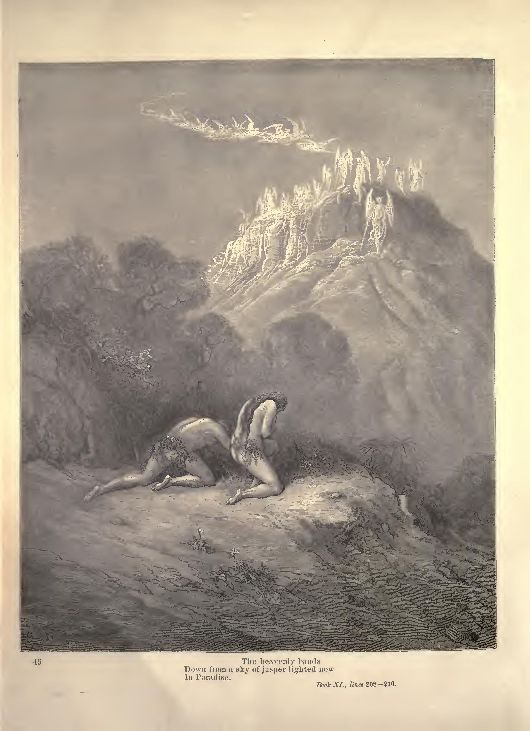
FULL-SIZE--Medium-Size
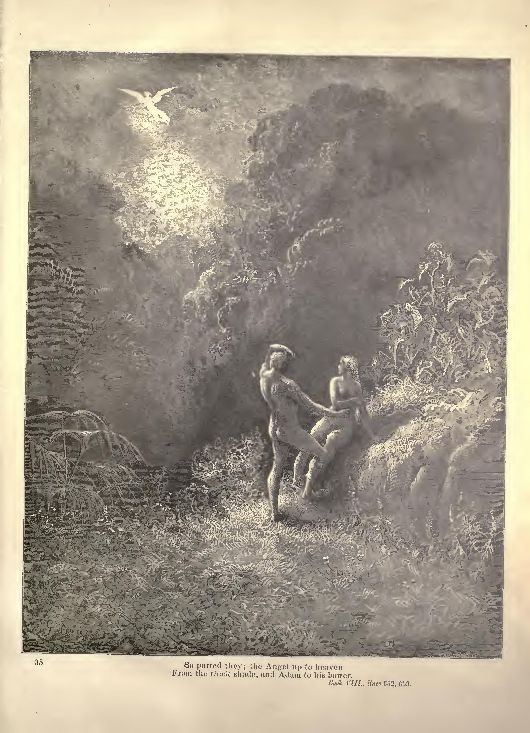
FULL-SIZE--Medium-Size
ON Paradise Lost.
WHEN I beheld the Poet blind, yet bold, In slender Book his vast Design unfold, Messiah Crown'd, Gods Reconcil'd Decree, Rebelling Angels, the Forbidden Tree, Heav'n, Hell, Earth, Chaos, All; the Argument Held me a while misdoubting his Intent, That he would ruine (for I saw him strong) The sacred Truths to Fable and old Song (So Sampson groap'd the Temples Posts in spight) The World o'rewhelming to revenge his sight. Yet as I read soon growing less severe, I lik'd his Project, the success did fear; Through that wide Field how he his way should find O're which lame Faith leads Understanding blind; Lest he perplex'd the things he would explain, And what was easie he should render vain. Or if a Work so infinite he spann'd, Jealous I was that some less skilful hand (Such as disquiet always what is well, And by ill imitating would excell) Might hence presume the whole Creations day To change in Scenes, and show it in a Play. Pardon me, Mighty Poet, nor despise My causeless, yet not impious, surmise. But I am now convinc'd, and none will dare Within thy Labours to pretend a share, Thou hast not miss'd one thought that could be fit, And all that was improper dost omit: So that no room is here for Writers left, But to detect their Ignorance or Theft. That Majesty which through thy Work doth Reign Draws the Devout, deterring the Profane, And things divine thou treatst of in such state As them preserves, and thee, inviolate. At once delight and horrour on us seise, Thou singst with so much gravity and ease; And above humane flight dost soar aloft With Plume so strong, so equal, and so soft. The Bird nam'd from that Paradise you sing So never flaggs, but always keeps on Wing. Where couldst thou words of such a compass find? Whence furnish such a vast expence of mind? Just Heav'n thee like Tiresias to requite Rewards with Prophesie thy loss of sight. Well mightst thou scorn thy Readers to allure With tinkling Rhime, of thy own sense secure; While the Town-Bayes writes all the while and spells, And like a Pack-horse tires without his Bells: Their Fancies like our Bushy-points appear, The Poets tag them, we for fashion wear. I too transported by the Mode offend, And while I meant to Praise thee must Commend. Thy Verse created like thy Theme sublime, In Number, Weight, and Measure, needs not Rhime. A.M. Note: On Paradise Lost] Added in the second edition 1674.
THE VERSE.
BOOK I.
Of Mans First Disobedience, and the Fruit Of that Forbidden Tree, whose mortal tast Brought Death into the World, and all our woe, With loss of Eden, till one greater Man Restore us, and regain the blissful Seat, Sing Heav'nly Muse, that on the secret top Of Oreb, or of Sinai, didst inspire That Shepherd, who first taught the chosen Seed, In the Beginning how the Heav'ns and Earth Rose out of Chaos: Or if Sion Hill 10 Delight thee more, and Siloa's Brook that flow'd Fast by the Oracle of God; I thence Invoke thy aid to my adventrous Song, That with no middle flight intends to soar Above th' Aonian Mount, while it pursues Things unattempted yet in Prose or Rhime. And chiefly Thou O Spirit, that dost prefer Before all Temples th' upright heart and pure, Instruct me, for Thou know'st; Thou from the first Wast present, and with mighty wings outspread 20 Dove-like satst brooding on the vast Abyss And mad'st it pregnant: What in me is dark Illumine, what is low raise and support; That to the highth of this great Argument I may assert th' Eternal Providence, And justifie the wayes of God to men. Say first, for Heav'n hides nothing from thy view Nor the deep Tract of Hell, say first what cause Mov'd our Grand Parents in that happy State, Favour'd of Heav'n so highly, to fall off 30 From their Creator, and transgress his Will For one restraint, Lords of the World besides? Who first seduc'd them to that fowl revolt? Th' infernal Serpent; he it was, whose guile Stird up with Envy and Revenge, deceiv'd The Mother of Mankinde, what time his Pride Had cast him out from Heav'n, with all his Host Of Rebel Angels, by whose aid aspiring To set himself in Glory above his Peers, He trusted to have equal'd the most High, 40 If he oppos'd; and with ambitious aim Against the Throne and Monarchy of God Rais'd impious War in Heav'n and Battel proud With vain attempt. Him the Almighty Power
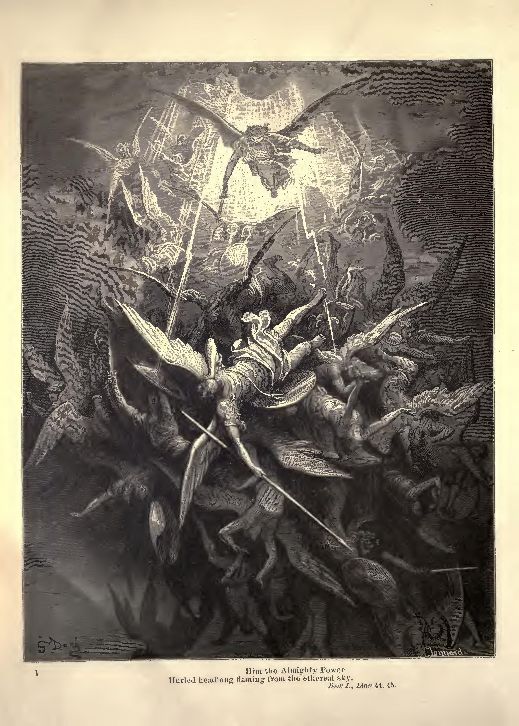
FULL-SIZE--Medium-Size
Hurld headlong flaming from th' Ethereal Skie With hideous ruine and combustion down To bottomless perdition, there to dwell In Adamantine Chains and penal Fire, Who durst defie th' Omnipotent to Arms. Nine times the Space that measures Day and Night 50 To mortal men, he with his horrid crew Lay vanquisht, rowling in the fiery Gulfe Confounded though immortal: But his doom Reserv'd him to more wrath; for now the thought Both of lost happiness and lasting pain Torments him; round he throws his baleful eyes That witness'd huge affliction and dismay Mixt with obdurate pride and stedfast hate: At once as far as Angels kenn he views The dismal Situation waste and wilde, 60 A Dungeon horrible, on all sides round As one great Furnace flam'd, yet from those flames No light, but rather darkness visible Serv'd only to discover sights of woe, Regions of sorrow, doleful shades, where peace And rest can never dwell, hope never comes That comes to all; but torture without end Still urges, and a fiery Deluge, fed With ever-burning Sulphur unconsum'd: Such place Eternal Justice had prepar'd 70 For those rebellious, here their Prison ordain'd In utter darkness, and their portion set As far remov'd from God and light of Heav'n As from the Center thrice to th' utmost Pole. O how unlike the place from whence they fell! There the companions of his fall, o'rewhelm'd With Floods and Whirlwinds of tempestuous fire, He soon discerns, and weltring by his side One next himself in power, and next in crime, Long after known in Palestine, and nam'd 80 Beelzebub. To whom th' Arch-Enemy, And thence in Heav'n call'd Satan, with bold words Breaking the horrid silence thus began. If thou beest he; But O how fall'n! how chang'd From him, who in the happy Realms of Light Cloth'd with transcendent brightnes didst outshine Myriads though bright: If he whom mutual league, United thoughts and counsels, equal hope, And hazard in the Glorious Enterprize, Joynd with me once, now misery hath joynd 90 In equal ruin: into what Pit thou seest From what highth fal'n, so much the stronger provd He with his Thunder: and till then who knew The force of those dire Arms? yet not for those Nor what the Potent Victor in his rage Can else inflict do I repent or change, Though chang'd in outward lustre; that fixt mind And high disdain, from sence of injur'd merit, That with the mightiest rais'd me to contend, And to the fierce contention brought along 100 Innumerable force of Spirits arm'd That durst dislike his reign, and me preferring, His utmost power with adverse power oppos'd In dubious Battel on the Plains of Heav'n, And shook his throne. What though the field be lost? All is not lost; the unconquerable Will, And study of revenge, immortal hate, And courage never to submit or yield: And what is else not to be overcome? That Glory never shall his wrath or might 110 Extort from me. To bow and sue for grace With suppliant knee, and deifie his power Who from the terrour of this Arm so late Doubted his Empire, that were low indeed, That were an ignominy and shame beneath This downfall; since by Fate the strength of Gods And this Empyreal substance cannot fail, Since through experience of this great event In Arms not worse, in foresight much advanc't, We may with more successful hope resolve 120 To wage by force or guile eternal Warr Irreconcileable, to our grand Foe, Who now triumphs, and in th' excess of joy Sole reigning holds the Tyranny of Heav'n. So spake th' Apostate Angel, though in pain, Vaunting aloud, but rackt with deep despare: And him thus answer'd soon his bold Compeer. O Prince, O Chief of many Throned Powers, That led th' imbattelld Seraphim to Warr Under thy conduct, and in dreadful deeds 130 Fearless, endanger'd Heav'ns perpetual King; And put to proof his high Supremacy, Whether upheld by strength, or Chance, or Fate, Too well I see and rue the dire event, That with sad overthrow and foul defeat Hath lost us Heav'n, and all this mighty Host In horrible destruction laid thus low, As far as Gods and Heav'nly Essences Can Perish: for the mind and spirit remains Invincible, and vigour soon returns, 140 Though all our Glory extinct, and happy state Here swallow'd up in endless misery. But what if he our Conquerour, (whom I now Of force believe Almighty, since no less Then such could hav orepow'rd such force as ours) Have left us this our spirit and strength intire Strongly to suffer and support our pains, That we may so suffice his vengeful ire, Or do him mightier service as his thralls By right of Warr, what e're his business be 150 Here in the heart of Hell to work in Fire, Or do his Errands in the gloomy Deep; What can it then avail though yet we feel Strength undiminisht, or eternal being To undergo eternal punishment? Whereto with speedy words th' Arch-fiend reply'd. Fall'n Cherube, to be weak is miserable Doing or Suffering: but of this be sure, To do ought good never will be our task, But ever to do ill our sole delight, 160 As being the contrary to his high will Whom we resist. If then his Providence Out of our evil seek to bring forth good, Our labour must be to pervert that end, And out of good still to find means of evil; Which oft times may succeed, so as perhaps Shall grieve him, if I fail not, and disturb His inmost counsels from their destind aim. But see the angry Victor hath recall'd His Ministers of vengeance and pursuit 170 Back to the Gates of Heav'n: The Sulphurous Hail Shot after us in storm, oreblown hath laid The fiery Surge, that from the Precipice Of Heav'n receiv'd us falling, and the Thunder, Wing'd with red Lightning and impetuous rage, Perhaps hath spent his shafts, and ceases now To bellow through the vast and boundless Deep. Let us not slip th' occasion, whether scorn, Or satiate fury yield it from our Foe. Seest thou yon dreary Plain, forlorn and wilde, 180 The seat of desolation, voyd of light, Save what the glimmering of these livid flames Casts pale and dreadful? Thither let us tend From off the tossing of these fiery waves, There rest, if any rest can harbour there, And reassembling our afflicted Powers, Consult how we may henceforth most offend Our Enemy, our own loss how repair, How overcome this dire Calamity, What reinforcement we may gain from Hope, 190 If not what resolution from despare. Thus Satan talking to his neerest Mate With Head up-lift above the wave, and Eyes That sparkling blaz'd, his other Parts besides Prone on the Flood, extended long and large Lay floating many a rood, in bulk as huge As whom the Fables name of monstrous size, Titanian, or Earth-born, that warr'd on Jove, Briarios or Typhon, whom the Den By ancient Tarsus held, or that Sea-beast 200 Leviathan, which God of all his works Created hugest that swim th' Ocean stream: Him haply slumbring on the Norway foam The Pilot of some small night-founder'd Skiff, Deeming some Island, oft, as Sea-men tell, With fixed Anchor in his skaly rind Moors by his side under the Lee, while Night Invests the Sea, and wished Morn delayes: So stretcht out huge in length the Arch-fiend lay Chain'd on the burning Lake, nor ever thence 210 Had ris'n or heav'd his head, but that the will And high permission of all-ruling Heaven Left him at large to his own dark designs, That with reiterated crimes he might Heap on himself damnation, while he sought Evil to others, and enrag'd might see How all his malice serv'd but to bring forth Infinite goodness, grace and mercy shewn On Man by him seduc't, but on himself Treble confusion, wrath and vengeance pour'd. 220 Forthwith upright he rears from off the Pool
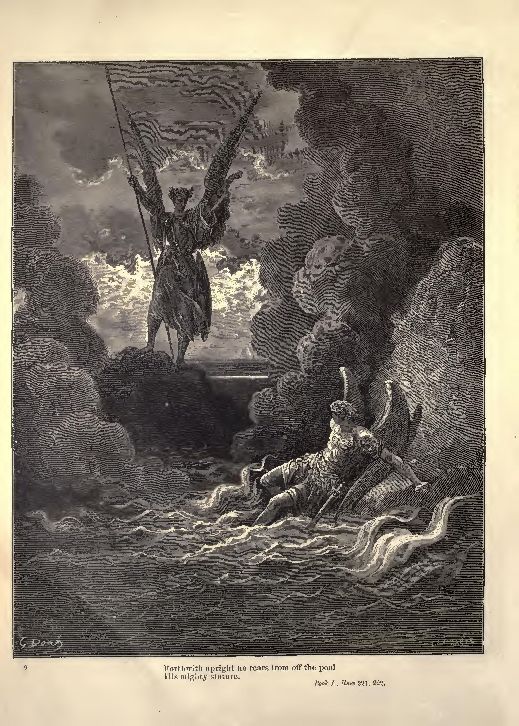
FULL-SIZE--Medium-Size
His mighty Stature; on each hand the flames Drivn backward slope their pointing spires, & rowld In billows, leave i'th' midst a horrid Vale. Then with expanded wings he stears his flight Aloft, incumbent on the dusky Air That felt unusual weight, till on dry Land He lights, if it were Land that ever burn'd With solid, as the Lake with liquid fire; And such appear'd in hue, as when the force 230 Of subterranean wind transports a Hill Torn from Pelorus, or the shatter'd side Of thundring Aetna, whose combustible And fewel'd entrals thence conceiving Fire, Sublim'd with Mineral fury, aid the Winds, And leave a singed bottom all involv'd With stench and smoak: Such resting found the sole Of unblest feet. Him followed his next Mate, Both glorying to have scap't the Stygian flood As Gods, and by their own recover'd strength, 240 Not by the sufferance of supernal Power. Is this the Region, this the Soil, the Clime, Said then the lost Arch Angel, this the seat That we must change for Heav'n, this mournful gloom For that celestial light? Be it so, since hee Who now is Sovran can dispose and bid What shall be right: fardest from him is best Whom reason hath equald, force hath made supream Above his equals. Farewel happy Fields Where Joy for ever dwells: Hail horrours, hail 250 Infernal world, and thou profoundest Hell Receive thy new Possessor: One who brings A mind not to be chang'd by Place or Time. The mind is its own place, and in it self Can make a Heav'n of Hell, a Hell of Heav'n. What matter where, if I be still the same, And what I should be, all but less then hee Whom Thunder hath made greater? Here at least We shall be free; th' Almighty hath not built Here for his envy, will not drive us hence: 260 Here we may reign secure, and in my choyce To reign is worth ambition though in Hell: Better to reign in Hell, then serve in Heav'n. But wherefore let we then our faithful friends, Th' associates and copartners of our loss Lye thus astonisht on th' oblivious Pool, And call them not to share with us their part In this unhappy Mansion, or once more With rallied Arms to try what may be yet Regaind in Heav'n, or what more lost in Hell? 270 So Satan spake, and him Beelzebub Thus answer'd. Leader of those Armies bright, Which but th' Omnipotent none could have foyld, If once they hear that voyce, their liveliest pledge Of hope in fears and dangers, heard so oft In worst extreams, and on the perilous edge Of battel when it rag'd, in all assaults Their surest signal, they will soon resume New courage and revive, though now they lye Groveling and prostrate on yon Lake of Fire, 280 As we erewhile, astounded and amaz'd, No wonder, fall'n such a pernicious highth. He scarce had ceas't when the superiour Fiend Was moving toward the shore; his ponderous shield Ethereal temper, massy, large and round, Behind him cast; the broad circumference Hung on his shoulders like the Moon, whose Orb Through Optic Glass the Tuscan Artist views At Ev'ning from the top of Fesole, Or in Valdarno, to descry new Lands, 290 Rivers or Mountains in her spotty Globe. His Spear, to equal which the tallest Pine Hewn on Norwegian hills, to be the Mast Of some great Ammiral, were but a wand, He walkt with to support uneasie steps Over the burning Marle, not like those steps On Heavens Azure, and the torrid Clime Smote on him sore besides, vaulted with Fire; Nathless he so endur'd, till on the Beach Of that inflamed Sea, he stood and call'd 300 His Legions, Angel Forms, who lay intrans't Thick as Autumnal Leaves that strow the Brooks In Vallombrosa, where th' Etrurian shades High overarch't imbowr; or scatterd sedge Afloat, when with fierce Winds Orion arm'd Hath vext the Red-Sea Coast, whose waves orethrew Busiris and his Memphian Chivalrie, While with perfidious hatred they pursu'd The Sojourners of Goshen, who beheld From the safe shore their floating Carkases 310 And broken Chariot Wheels, so thick bestrown Abject and lost lay these, covering the Flood, Under amazement of their hideous change. He call'd so loud, that all the hollow Deep Of Hell resounded. Princes, Potentates, Warriers, the Flowr of Heav'n, once yours, now lost, If such astonishment as this can sieze Eternal spirits; or have ye chos'n this place After the toyl of Battel to repose Your wearied vertue, for the ease you find 320 To slumber here, as in the Vales of Heav'n? Or in this abject posture have ye sworn To adore the Conquerour? who now beholds Cherube and Seraph rowling in the Flood With scatter'd Arms and Ensigns, till anon His swift pursuers from Heav'n Gates discern Th' advantage, and descending tread us down Thus drooping, or with linked Thunderbolts Transfix us to the bottom of this Gulfe. Awake, arise, or be for ever fall'n. 330 They heard, and were abasht, and up they sprung
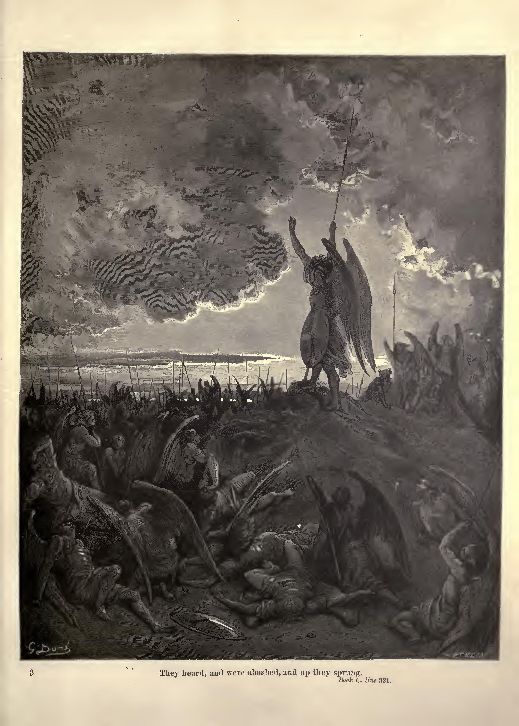
FULL-SIZE--Medium-Size
Upon the wing, as when men wont to watch On duty, sleeping found by whom they dread, Rouse and bestir themselves ere well awake. Nor did they not perceave the evil plight In which they were, or the fierce pains not feel; Yet to their Generals Voyce they soon obeyd Innumerable. As when the potent Rod Of Amrams Son in Egypts evill day Wav'd round the Coast, up call'd a pitchy cloud 340 Of Locusts, warping on the Eastern Wind, That ore the Realm of impious Pharoah hung Like Night, and darken'd all the Land of Nile: So numberless were those bad Angels seen Hovering on wing under the Cope of Hell
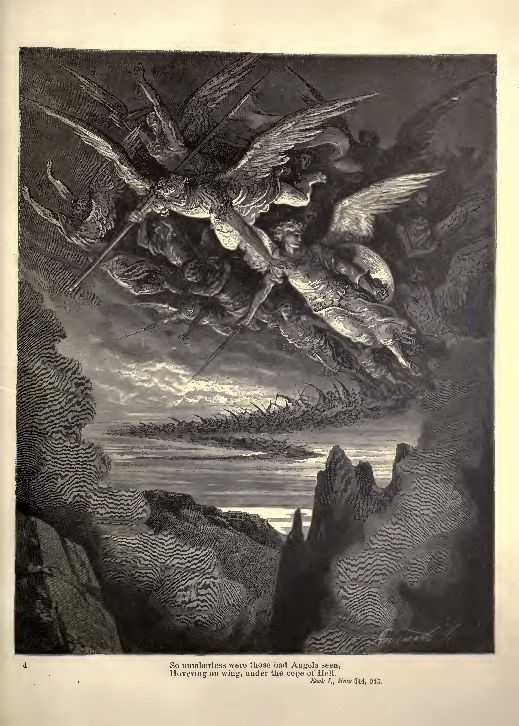
FULL-SIZE--Medium-Size
'Twixt upper, nether, and surrounding Fires; Till, as a signal giv'n, th' uplifted Spear Of their great Sultan waving to direct Thir course, in even ballance down they light On the firm brimstone, and fill all the Plain; 350 A multitude, like which the populous North Pour'd never from her frozen loyns, to pass Rhene or the Danaw, when her barbarous Sons Came like a Deluge on the South, and spread Beneath Gibraltar to the Lybian sands. Forthwith from every Squadron and each Band The Heads and Leaders thither hast where stood Their great Commander; Godlike shapes and forms Excelling human, Princely Dignities, And Powers that earst in Heaven sat on Thrones; 360 Though of their Names in heav'nly Records now Be no memorial, blotted out and ras'd By thir Rebellion, from the Books of Life. Nor had they yet among the Sons of Eve Got them new Names, till wandring ore the Earth, Through Gods high sufferance for the tryal of man, By falsities and lyes the greatest part Of Mankind they corrupted to forsake God their Creator, and th' invisible Glory of him, that made them, to transform 370 Oft to the Image of a Brute, adorn'd With gay Religions full of Pomp and Gold, And Devils to adore for Deities: Then were they known to men by various Names, And various Idols through the Heathen World. Say, Muse, their Names then known, who first, who last, Rous'd from the slumber, on that fiery Couch, At thir great Emperors call, as next in worth Came singly where he stood on the bare strand, While the promiscuous croud stood yet aloof? 380 The chief were those who from the Pit of Hell Roaming to seek their prey on earth, durst fix Their Seats long after next the Seat of God, Their Altars by his Altar, Gods ador'd Among the Nations round, and durst abide Jehovah thundring out of Sion, thron'd Between the Cherubim; yea, often plac'd Within his Sanctuary it self their Shrines, Abominations; and with cursed things His holy Rites, and solemn Feasts profan'd, 390 And with their darkness durst affront his light. First Moloch, horrid King besmear'd with blood Of human sacrifice, and parents tears, Though for the noyse of Drums and Timbrels loud Their childrens cries unheard, that past through fire To his grim Idol. Him the Ammonite Worshipt in Rabba and her watry Plain, In Argob and in Basan, to the stream Of utmost Arnon. Nor content with such Audacious neighbourhood, the wisest heart 400 Of Solomon he led by fraud to build His Temple right against the Temple of God On that opprobrious Hill, and made his Grove The pleasant Vally of Hinnom, Tophet thence And black Gehenna call'd, the Type of Hell. Next Chemos, th' obscene dread of Moabs Sons, From Aroer to Nebo, and the wild Of Southmost Abarim; in Hesebon And Heronaim, Seons Realm, beyond The flowry Dale of Sibma clad with Vines, 410 And Eleale to th' Asphaltick Pool. Peor his other Name, when he entic'd Israel in Sittim on their march from Nile To do him wanton rites, which cost them woe. Yet thence his lustful Orgies he enlarg'd Even to that Hill of scandal, by the Grove Of Moloch homicide, lust hard by hate; Till good Josiah drove them thence to Hell. With these came they, who from the bordring flood Of old Euphrates to the Brook that parts 420 Egypt from Syrian ground, had general Names Of Baalim and Ashtaroth, those male, These Feminine. For Spirits when they please Can either Sex assume, or both; so soft And uncompounded is their Essence pure, Not ti'd or manacl'd with joynt or limb, Nor founded on the brittle strength of bones, Like cumbrous flesh; but in what shape they choose Dilated or condens't, bright or obscure, Can execute their aerie purposes, 430 And works of love or enmity fulfill. For those the Race of Israel oft forsook Their living strength, and unfrequented left His righteous Altar, bowing lowly down To bestial Gods; for which their heads as low Bow'd down in Battel, sunk before the Spear Of despicable foes. With these in troop Came Astoreth, whom the Phoenicians call'd Astarte, Queen of Heav'n, with crescent Horns; To whose bright Image nightly by the Moon 440 Sidonian Virgins paid their Vows and Songs, In Sion also not unsung, where stood Her Temple on th' offensive Mountain, built By that uxorious King, whose heart though large, Beguil'd by fair Idolatresses, fell To Idols foul. Thammuz came next behind, Whose annual wound in Lebanon allur'd The Syrian Damsels to lament his fate In amorous dittyes all a Summers day, While smooth Adonis from his native Rock 450 Ran purple to the Sea, suppos'd with blood Of Thammuz yearly wounded: the Love-tale Infected Sions daughters with like heat, Whose wanton passions in the sacred Porch Ezekiel saw, when by the Vision led His eye survay'd the dark Idolatries Of alienated Judah. Next came one Who mourn'd in earnest, when the Captive Ark Maim'd his brute Image, head and hands lopt off In his own Temple, on the grunsel edge, 460 Where he fell flat, and sham'd his Worshipers: Dagon his Name, Sea Monster, upward Man And downward Fish: yet had his Temple high Rear'd in Azotus, dreaded through the Coast Of Palestine, in Gath and Ascalon, And Accaron and Gaza's frontier bounds. Him follow'd Rimmon, whose delightful Seat Was fair Damascus, on the fertil Banks Of Abbana and Pharphar, lucid streams. He also against the house of God was bold: 470 A Leper once he lost and gain'd a King, Ahaz his sottish Conquerour, whom he drew Gods Altar to disparage and displace For one of Syrian mode, whereon to burn His odious offrings, and adore the Gods Whom he had vanquisht. After these appear'd A crew who under Names of old Renown, Osiris, Isis, Orus and their Train With monstrous shapes and sorceries abus'd Fanatic Egypt and her Priests, to seek 480 Thir wandring Gods disguis'd in brutish forms Rather then human. Nor did Israel scape Th' infection when their borrow'd Gold compos'd The Calf in Oreb: and the Rebel King Doubl'd that sin in Bethel and in Dan, Lik'ning his Maker to the Grazed Ox, Jehovah, who in one Night when he pass'd From Egypt marching, equal'd with one stroke Both her first born and all her bleating Gods. Belial came last, then whom a Spirit more lewd 490 Fell not from Heaven, or more gross to love Vice for it self: To him no Temple stood Or Altar smoak'd; yet who more oft then hee In Temples and at Altars, when the Priest Turns Atheist, as did Ely's Sons, who fill'd With lust and violence the house of God. In Courts and Palaces he also Reigns And in luxurious Cities, where the noyse Of riot ascends above thir loftiest Towrs, And injury and outrage: And when Night 500 Darkens the Streets, then wander forth the Sons Of Belial, flown with insolence and wine. Witness the Streets of Sodom, and that night In Gibeah, when hospitable Dores Yielded thir Matrons to prevent worse rape. These were the prime in order and in might; The rest were long to tell, though far renown'd, Th' Ionian Gods, of Javans Issue held Gods, yet confest later then Heav'n and Earth Thir boasted Parents; Titan Heav'ns first born 510 With his enormous brood, and birthright seis'd By younger Saturn, he from mightier Jove His own and Rhea's Son like measure found; So Jove usurping reign'd: these first in Creet And Ida known, thence on the Snowy top Of cold Olympus rul'd the middle Air Thir highest Heav'n; or on the Delphian Cliff, Or in Dodona, and through all the bounds Of Doric Land; or who with Saturn old Fled over Adria to th' Hesperian Fields, 520 And ore the Celtic roam'd the utmost Isles. All these and more came flocking; but with looks Down cast and damp, yet such wherein appear'd Obscure som glimps of joy, to have found thir chief Not in despair, to have found themselves not lost In loss it self; which on his count'nance cast Like doubtful hue: but he his wonted pride Soon recollecting, with high words, that bore Semblance of worth not substance, gently rais'd Their fainted courage, and dispel'd their fears. 530 Then strait commands that at the warlike sound Of Trumpets loud and Clarions be upreard His mighty Standard; that proud honour claim'd Azazel as his right, a Cherube tall: Who forthwith from the glittering Staff unfurld Th' Imperial Ensign, which full high advanc't Shon like a Meteor streaming to the Wind With Gemms and Golden lustre rich imblaz'd, Seraphic arms and Trophies: all the while Sonorous mettal blowing Martial sounds: 540 At which the universal Host upsent A shout that tore Hells Concave, and beyond Frighted the Reign of Chaos and old Night. All in a moment through the gloom were seen Ten thousand Banners rise into the Air With Orient Colours waving: with them rose A Forrest huge of Spears: and thronging Helms Appear'd, and serried Shields in thick array Of depth immeasurable: Anon they move In perfect Phalanx to the Dorian mood 550 Of Flutes and soft Recorders; such as rais'd To highth of noblest temper Hero's old Arming to Battel, and in stead of rage Deliberate valour breath'd, firm and unmov'd With dread of death to flight or foul retreat, Nor wanting power to mitigate and swage With solemn touches, troubl'd thoughts, and chase Anguish and doubt and fear and sorrow and pain From mortal or immortal minds. Thus they Breathing united force with fixed thought 560 Mov'd on in silence to soft Pipes that charm'd Thir painful steps o're the burnt soyle; and now Advanc't in view they stand, a horrid Front Of dreadful length and dazling Arms, in guise Of Warriers old with order'd Spear and Shield, Awaiting what command thir mighty Chief Had to impose: He through the armed Files Darts his experienc't eye, and soon traverse The whole Battalion views, thir order due, Thir visages and stature as of Gods, 570 Thir number last he summs. And now his heart Distends with pride, and hardning in his strength Glories: For never since created man, Met such imbodied force, as nam'd with these Could merit more then that small infantry Warr'd on by Cranes: though all the Giant brood Of Phlegra with th' Heroic Race were joyn'd That fought at Theb's and Ilium, on each side Mixt with auxiliar Gods; and what resounds In Fable or Romance of Uthers Son 580 Begirt with British and Armoric Knights; And all who since, Baptiz'd or Infidel Jousted in Aspramont or Montalban, Damasco, or Marocco, or Trebisond, Or whom Biserta sent from Afric shore When Charlemain with all his Peerage fell By Fontarabbia. Thus far these beyond Compare of mortal prowess, yet observ'd Thir dread Commander: he above the rest In shape and gesture proudly eminent 590 Stood like a Towr; his form had yet not lost All her Original brightness, nor appear'd Less then Arch Angel ruind, and th' excess Of Glory obscur'd: As when the Sun new ris'n Looks through the Horizontal misty Air Shorn of his Beams, or from behind the Moon In dim Eclips disastrous twilight sheds On half the Nations, and with fear of change Perplexes Monarchs. Dark'n'd so, yet shon Above them all th' Arch Angel: but his face 600 Deep scars of Thunder had intrencht, and care Sat on his faded cheek, but under Browes Of dauntless courage, and considerate Pride Waiting revenge: cruel his eye, but cast Signs of remorse and passion to behold The fellows of his crime, the followers rather (Far other once beheld in bliss) condemn'd For ever now to have their lot in pain, Millions of Spirits for his fault amerc't Of Heav'n, and from Eternal Splendors flung 610 For his revolt, yet faithfull how they stood, Thir Glory witherd. As when Heavens Fire Hath scath'd the Forrest Oaks, or Mountain Pines, With singed top their stately growth though bare Stands on the blasted Heath. He now prepar'd To speak; whereat their doubl'd Ranks they bend From Wing to Wing, and half enclose him round With all his Peers: attention held them mute. Thrice he assayd, and thrice in spite of scorn, Tears such as Angels weep, burst forth: at last 620 Words interwove with sighs found out their way. O Myriads of immortal Spirits, O Powers Matchless, but with th' Almighty, and that strife Was not inglorious, though th' event was dire, As this place testifies, and this dire change Hateful to utter: but what power of mind Foreseeing or presaging, from the Depth Of knowledge past or present, could have fear'd, How such united force of Gods, how such As stood like these, could ever know repulse? 630 For who can yet beleeve, though after loss, That all these puissant Legions, whose exile Hath emptied Heav'n, shall faile to re-ascend Self-rais'd, and repossess their native seat. For me, be witness all the Host of Heav'n, If counsels different, or danger shun'd By me, have lost our hopes. But he who reigns Monarch in Heav'n, till then as one secure Sat on his Throne, upheld by old repute, Consent or custome, and his Regal State 640 Put forth at full, but still his strength conceal'd, Which tempted our attempt, and wrought our fall. Henceforth his might we know, and know our own So as not either to provoke, or dread New warr, provok't; our better part remains To work in close design, by fraud or guile What force effected not: that he no less At length from us may find, who overcomes By force, hath overcome but half his foe. Space may produce new Worlds; whereof so rife 650 There went a fame in Heav'n that he ere long Intended to create, and therein plant A generation, whom his choice regard Should favour equal to the Sons of Heaven: Thither, if but to prie, shall be perhaps Our first eruption, thither or elsewhere: For this Infernal Pit shall never hold Caelestial Spirits in Bondage, nor th' Abysse Long under darkness cover. But these thoughts Full Counsel must mature: Peace is despaird, 660 For who can think Submission? Warr then, Warr Open or understood must be resolv'd. He spake: and to confirm his words, out-flew Millions of flaming swords, drawn from the thighs Of mighty Cherubim; the sudden blaze Far round illumin'd hell: highly they rag'd Against the Highest, and fierce with grasped arm's Clash'd on their sounding shields the din of war, Hurling defiance toward the vault of Heav'n. There stood a Hill not far whose griesly top 670 Belch'd fire and rowling smoak; the rest entire Shon with a glossie scurff, undoubted sign That in his womb was hid metallic Ore, The work of Sulphur. Thither wing'd with speed A numerous Brigad hasten'd. As when bands Of Pioners with Spade and Pickaxe arm'd Forerun the Royal Camp, to trench a Field, Or cast a Rampart. Mammon led them on, Mammon, the least erected Spirit that fell From heav'n, for ev'n in heav'n his looks and thoughts 680 Were always downward bent, admiring more The riches of Heav'ns pavement, trod'n Gold, Then aught divine or holy else enjoy'd In vision beatific: by him first Men also, and by his suggestion taught, Ransack'd the Center, and with impious hands Rifl'd the bowels of thir mother Earth For Treasures better hid. Soon had his crew Op'nd into the Hill a spacious wound And dig'd out ribs of Gold. Let none admire 690 That riches grow in Hell; that soyle may best Deserve the pretious bane. And here let those Who boast in mortal things, and wondring tell Of Babel, and the works of Memphian Kings, Learn how thir greatest Monuments of Fame, And Strength and Art are easily outdone By Spirits reprobate, and in an hour What in an age they with incessant toyle And hands innumerable scarce perform. Nigh on the Plain in many cells prepar'd, 700 That underneath had veins of liquid fire Sluc'd from the Lake, a second multitude With wondrous Art founded the massie Ore, Severing each kinde, and scum'd the Bullion dross: A third as soon had form'd within the ground A various mould, and from the boyling cells By strange conveyance fill'd each hollow nook, As in an Organ from one blast of wind To many a row of Pipes the sound-board breaths. Anon out of the earth a Fabrick huge 710 Rose like an Exhalation, with the sound Of Dulcet Symphonies and voices sweet, Built like a Temple, where Pilasters round Were set, and Doric pillars overlaid With Golden Architrave; nor did there want Cornice or Freeze, with bossy Sculptures grav'n, The Roof was fretted Gold. Not Babilon, Nor great Alcairo such magnificence Equal'd in all thir glories, to inshrine Belus or Serapis thir Gods, or seat 720 Thir Kings, when Aegypt with Assyria strove In wealth and luxurie. Th' ascending pile Stood fixt her stately highth, and strait the dores Op'ning thir brazen foulds discover wide Within, her ample spaces, o're the smooth And level pavement: from the arched roof Pendant by suttle Magic many a row Of Starry Lamps and blazing Cressets fed With Naphtha and Asphaltus yeilded light As from a sky. The hasty multitude 730 Admiring enter'd, and the work some praise And some the Architect: his hand was known In Heav'n by many a Towred structure high, Where Scepter'd Angels held thir residence, And sat as Princes, whom the supreme King Exalted to such power, and gave to rule, Each in his Herarchie, the Orders bright. Nor was his name unheard or unador'd In ancient Greece; and in Ausonian land Men call'd him Mulciber; and how he fell 740 From Heav'n, they fabl'd, thrown by angry Jove Sheer o're the Chrystal Battlements: from Morn To Noon he fell, from Noon to dewy Eve, A Summers day; and with the setting Sun Dropt from the Zenith like a falling Star, On Lemnos th' Aegaean Ile: thus they relate, Erring; for he with this rebellious rout Fell long before; nor aught avail'd him now To have built in Heav'n high Towrs; nor did he scape By all his Engins, but was headlong sent 750 With his industrious crew to build in hell. Mean while the winged Haralds by command Of Sovran power, with awful Ceremony And Trumpets sound throughout the Host proclaim A solemn Councel forthwith to be held At Pandaemonium, the high Capital Of Satan and his Peers: thir summons call'd From every Band and squared Regiment
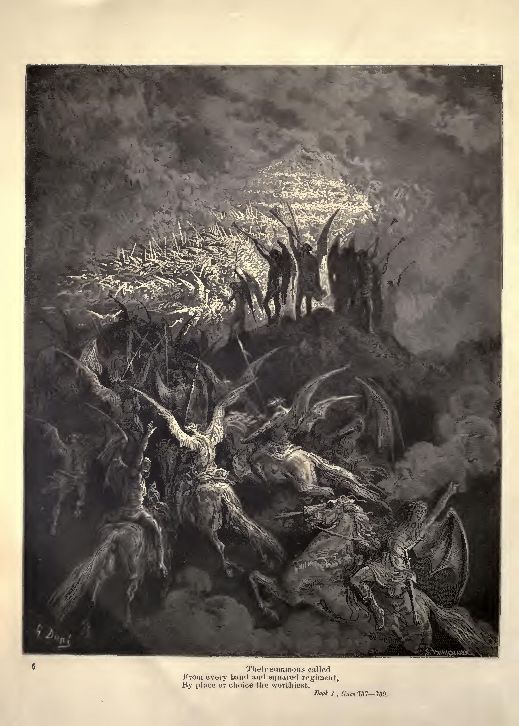
FULL-SIZE--Medium-Size
By place or choice the worthiest; they anon With hundreds and with thousands trooping came 760 Attended: all access was throng'd, the Gates And Porches wide, but chief the spacious Hall (Though like a cover'd field, where Champions bold Wont ride in arm'd, and at the Soldans chair Defi'd the best of Panim chivalry To mortal combat or carreer with Lance) Thick swarm'd, both on the ground and in the air, Brusht with the hiss of russling wings. As Bees In spring time, when the Sun with Taurus rides, Poure forth thir populous youth about the Hive 770 In clusters; they among fresh dews and flowers Flie to and fro, or on the smoothed Plank, The suburb of thir Straw-built Cittadel, New rub'd with Baume, expatiate and confer Thir State affairs. So thick the aerie crowd Swarm'd and were straitn'd; till the Signal giv'n, Behold a wonder! they but now who seemd In bigness to surpass Earths Giant Sons Now less then smallest Dwarfs, in narrow room Throng numberless, like that Pigmean Race 780 Beyond the Indian Mount, or Faerie Elves, Whose midnight Revels, by a Forrest side Or Fountain some belated Peasant sees, Or dreams he sees, while over head the Moon Sits Arbitress, and neerer to the Earth Wheels her pale course, they on thir mirth & dance Intent, with jocond Music charm his ear; At once with joy and fear his heart rebounds. Thus incorporeal Spirits to smallest forms Reduc'd thir shapes immense, and were at large, 790 Though without number still amidst the Hall Of that infernal Court. But far within And in thir own dimensions like themselves The great Seraphic Lords and Cherubim In close recess and secret conclave sat A thousand Demy-Gods on golden seat's, Frequent and full. After short silence then And summons read, the great consult began. Notes: 504, 505 hospitable Dores Yielded thir Matrons] the hospitable door Expos'd a Matron 1674. 530 fainted] fa(i)nting 1674. 703 founded] found out 1674. 737 Herarchie] Hierarchie 1674. The End Of The First Book.
BOOK II.
High on a Throne of Royal State, which far
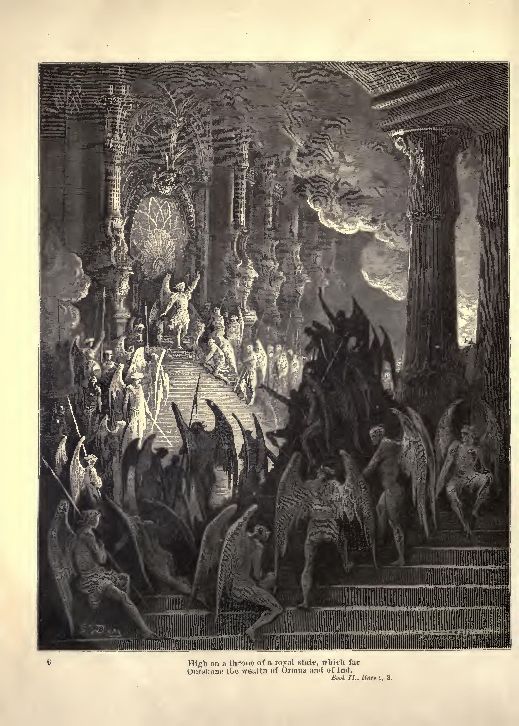
FULL-SIZE--Medium-Size
Outshon the wealth of Ormus and of Ind, Or where the gorgeous East with richest hand Showrs on her Kings Barbaric Pearl & Gold, Satan exalted sat, by merit rais'd To that bad eminence; and from despair Thus high uplifted beyond hope, aspires Beyond thus high, insatiate to pursue Vain Warr with Heav'n, and by success untaught His proud imaginations thus displaid. 10 Powers and Dominions, Deities of Heav'n, For since no deep within her gulf can hold Immortal vigor, though opprest and fall'n, I give not Heav'n for lost. From this descent Celestial vertues rising, will appear More glorious and more dread then from no fall, And trust themselves to fear no second fate: Mee though just right, and the fixt Laws of Heav'n Did first create your Leader, next, free choice, With what besides, in Counsel or in Fight, 20 Hath bin achievd of merit, yet this loss Thus farr at least recover'd, hath much more Establisht in a safe unenvied Throne Yielded with full consent. The happier state In Heav'n, which follows dignity, might draw Envy from each inferior; but who here Will envy whom the highest place exposes Formost to stand against the Thunderers aime Your bulwark, and condemns to greatest share Of endless pain? where there is then no good 30 For which to strive, no strife can grow up there From Faction; for none sure will claim in hell Precedence, none, whose portion is so small Of present pain, that with ambitious mind Will covet more. With this advantage then To union, and firm Faith, and firm accord, More then can be in Heav'n, we now return To claim our just inheritance of old, Surer to prosper then prosperity Could have assur'd us; and by what best way, 40 Whether of open Warr or covert guile, We now debate; who can advise, may speak. He ceas'd, and next him Moloc, Scepter'd King Stood up, the strongest and the fiercest Spirit That fought in Heav'n; now fiercer by despair: His trust was with th' Eternal to be deem'd Equal in strength, and rather then be less Car'd not to be at all; with that care lost Went all his fear: of God, or Hell, or worse He reckd not, and these words thereafter spake. 50 My sentence is for open Warr: Of Wiles, More unexpert, I boast not: them let those Contrive who need, or when they need, not now. For while they sit contriving, shall the rest, Millions that stand in Arms, and longing wait The Signal to ascend, sit lingring here Heav'ns fugitives, and for thir dwelling place Accept this dark opprobrious Den of shame, The Prison of his Tyranny who Reigns By our delay? no, let us rather choose 60 Arm'd with Hell flames and fury all at once O're Heav'ns high Towrs to force resistless way, Turning our Tortures into horrid Arms Against the Torturer; when to meet the noise Of his Almighty Engin he shall hear Infernal Thunder, and for Lightning see Black fire and horror shot with equal rage Among his Angels; and his Throne it self Mixt with Tartarean Sulphur, and strange fire, His own invented Torments. But perhaps 70 The way seems difficult and steep to scale With upright wing against a higher foe. Let such bethink them, if the sleepy drench Of that forgetful Lake benumme not still, That in our proper motion we ascend Up to our native seat: descent and fall To us is adverse. Who but felt of late When the fierce Foe hung on our brok'n Rear Insulting, and pursu'd us through the Deep, With what compulsion and laborious flight 80 We sunk thus low? Th' ascent is easie then; Th' event is fear'd; should we again provoke Our stronger, some worse way his wrath may find To our destruction: if there be in Hell Fear to be worse destroy'd: what can be worse Then to dwell here, driv'n out from bliss, condemn'd In this abhorred deep to utter woe; Where pain of unextinguishable fire Must exercise us without hope of end The Vassals of his anger, when the Scourge 90 Inexorably, and the torturing houre Calls us to Penance? More destroy'd then thus We should be quite abolisht and expire. What fear we then? what doubt we to incense His utmost ire? which to the highth enrag'd, Will either quite consume us, and reduce To nothing this essential, happier farr Then miserable to have eternal being: Or if our substance be indeed Divine, And cannot cease to be, we are at worst 100 On this side nothing; and by proof we feel Our power sufficient to disturb his Heav'n, And with perpetual inrodes to Allarme, Though inaccessible, his fatal Throne: Which if not Victory is yet Revenge. He ended frowning, and his look denounc'd Desperate revenge, and Battel dangerous To less then Gods. On th' other side up rose Belial, in act more graceful and humane; A fairer person lost not Heav'n; he seemd 110 For dignity compos'd and high exploit: But all was false and hollow; though his Tongue Dropt Manna, and could make the worse appear The better reason, to perplex and dash Maturest Counsels: for his thoughts were low; To vice industrious, but to Nobler deeds Timorous and slothful: yet he pleas'd the eare, And with perswasive accent thus began. I should be much for open Warr, O Peers, As not behind in hate; if what was urg'd 120 Main reason to perswade immediate Warr, Did not disswade me most, and seem to cast Ominous conjecture on the whole success: When he who most excels in fact of Arms, In what he counsels and in what excels Mistrustful, grounds his courage on despair And utter dissolution, as the scope Of all his aim, after some dire revenge. First, what Revenge? the Towrs of Heav'n are fill'd With Armed watch, that render all access 130 Impregnable; oft on the bordering Deep Encamp thir Legions, or with obscure wing Scout farr and wide into the Realm of night, Scorning surprize. Or could we break our way By force, and at our heels all Hell should rise With blackest Insurrection, to confound Heav'ns purest Light, yet our great Enemie All incorruptible would on his Throne Sit unpolluted, and th' Ethereal mould Incapable of stain would soon expel 140 Her mischief, and purge off the baser fire Victorious. Thus repuls'd, our final hope Is flat despair: we must exasperate Th' Almighty Victor to spend all his rage, And that must end us, that must be our cure, To be no more; sad cure; for who would loose, Though full of pain, this intellectual being, Those thoughts that wander through Eternity, To perish rather, swallowd up and lost In the wide womb of uncreated night, 150 Devoid of sense and motion? and who knows, Let this be good, whether our angry Foe Can give it, or will ever? how he can Is doubtful; that he never will is sure. Will he, so wise, let loose at once his ire, Belike through impotence, or unaware, To give his Enemies thir wish, and end Them in his anger, whom his anger saves To punish endless? wherefore cease we then? Say they who counsel Warr, we are decreed, 160 Reserv'd and destin'd to Eternal woe; Whatever doing, what can we suffer more, What can we suffer worse? is this then worst, Thus sitting, thus consulting, thus in Arms? What when we fled amain, pursu'd and strook With Heav'ns afflicting Thunder, and besought The Deep to shelter us? this Hell then seem'd A refuge from those wounds: or when we lay Chain'd on the burning Lake? that sure was worse. What if the breath that kindl'd those grim fires 170 Awak'd should blow them into sevenfold rage And plunge us in the Flames? or from above Should intermitted vengeance Arme again His red right hand to plague us? what if all Her stores were op'n'd, and this Firmament Of Hell should spout her Cataracts of Fire, Impendent horrors, threatning hideous fall One day upon our heads; while we perhaps Designing or exhorting glorious Warr, Caught in a fierie Tempest shall be hurl'd 180 Each on his rock transfixt, the sport and prey Of racking whirlwinds, or for ever sunk Under yon boyling Ocean, wrapt in Chains; There to converse with everlasting groans, Unrespited, unpitied, unrepreevd, Ages of hopeless end; this would be worse. Warr therefore, open or conceal'd, alike My voice disswades; for what can force or guile With him, or who deceive his mind, whose eye Views all things at one view? he from heav'ns highth 190 All these our motions vain, sees and derides; Not more Almighty to resist our might Then wise to frustrate all our plots and wiles. Shall we then live thus vile, the race of Heav'n Thus trampl'd, thus expell'd to suffer here Chains and these Torments? better these then worse By my advice; since fate inevitable Subdues us, and Omnipotent Decree, The Victors will. To suffer, as to doe, Our strength is equal, nor the Law unjust 200 That so ordains: this was at first resolv'd, If we were wise, against so great a foe Contending, and so doubtful what might fall. I laugh, when those who at the Spear are bold And vent'rous, if that fail them, shrink and fear What yet they know must follow, to endure Exile, or ignominy, or bonds, or pain, The sentence of thir Conquerour: This is now Our doom; which if we can sustain and bear, Our Supream Foe in time may much remit 210 His anger, and perhaps thus farr remov'd Not mind us not offending, satisfi'd With what is punish't; whence these raging fires Will slack'n, if his breath stir not thir flames. Our purer essence then will overcome Thir noxious vapour, or enur'd not feel, Or chang'd at length, and to the place conformd In temper and in nature, will receive Familiar the fierce heat, and void of pain; This horror will grow milde, this darkness light, 220 Besides what hope the never-ending flight Of future days may bring, what chance, what change Worth waiting, since our present lot appeers For happy though but ill, for ill not worst, If we procure not to our selves more woe. Thus Belial with words cloath'd in reasons garb Counsel'd ignoble ease, and peaceful sloath, Not peace: and after him thus Mammon spake. Either to disinthrone the King of Heav'n We warr, if warr be best, or to regain 230 Our own right lost: him to unthrone we then May hope, when everlasting Fate shall yeild To fickle Chance, and Chaos judge the strife: The former vain to hope argues as vain The latter: for what place can be for us Within Heav'ns bound, unless Heav'ns Lord supream We overpower? Suppose he should relent And publish Grace to all, on promise made Of new Subjection; with what eyes could we Stand in his presence humble, and receive 240 Strict Laws impos'd, to celebrate his Throne With warbl'd Hymns, and to his Godhead sing Forc't Halleluiah's; while he Lordly sits Our envied Sovran, and his Altar breathes Ambrosial Odours and Ambrosial Flowers, Our servile offerings. This must be our task In Heav'n, this our delight; how wearisom Eternity so spent in worship paid To whom we hate. Let us not then pursue By force impossible, by leave obtain'd 250 Unacceptable, though in Heav'n, our state Of splendid vassalage, but rather seek Our own good from our selves, and from our own Live to our selves, though in this vast recess, Free, and to none accountable, preferring Hard liberty before the easie yoke Of servile Pomp. Our greatness will appear Then most conspicuous, when great things of small, Useful of hurtful, prosperous of adverse We can create, and in what place so e're 260 Thrive under evil, and work ease out of pain Through labour and endurance. This deep world Of darkness do we dread? How oft amidst Thick clouds and dark doth Heav'ns all-ruling Sire Choose to reside, his Glory unobscur'd, And with the Majesty of darkness round Covers his Throne; from whence deep thunders roar Must'ring thir rage, and Heav'n resembles Hell? As he our Darkness, cannot we his Light Imitate when we please? This Desart soile 270 Wants not her hidden lustre, Gemms and Gold; Nor want we skill or art, from whence to raise Magnificence; and what can Heav'n shew more? Our torments also may in length of time Become our Elements, these piercing Fires As soft as now severe, our temper chang'd Into their temper; which must needs remove The sensible of pain. All things invite To peaceful Counsels, and the settl'd State Of order, how in safety best we may 280 Compose our present evils, with regard Of what we are and where, dismissing quite All thoughts of Warr: ye have what I advise. He scarce had finisht, when such murmur filld Th' Assembly, as when hollow Rocks retain The sound of blustring winds, which all night long Had rous'd the Sea, now with hoarse cadence lull Sea-faring men orewatcht, whose Bark by chance Or Pinnace anchors in a craggy Bay After the Tempest: Such applause was heard 290 As Mammon ended, and his Sentence pleas'd, Advising peace: for such another Field They dreaded worse then Hell: so much the fear Of Thunder and the Sword of Michael Wrought still within them; and no less desire To found this nether Empire, which might rise By pollicy, and long process of time, In emulation opposite to Heav'n. Which when Beelzebub perceiv'd, then whom, Satan except, none higher sat, with grave 300 Aspect he rose, and in his rising seem'd A Pillar of State; deep on his Front engraven Deliberation sat and publick care; And Princely counsel in his face yet shon, Majestick though in ruin: sage he stood With Atlantean shoulders fit to bear The weight of mightiest Monarchies; his look Drew audience and attention still as Night Or Summers Noon-tide air, while thus he spake. Thrones and imperial Powers, off-spring of heav'n, 310 Ethereal Vertues; or these Titles now Must we renounce, and changing stile be call'd Princes of Hell? for so the popular vote Inclines, here to continue, and build up here A growing Empire; doubtless; while we dream, And know not that the King of Heav'n hath doom'd This place our dungeon, not our safe retreat Beyond his Potent arm, to live exempt From Heav'ns high jurisdiction, in new League Banded against his Throne, but to remaine 320 In strictest bondage, though thus far remov'd, Under th' inevitable curb, reserv'd His captive multitude: For he, be sure, In highth or depth, still first and last will Reign Sole King, and of his Kingdom loose no part By our revolt, but over Hell extend His Empire, and with Iron Scepter rule Us here, as with his Golden those in Heav'n. What sit we then projecting Peace and Warr? Warr hath determin'd us, and foild with loss 330 Irreparable; tearms of peace yet none Voutsaf't or sought; for what peace will be giv'n To us enslav'd, but custody severe, And stripes, and arbitrary punishment Inflicted? and what peace can we return, But to our power hostility and hate, Untam'd reluctance, and revenge though slow, Yet ever plotting how the Conquerour least May reap his conquest, and may least rejoyce In doing what we most in suffering feel? 340 Nor will occasion want, nor shall we need With dangerous expedition to invade Heav'n, whose high walls fear no assault or Siege, Or ambush from the Deep. What if we find Some easier enterprize? There is a place (If ancient and prophetic fame in Heav'n Err not) another World, the happy seat Of som new Race call'd Man, about this time To be created like to us, though less In power and excellence, but favour'd more 350 Of him who rules above; so was his will Pronounc'd among the Gods, and by an Oath, That shook Heav'ns whol circumference, confirm'd. Thither let us bend all our thoughts, to learn What creatures there inhabit, of what mould, Or substance, how endu'd, and what thir Power, And where thir weakness, how attempted best, By force or suttlety: Though Heav'n be shut, And Heav'ns high Arbitrator sit secure In his own strength, this place may lye expos'd 360 The utmost border of his Kingdom, left To their defence who hold it: here perhaps Som advantagious act may be achiev'd By sudden onset, either with Hell fire To waste his whole Creation, or possess All as our own, and drive as we were driven, The punie habitants, or if not drive, Seduce them to our Party, that thir God May prove thir foe, and with repenting hand Abolish his own works. This would surpass 370 Common revenge, and interrupt his joy In our Confusion, and our Joy upraise In his disturbance; when his darling Sons Hurl'd headlong to partake with us, shall curse Thir frail Originals, and faded bliss, Faded so soon. Advise if this be worth Attempting, or to sit in darkness here Hatching vain Empires. Thus Beelzebub Pleaded his devilish Counsel, first devis'd By Satan, and in part propos'd: for whence, 380 But from the Author of all ill could Spring So deep a malice, to confound the race Of mankind in one root, and Earth with Hell To mingle and involve, done all to spite The great Creatour? But thir spite still serves His glory to augment. The bold design Pleas'd highly those infernal States, and joy Sparkl'd in all thir eyes; with full assent They vote: whereat his speech he thus renews. Well have ye judg'd, well ended long debate, 390 Synod of Gods, and like to what ye are, Great things resolv'd; which from the lowest deep Will once more lift us up, in spight of Fate, Neerer our ancient Seat; perhaps in view Of those bright confines, whence with neighbouring Arms And opportune excursion we may chance Re-enter Heav'n; or else in some milde Zone Dwell not unvisited of Heav'ns fair Light Secure, and at the brightning Orient beam Purge off this gloom; the soft delicious Air, 400 To heal the scarr of these corrosive Fires Shall breath her balme. But first whom shall we send In search of this new world, whom shall we find Sufficient? who shall tempt with wandring feet The dark unbottom'd infinite Abyss And through the palpable obscure find out His uncouth way, or spread his aerie flight Upborn with indefatigable wings Over the vast abrupt, ere he arrive The happy Ile; what strength, what art can then 410 Suffice, or what evasion bear him safe Through the strict Senteries and Stations thick Of Angels watching round? Here he had need All circumspection, and we now no less Choice in our suffrage; for on whom we send, The weight of all and our last hope relies. This said, he sat; and expectation held His look suspence, awaiting who appeer'd To second, or oppose, or undertake The perilous attempt: but all sat mute, 420 Pondering the danger with deep thoughts; and each In others count'nance red his own dismay Astonisht: none among the choice and prime Of those Heav'n-warring Champions could be found So hardie as to proffer or accept Alone the dreadful voyage; till at last Satan, whom now transcendent glory rais'd Above his fellows, with Monarchal pride Conscious of highest worth, unmov'd thus spake. O Progeny of Heav'n, Empyreal Thrones, 430 With reason hath deep silence and demurr Seis'd us, though undismaid: long is the way And hard, that out of Hell leads up to Light; Our prison strong, this huge convex of Fire, Outrageous to devour, immures us round Ninefold, and gates of burning Adamant Barr'd over us prohibit all egress. These past, if any pass, the void profound Of unessential Night receives him next Wide gaping, and with utter loss of being 440 Threatens him, plung'd in that abortive gulf. If thence he scape into what ever world, Or unknown Region, what remains him less Then unknown dangers and as hard escape. But I should ill become this Throne, O Peers, And this Imperial Sov'ranty, adorn'd With splendor, arm'd with power, if aught propos'd And judg'd of public moment, in the shape Of difficulty or danger could deterre Me from attempting. Wherefore do I assume 450 These Royalties, and not refuse to Reign, Refusing to accept as great a share Of hazard as of honour, due alike To him who Reigns, and so much to him due Of hazard more, as he above the rest High honourd sits? Go therfore mighty powers, Terror of Heav'n, though fall'n; intend at home, While here shall be our home, what best may ease The present misery, and render Hell More tollerable; if there be cure or charm 460 To respite or deceive, or slack the pain Of this ill Mansion: intermit no watch Against a wakeful Foe, while I abroad Through all the coasts of dark destruction seek Deliverance for us all: this enterprize None shall partake with me. Thus saying rose The Monarch, and prevented all reply, Prudent, least from his resolution rais'd Others among the chief might offer now (Certain to be refus'd) what erst they feard; 470 And so refus'd might in opinion stand His rivals, winning cheap the high repute Which he through hazard huge must earn. But they Dreaded not more th' adventure then his voice Forbidding; and at once with him they rose; Thir rising all at once was as the sound Of Thunder heard remote. Towards him they bend With awful reverence prone; and as a God Extoll him equal to the highest in Heav'n: Nor fail'd they to express how much they prais'd, 480 That for the general safety he despis'd His own: for neither do the Spirits damn'd Loose all thir vertue; least bad men should boast Thir specious deeds on earth, which glory excites, Or close ambition varnisht o're with zeal. Thus they thir doubtful consultations dark Ended rejoycing in thir matchless Chief: As when from mountain tops the dusky clouds Ascending, while the North wind sleeps, o'respread Heav'ns chearful face, the lowring Element 490 Scowls ore the dark'nd lantskip Snow, or showre; If chance the radiant Sun with farewell sweet Extend his ev'ning beam, the fields revive, The birds thir notes renew, and bleating herds Attest thir joy, that hill and valley rings. O shame to men! Devil with Devil damn'd Firm concord holds, men onely disagree Of Creatures rational, though under hope Of heavenly Grace: and God proclaiming peace, Yet live in hatred, enmitie, and strife 500 Among themselves, and levie cruel warres, Wasting the Earth, each other to destroy: As if (which might induce us to accord) Man had not hellish foes anow besides, That day and night for his destruction waite. The Stygian Councel thus dissolv'd; and forth In order came the grand infernal Peers, Midst came thir mighty Paramount, and seemd Alone th' Antagonist of Heav'n, nor less Then Hells dread Emperour with pomp Supream, 510 And God-like imitated State; him round A Globe of fierie Seraphim inclos'd With bright imblazonrie, and horrent Arms. Then of thir Session ended they bid cry With Trumpets regal sound the great result: Toward the four winds four speedy Cherubim Put to thir mouths the sounding Alchymie By Haralds voice explain'd: the hollow Abyss Heard farr and wide, and all the host of Hell With deafning shout, return'd them loud acclaim. 520 Thence more at ease thir minds and somwhat rais'd By false presumptuous hope, the ranged powers Disband, and wandring, each his several way Pursues, as inclination or sad choice Leads him perplext, where he may likeliest find Truce to his restless thoughts, and entertain The irksome hours, till his great Chief return. Part on the Plain, or in the Air sublime Upon the wing, or in swift race contend, As at th' Olympian Games or Pythian fields; 530 Part curb thir fierie Steeds, or shun the Goal With rapid wheels, or fronted Brigads form. As when to warn proud Cities warr appears Wag'd in the troubl'd Skie, and Armies rush To Battel in the Clouds, before each Van Pric forth the Aerie Knights, and couch thir spears Till thickest Legions close; with feats of Arms From either end of Heav'n the welkin burns. Others with vast Typhoean rage more fell Rend up both Rocks and Hills, and ride the Air 540 In whirlwind; Hell scarce holds the wilde uproar. As when Alcides from Oealia Crown'd With conquest, felt th' envenom'd robe, and tore Through pain up by the roots Thessalian Pines, And Lichas from the top of Oeta threw Into th' Euboic Sea. Others more milde, Retreated in a silent valley, sing With notes Angelical to many a Harp Thir own Heroic deeds and hapless fall By doom of Battel; and complain that Fate 550 Free Vertue should enthrall to Force or Chance. Thir song was partial, but the harmony (What could it less when Spirits immortal sing?) Suspended Hell, and took with ravishment The thronging audience. In discourse more sweet (For Eloquence the Soul, Song charms the Sense,) Others apart sat on a Hill retir'd, In thoughts more elevate, and reason'd high Of Providence, Foreknowledge, Will, and Fate, Fixt Fate, free will, foreknowledge absolute, 560 And found no end, in wandring mazes lost. Of good and evil much they argu'd then, Of happiness and final misery, Passion and Apathie, and glory and shame, Vain wisdom all, and false Philosophie: Yet with a pleasing sorcerie could charm Pain for a while or anguish, and excite Fallacious hope, or arm th' obdured brest With stubborn patience as with triple steel. Another part in Squadrons and gross Bands, 570 On bold adventure to discover wide That dismal world, if any Clime perhaps Might yeild them easier habitation, bend Four ways thir flying March, along the Banks Of four infernal Rivers that disgorge Into the burning Lake thir baleful streams; Abhorred Styx the flood of deadly hate, Sad Acheron of sorrow, black and deep; Cocytus, nam'd of lamentation loud Heard on the ruful stream; fierce Phlegeton 580 Whose waves of torrent fire inflame with rage. Farr off from these a slow and silent stream, Lethe the River of Oblivion roules Her watrie Labyrinth, whereof who drinks, Forthwith his former state and being forgets, Forgets both joy and grief, pleasure and pain. Beyond this flood a frozen Continent Lies dark and wilde, beat with perpetual storms Of Whirlwind and dire Hail, which on firm land Thaws not, but gathers heap, and ruin seems 590 Of ancient pile; all else deep snow and ice, A gulf profound as that Serbonian Bog Betwixt Damiata and mount Casius old, Where Armies whole have sunk: the parching Air Burns frore, and cold performs th' effect of Fire. Thither by harpy-footed Furies hail'd, At certain revolutions all the damn'd Are brought: and feel by turns the bitter change Of fierce extreams, extreams by change more fierce, From Beds of raging Fire to starve in Ice 600 Thir soft Ethereal warmth, and there to pine Immovable, infixt, and frozen round, Periods of time, thence hurried back to fire. They ferry over this Lethean Sound Both to and fro, thir sorrow to augment, And wish and struggle, as they pass, to reach The tempting stream, with one small drop to loose In sweet forgetfulness all pain and woe, All in one moment, and so neer the brink; But fate withstands, and to oppose th' attempt 610 Medusa with Gorgonian terror guards The Ford, and of it self the water flies All taste of living wight, as once it fled The lip of Tantalus. Thus roving on In confus'd march forlorn, th' adventrous Bands With shuddring horror pale, and eyes agast View'd first thir lamentable lot, and found No rest: through many a dark and drearie Vaile They pass'd, and many a Region dolorous, O're many a Frozen, many a Fierie Alpe, 620 Rocks, Caves, Lakes, Fens, Bogs, Dens, and shades of death, A Universe of death, which God by curse Created evil, for evil only good, Where all life dies, death lives, and nature breeds, Perverse, all monstrous, all prodigious things, Abominable, inutterable, and worse Then Fables yet have feign'd, or fear conceiv'd, Gorgons and Hydra's, and Chimera's dire.
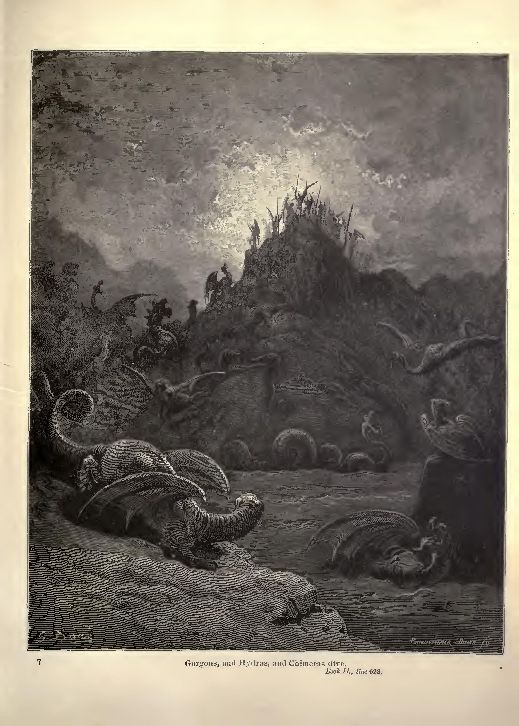
FULL-SIZE--Medium-Size
Mean while the Adversary of God and Man, Satan with thoughts inflam'd of highest design, 630 Puts on swift wings, and toward the Gates of Hell Explores his solitary flight; som times He scours the right hand coast, som times the left, Now shaves with level wing the Deep, then soares Up to the fiery concave touring high. As when farr off at Sea a Fleet descri'd Hangs in the Clouds, by Aequinoctial Winds Close sailing from Bengala, or the Iles Of Ternate and Tidore, whence Merchants bring Thir spicie Drugs: they on the trading Flood 640 Through the wide Ethiopian to the Cape Ply stemming nightly toward the Pole. So seem'd Farr off the flying Fiend: at last appeer Hell bounds high reaching to the horrid Roof, And thrice threefold the Gates; three folds were Brass Three Iron, three of Adamantine Rock, Impenitrable, impal'd with circling fire, Yet unconsum'd. Before the Gates there sat
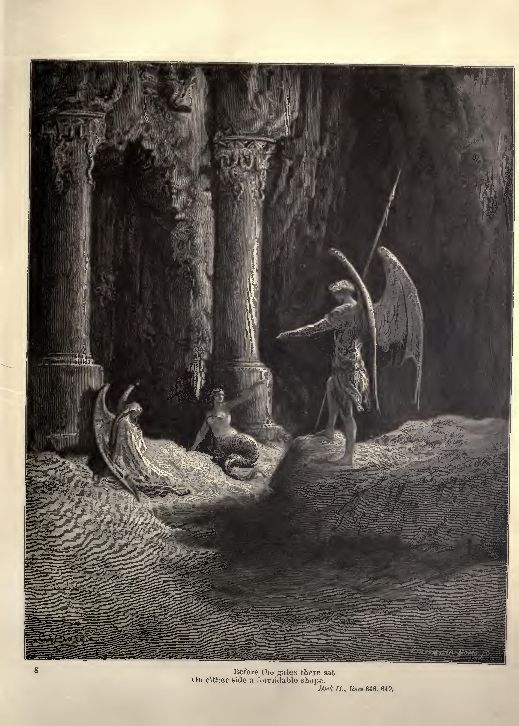
FULL-SIZE--Medium-Size
On either side a formidable shape; The one seem'd Woman to the waste, and fair, 650 But ended foul in many a scaly fould Voluminous and vast, a Serpent arm'd With mortal sting: about her middle round A cry of Hell Hounds never ceasing bark'd With wide Cerberean mouths full loud, and rung A hideous Peal: yet, when they list, would creep, If aught disturb'd thir noyse, into her woomb, And kennel there, yet there still bark'd and howl'd Within unseen. Farr less abhorrd then these Vex'd Scylla bathing in the Sea that parts 660 Calabria from the hoarce Trinacrian shore: Nor uglier follow the Night-Hag, when call'd In secret, riding through the Air she comes Lur'd with the smell of infant blood, to dance With Lapland Witches, while the labouring Moon Eclipses at thir charms. The other shape, If shape it might be call'd that shape had none Distinguishable in member, joynt, or limb, Or substance might be call'd that shadow seem'd, For each seem'd either; black it stood as Night, 670 Fierce as ten Furies, terrible as Hell, And shook a dreadful Dart; what seem'd his head The likeness of a Kingly Crown had on. Satan was now at hand, and from his seat The Monster moving onward came as fast, With horrid strides, Hell trembled as he strode. Th' undaunted Fiend what this might be admir'd, Admir'd, not fear'd; God and his Son except, Created thing naught vallu'd he nor shun'd; And with disdainful look thus first began. 680 Whence and what art thou, execrable shape, That dar'st, though grim and terrible, advance Thy miscreated Front athwart my way To yonder Gates? through them I mean to pass, That be assur'd, without leave askt of thee: Retire, or taste thy folly, and learn by proof, Hell-born, not to contend with Spirits of Heav'n. To whom the Goblin full of wrauth reply'd, Art thou that Traitor Angel, art thou hee, Who first broke peace in Heav'n and Faith, till then 690 Unbrok'n, and in proud rebellious Arms Drew after him the third part of Heav'ns Sons Conjur'd against the highest, for which both Thou And they outcast from God, are here condemn'd To waste Eternal daies in woe and pain? And reck'n'st thou thy self with Spirits of Heav'n, Hell-doomd, and breath'st defiance here and scorn, Where I reign King, and to enrage thee more, Thy King and Lord? Back to thy punishment, False fugitive, and to thy speed add wings, 700 Least with a whip of Scorpions I pursue Thy lingring, or with one stroke of this Dart Strange horror seise thee, and pangs unfelt before. So spake the grieslie terrour, and in shape, So speaking and so threatning, grew ten fold More dreadful and deform: on th' other side Incenc't with indignation Satan stood Unterrifi'd, and like a Comet burn'd, That fires the length of Ophiucus huge In th' Artick Sky, and from his horrid hair 710 Shakes Pestilence and Warr. Each at the Head Level'd his deadly aime; thir fatall hands No second stroke intend, and such a frown Each cast at th' other, as when two black Clouds With Heav'ns Artillery fraught, come rattling on Over the Caspian, then stand front to front Hov'ring a space, till Winds the signal blow To joyn thir dark Encounter in mid air: So frownd the mighty Combatants, that Hell Grew darker at thir frown, so matcht they stood; 720 For never but once more was either like To meet so great a foe: and now great deeds Had been achiev'd, whereof all Hell had rung, Had not the Snakie Sorceress that sat Fast by Hell Gate, and kept the fatal Key, Ris'n, and with hideous outcry rush'd between. O Father, what intends thy hand, she cry'd, Against thy only Son? What fury O Son, Possesses thee to bend that mortal Dart Against thy Fathers head? and know'st for whom; 730 For him who sits above and laughs the while At thee ordain'd his drudge, to execute What e're his wrath, which he calls Justice, bids, His wrath which one day will destroy ye both. She spake, and at her words the hellish Pest Forbore, then these to her Satan return'd: So strange thy outcry, and thy words so strange Thou interposest, that my sudden hand Prevented spares to tell thee yet by deeds What it intends; till first I know of thee, 740 What thing thou art, thus double-form'd, and why In this infernal Vaile first met thou call'st Me Father, and that Fantasm call'st my Son? I know thee not, nor ever saw till now Sight more detestable then him and thee. T' whom thus the Portress of Hell Gate reply'd; Hast thou forgot me then, and do I seem Now in thine eye so foul, once deemd so fair In Heav'n, when at th' Assembly, and in sight Of all the Seraphim with thee combin'd 750 In bold conspiracy against Heav'ns King, All on a sudden miserable pain Surpris'd thee, dim thine eyes, and dizzie swumm In darkness, while thy head flames thick and fast Threw forth, till on the left side op'ning wide, Likest to thee in shape and count'nance bright, Then shining heav'nly fair, a Goddess arm'd Out of thy head I sprung: amazement seis'd All th' Host of Heav'n; back they recoild affraid At first, and call'd me Sin, and for a Sign 760 Portentous held me; but familiar grown, I pleas'd, and with attractive graces won The most averse, thee chiefly, who full oft Thy self in me thy perfect image viewing Becam'st enamour'd, and such joy thou took'st With me in secret, that my womb conceiv'd A growing burden. Mean while Warr arose, And fields were fought in Heav'n; wherein remaind (For what could else) to our Almighty Foe Cleer Victory, to our part loss and rout 770 Through all the Empyrean: down they fell Driv'n headlong from the Pitch of Heaven, down Into this Deep, and in the general fall I also; at which time this powerful Key Into my hand was giv'n, with charge to keep These Gates for ever shut, which none can pass Without my op'ning. Pensive here I sat Alone, but long I sat not, till my womb Pregnant by thee, and now excessive grown Prodigious motion felt and rueful throes. 780 At last this odious offspring whom thou seest Thine own begotten, breaking violent way Tore through my entrails, that with fear and pain Distorted, all my nether shape thus grew Transform'd: but he my inbred enemie Forth issu'd, brandishing his fatal Dart Made to destroy: I fled, and cry'd out Death; Hell trembl'd at the hideous Name, and sigh'd From all her Caves, and back resounded Death. I fled, but he pursu'd (though more, it seems, 790 Inflam'd with lust then rage) and swifter far, Me overtook his mother all dismaid, And in embraces forcible and foule Ingendring with me, of that rape begot These yelling Monsters that with ceasless cry Surround me, as thou sawst, hourly conceiv'd And hourly born, with sorrow infinite To me, for when they list into the womb That bred them they return, and howle and gnaw My Bowels, their repast; then bursting forth 800 Afresh with conscious terrours vex me round, That rest or intermission none I find. Before mine eyes in opposition sits Grim Death my Son and foe, who sets them on, And me his Parent would full soon devour For want of other prey, but that he knows His end with mine involvd; and knows that I Should prove a bitter Morsel, and his bane, When ever that shall be; so Fate pronounc'd. But thou O Father, I forewarn thee, shun 810 His deadly arrow; neither vainly hope To be invulnerable in those bright Arms, Though temper'd heav'nly, for that mortal dint, Save he who reigns above, none can resist. She finish'd, and the suttle Fiend his lore Soon learnd, now milder, and thus answerd smooth. Dear Daughter, since thou claim'st me for thy Sire, And my fair Son here showst me, the dear pledge Of dalliance had with thee in Heav'n, and joys Then sweet, now sad to mention, through dire change 820 Befalln us unforeseen, unthought of, know I come no enemie, but to set free From out this dark and dismal house of pain, Both him and thee, and all the heav'nly Host Of Spirits that in our just pretenses arm'd Fell with us from on high: from them I go This uncouth errand sole, and one for all My self expose, with lonely steps to tread Th' unfounded deep, & through the void immense To search with wandring quest a place foretold 830 Should be, and, by concurring signs, ere now Created vast and round, a place of bliss In the Pourlieues of Heav'n, and therein plac't A race of upstart Creatures, to supply Perhaps our vacant room, though more remov'd, Least Heav'n surcharg'd with potent multitude Might hap to move new broiles: Be this or aught Then this more secret now design'd, I haste To know, and this once known, shall soon return, And bring ye to the place where Thou and Death 840 Shall dwell at ease, and up and down unseen Wing silently the buxom Air, imbalm'd With odours; there ye shall be fed and fill'd Immeasurably, all things shall be your prey. He ceas'd, for both seemd highly pleasd, and Death Grinnd horrible a gastly smile, to hear His famine should be fill'd, and blest his mawe Destin'd to that good hour: no less rejoyc'd His mother bad, and thus bespake her Sire. The key of this infernal Pit by due, 850 And by command of Heav'ns all-powerful King I keep, by him forbidden to unlock These Adamantine Gates; against all force Death ready stands to interpose his dart, Fearless to be o'rematcht by living might. But what ow I to his commands above Who hates me, and hath hither thrust me down Into this gloom of Tartarus profound, To sit in hateful Office here confin'd, Inhabitant of Heav'n, and heav'nlie-born, 860 Here in perpetual agonie and pain, With terrors and with clamors compasst round Of mine own brood, that on my bowels feed: Thou art my Father, thou my Author, thou My being gav'st me; whom should I obey But thee, whom follow? thou wilt bring me soon To that new world of light and bliss, among The Gods who live at ease, where I shall Reign At thy right hand voluptuous, as beseems Thy daughter and thy darling, without end. 870 Thus saying, from her side the fatal Key, Sad instrument of all our woe, she took; And towards the Gate rouling her bestial train, Forthwith the huge Portcullis high up drew, Which but her self not all the Stygian powers Could once have mov'd; then in the key-hole turns Th' intricate wards, and every Bolt and Bar Of massie Iron or sollid Rock with ease Unfast'ns: on a sudden op'n flie With impetuous recoile and jarring sound 880 Th' infernal dores, and on thir hinges great Harsh Thunder, that the lowest bottom shook Of Erebus. She op'nd, but to shut Excel'd her power; the Gates wide op'n stood, That with extended wings a Bannerd Host Under spread Ensigns marching might pass through With Horse and Chariots rankt in loose array; So wide they stood, and like a Furnace mouth Cast forth redounding smoak and ruddy flame. Before thir eyes in sudden view appear 890 The secrets of the hoarie deep, a dark Illimitable Ocean without bound, Without dimension, where length, breadth, and highth, And time and place are lost; where eldest Night And Chaos, Ancestors of Nature, hold Eternal Anarchie, amidst the noise Of endless warrs and by confusion stand. For hot, cold, moist, and dry, four Champions fierce Strive here for Maistrie, and to Battel bring Thir embryon Atoms; they around the flag 900 Of each his faction, in thir several Clanns, Light-arm'd or heavy, sharp, smooth, swift or slow, Swarm populous, unnumber'd as the Sands Of Barca or Cyrene's torrid soil, Levied to side with warring Winds, and poise Thir lighter wings. To whom these most adhere, Hee rules a moment; Chaos Umpire sits, And by decision more imbroiles the fray By which he Reigns: next him high Arbiter Chance governs all. Into this wilde Abyss, 910 The Womb of nature and perhaps her Grave, Of neither Sea, nor Shore, nor Air, nor Fire, But all these in thir pregnant causes mixt Confus'dly, and which thus must ever fight, Unless th' Almighty Maker them ordain His dark materials to create more Worlds, Into this wilde Abyss the warie fiend Stood on the brink of Hell and look'd a while, Pondering his Voyage; for no narrow frith He had to cross. Nor was his eare less peal'd 920 With noises loud and ruinous (to compare Great things with small) then when Bellona storms, With all her battering Engines bent to rase Som Capital City, or less then if this frame Of Heav'n were falling, and these Elements In mutinie had from her Axle torn The stedfast Earth. At last his Sail-broad Vannes He spreads for flight, and in the surging smoak Uplifted spurns the ground, thence many a League As in a cloudy Chair ascending rides 930 Audacious, but that seat soon failing, meets A vast vacuitie: all unawares Fluttring his pennons vain plumb down he drops Ten thousand fadom deep, and to this hour Down had been falling, had not by ill chance The strong rebuff of som tumultuous cloud Instinct with Fire and Nitre hurried him As many miles aloft: that furie stay'd, Quencht in a Boggie Syrtis, neither Sea, Nor good dry Land: nigh founderd on he fares, 940 Treading the crude consistence, half on foot, Half flying; behoves him now both Oare and Saile. As when a Gryfon through the Wilderness With winged course ore Hill or moarie Dale, Pursues the Arimaspian, who by stelth Had from his wakeful custody purloind The guarded Gold: So eagerly the fiend Ore bog or steep, through strait, rough, dense, or rare, With head, hands, wings, or feet pursues his way,
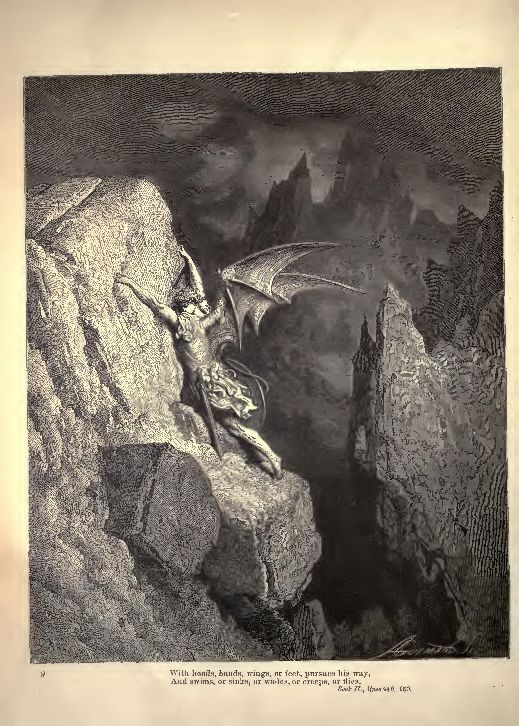
FULL-SIZE--Medium-Size
And swims or sinks, or wades, or creeps, or flyes: 950 At length a universal hubbub wilde Of stunning sounds and voices all confus'd Born through the hollow dark assaults his eare With loudest vehemence: thither he plyes, Undaunted to meet there what ever power Or Spirit of the nethermost Abyss Might in that noise reside, of whom to ask Which way the neerest coast of darkness lyes Bordering on light; when strait behold the Throne Of Chaos, and his dark Pavilion spread 960 Wide on the wasteful Deep; with him Enthron'd Sat Sable-vested Night, eldest of things, The consort of his Reign; and by them stood Orcus and Ades, and the dreaded name Of Demogorgon; Rumor next and Chance, And Tumult and Confusion all imbroild, And Discord with a thousand various mouths. T' whom Satan turning boldly, thus. Ye Powers And Spirits of this nethermost Abyss, Chaos and Ancient Night, I come no Spie, 970 With purpose to explore or to disturb The secrets of your Realm, but by constraint Wandring this darksome desart, as my way Lies through your spacious Empire up to light, Alone, and without guide, half lost, I seek What readiest path leads where your gloomie bounds Confine with Heav'n; or if som other place From your Dominion won, th' Ethereal King Possesses lately, thither to arrive I travel this profound, direct my course; 980 Directed, no mean recompence it brings To your behoof, if I that Region lost, All usurpation thence expell'd, reduce To her original darkness and your sway (Which is my present journey) and once more Erect the Standerd there of Ancient Night; Yours be th' advantage all, mine the revenge. Thus Satan; and him thus the Anarch old With faultring speech and visage incompos'd Answer'd. I know thee, stranger, who thou art, 990 That mighty leading Angel, who of late Made head against Heav'ns King, though overthrown. I saw and heard, for such a numerous host Fled not in silence through the frighted deep With ruin upon ruin, rout on rout, Confusion worse confounded; and Heav'n Gates Pourd out by millions her victorious Bands Pursuing. I upon my Frontieres here Keep residence; if all I can will serve, That little which is left so to defend 1000 Encroacht on still through our intestine broiles Weakning the Scepter of old Night: first Hell Your dungeon stretching far and wide beneath; Now lately Heaven and Earth, another World Hung ore my Realm, link'd in a golden Chain To that side Heav'n from whence your Legions fell: If that way be your walk, you have not farr; So much the neerer danger; goe and speed; Havock and spoil and ruin are my gain. He ceas'd; and Satan staid not to reply, 1010 But glad that now his Sea should find a shore, With fresh alacritie and force renew'd Springs upward like a Pyramid of fire Into the wilde expanse, and through the shock Of fighting Elements, on all sides round Environ'd wins his way; harder beset And more endanger'd, then when Argo pass'd Through Bosporus betwixt the justling Rocks: Or when Ulysses on the Larbord shunnd Charybdis, and by th' other whirlpool steard. 1020 So he with difficulty and labour hard Mov'd on, with difficulty and labour hee; But hee once past, soon after when man fell, Strange alteration! Sin and Death amain Following his track, such was the will of Heav'n, Pav'd after him a broad and beat'n way Over the dark Abyss, whose boiling Gulf Tamely endur'd a Bridge of wondrous length From Hell continu'd reaching th' utmost Orbe Of this frail World; by which the Spirits perverse 1030 With easie intercourse pass to and fro To tempt or punish mortals, except whom God and good Angels guard by special grace. But now at last the sacred influence Of light appears, and from the walls of Heav'n Shoots farr into the bosom of dim Night A glimmering dawn; here Nature first begins Her fardest verge, and Chaos to retire As from her outmost works a brok'n foe With tumult less and with less hostile din, 1040 That Satan with less toil, and now with ease Wafts on the calmer wave by dubious light And like a weather-beaten Vessel holds Gladly the Port, though Shrouds and Tackle torn; Or in the emptier waste, resembling Air, Weighs his spread wings, at leasure to behold Farr off th' Empyreal Heav'n, extended wide In circuit, undetermind square or round, With Opal Towrs and Battlements adorn'd Of living Saphire, once his native Seat; 1050 And fast by hanging in a golden Chain This pendant world, in bigness as a Starr Of smallest Magnitude close by the Moon. Thither full fraught with mischievous revenge, Accurst, and in a cursed hour he hies. Notes: 282 where] were 1674. 402 breath] misprint for breathe. 483 thir] her 1674. 527 his] this 1674. 542 Oealia] Oechalia 1674. 631 toward] towards 1674. The End Of The Second Book.
BOOK III.
Hail holy light, ofspring of Heav'n first-born, Or of th' Eternal Coeternal beam May I express thee unblam'd? since God is light, And never but in unapproached light Dwelt from Eternitie, dwelt then in thee, Bright effluence of bright essence increate. Or hear'st thou rather pure Ethereal stream, Whose Fountain who shall tell? before the Sun, Before the Heavens thou wert, and at the voice Of God, as with a Mantle didst invest 10 The rising world of waters dark and deep, Won from the void and formless infinite. Thee I re-visit now with bolder wing, Escap't the Stygian Pool, though long detain'd In that obscure sojourn, while in my flight Through utter and through middle darkness borne With other notes then to th' Orphean Lyre I sung of Chaos and Eternal Night, Taught by the heav'nly Muse to venture down The dark descent, and up to reascend, 20 Though hard and rare: thee I revisit safe, And feel thy sovran vital Lamp; but thou Revisit'st not these eyes, that rowle in vain To find thy piercing ray, and find no dawn; So thick a drop serene hath quencht thir Orbs, Or dim suffusion veild. Yet not the more Cease I to wander where the Muses haunt Cleer Spring, or shadie Grove, or Sunnie Hill, Smit with the love of sacred song; but chief Thee Sion and the flowrie Brooks beneath 30 That wash thy hallowd feet, and warbling flow, Nightly I visit: nor somtimes forget Those other two equal'd with me in Fate, So were I equal'd with them in renown, Blind Thamyris and blind Maeonides, And Tiresias and Phineus Prophets old. Then feed on thoughts, that voluntarie move Harmonious numbers; as the wakeful Bird Sings darkling, and in shadiest Covert hid Tunes her nocturnal Note. Thus with the Year 40 Seasons return, but not to me returns Day, or the sweet approach of Ev'n or Morn, Or sight of vernal bloom, or Summers Rose, Or flocks, or herds, or human face divine; But cloud in stead, and ever-during dark Surrounds me, from the chearful waies of men Cut off, and for the book of knowledg fair Presented with a Universal blanc Of Natures works to mee expung'd and ras'd, And wisdome at one entrance quite shut out. 50 So much the rather thou Celestial light Shine inward, and the mind through all her powers Irradiate, there plant eyes, all mist from thence Purge and disperse, that I may see and tell Of things invisible to mortal sight. Now had the Almighty Father from above, From the pure Empyrean where he sits High Thron'd above all highth, bent down his eye, His own works and their works at once to view: About him all the Sanctities of Heaven 60 Stood thick as Starrs, and from his sight receiv'd Beatitude past utterance; on his right The radiant image of his Glory sat, His onely Son; On Earth he first beheld Our two first Parents, yet the onely two Of mankind, in the happie Garden plac't, Reaping immortal fruits of joy and love, Uninterrupted joy, unrivald love In blissful solitude; he then survey'd Hell and the Gulf between, and Satan there 70 Coasting the wall of Heav'n on this side Night In the dun Air sublime, and ready now To stoop with wearied wings, and willing feet On the bare outside of this World, that seem'd Firm land imbosom'd without Firmament, Uncertain which, in Ocean or in Air. Him God beholding from his prospect high, Wherein past, present, future he beholds, Thus to his onely Son foreseeing spake. Onely begotten Son, seest thou what rage 80 Transports our adversarie, whom no bounds Prescrib'd, no barrs of Hell, nor all the chains Heapt on him there, nor yet the main Abyss Wide interrupt can hold; so bent he seems On desperat revenge, that shall redound Upon his own rebellious head. And now Through all restraint broke loose he wings his way Not farr off Heav'n, in the Precincts of light, Directly towards the new created World, And Man there plac't, with purpose to assay 90 If him by force he can destroy, or worse, By som false guile pervert; and shall pervert; For man will heark'n to his glozing lyes, And easily transgress the sole Command, Sole pledge of his obedience: So will fall Hee and his faithless Progenie: whose fault? Whose but his own? ingrate, he had of mee All he could have; I made him just and right, Sufficient to have stood, though free to fall. Such I created all th' Ethereal Powers 100 And Spirits, both them who stood & them who faild; Freely they stood who stood, and fell who fell. Not free, what proof could they have givn sincere Of true allegiance, constant Faith or Love, Where onely what they needs must do, appeard, Not what they would? what praise could they receive? What pleasure I from such obedience paid, When Will and Reason (Reason also is choice) Useless and vain, of freedom both despoild, Made passive both, had servd necessitie, 110 Not mee. They therefore as to right belongd, So were created, nor can justly accuse Thir maker, or thir making, or thir Fate; As if Predestination over-rul'd Thir will, dispos'd by absolute Decree Or high foreknowledge; they themselves decreed Thir own revolt, not I: if I foreknew, Foreknowledge had no influence on their fault, Which had no less prov'd certain unforeknown. So without least impulse or shadow of Fate, 120 Or aught by me immutablie foreseen, They trespass, Authors to themselves in all Both what they judge and what they choose; for so I formd them free, and free they must remain, Till they enthrall themselves: I else must change Thir nature, and revoke the high Decree Unchangeable, Eternal, which ordain'd Thir freedom, they themselves ordain'd thir fall. The first sort by thir own suggestion fell, Self-tempted, self-deprav'd: Man falls deceiv'd 130 By the other first: Man therefore shall find grace, The other none: in Mercy and Justice both, Through Heav'n and Earth, so shall my glorie excel, But Mercy first and last shall brightest shine. Thus while God spake, ambrosial fragrance fill'd All Heav'n, and in the blessed Spirits elect Sense of new joy ineffable diffus'd: Beyond compare the Son of God was seen Most glorious, in him all his Father shon Substantially express'd, and in his face 140 Divine compassion visibly appeerd, Love without end, and without measure Grace, Which uttering thus he to his Father spake. O Father, gracious was that word which clos'd Thy sovran sentence, that Man should find grace; For which both Heav'n and Earth shall high extoll Thy praises, with th' innumerable sound Of Hymns and sacred Songs, wherewith thy Throne Encompass'd shall resound thee ever blest. For should Man finally be lost, should Man 150 Thy creature late so lov'd, thy youngest Son Fall circumvented thus by fraud, though joynd With his own folly? that be from thee farr, That farr be from thee, Father, who art Judge Of all things made, and judgest onely right. Or shall the Adversarie thus obtain His end, and frustrate thine, shall he fulfill His malice, and thy goodness bring to naught, Or proud return though to his heavier doom, Yet with revenge accomplish't and to Hell 160 Draw after him the whole Race of mankind, By him corrupted? or wilt thou thy self Abolish thy Creation, and unmake, For him, what for thy glorie thou hast made? So should thy goodness and thy greatness both Be questiond and blaspheam'd without defence. To whom the great Creatour thus reply'd. O Son, in whom my Soul hath chief delight, Son of my bosom, Son who art alone My word, my wisdom, and effectual might, 170 All hast thou spok'n as my thoughts are, all As my Eternal purpose hath decreed: Man shall not quite be lost, but sav'd who will, Yet not of will in him, but grace in me Freely voutsaft; once more I will renew His lapsed powers, though forfeit and enthrall'd By sin to foul exorbitant desires; Upheld by me, yet once more he shall stand On even ground against his mortal foe, By me upheld, that he may know how frail 180 His fall'n condition is, and to me ow All his deliv'rance, and to none but me. Some I have chosen of peculiar grace Elect above the rest; so is my will: The rest shall hear me call, and oft be warnd Thir sinful state, and to appease betimes Th' incensed Deitie, while offerd grace Invites; for I will cleer thir senses dark, What may suffice, and soft'n stonie hearts To pray, repent, and bring obedience due. 190 To prayer, repentance, and obedience due, Though but endevord with sincere intent, Mine eare shall not be slow, mine eye not shut. And I will place within them as a guide My Umpire Conscience, whom if they will hear, Light after light well us'd they shall attain, And to the end persisting, safe arrive. This my long sufferance and my day of grace They who neglect and scorn, shall never taste; But hard be hard'nd, blind be blinded more, 200 That they may stumble on, and deeper fall; And none but such from mercy I exclude. But yet all is not don; Man disobeying, Disloyal breaks his fealtie, and sinns Against the high Supremacie of Heav'n, Affecting God-head, and so loosing all, To expiate his Treason hath naught left, But to destruction sacred and devote, He with his whole posteritie must die, Die hee or Justice must; unless for him 210 Som other able, and as willing, pay The rigid satisfaction, death for death. Say Heav'nly Powers, where shall we find such love, Which of ye will be mortal to redeem Mans mortal crime, and just th' unjust to save, Dwels in all Heaven charitie so deare? He ask'd, but all the Heav'nly Quire stood mute, And silence was in Heav'n: on mans behalf Patron or Intercessor none appeerd, Much less that durst upon his own head draw 220 The deadly forfeiture, and ransom set. And now without redemption all mankind Must have bin lost, adjudg'd to Death and Hell By doom severe, had not the Son of God, In whom the fulness dwels of love divine, His dearest mediation thus renewd. Father, thy word is past, man shall find grace; And shall grace not find means, that finds her way, The speediest of thy winged messengers, To visit all thy creatures, and to all 230 Comes unprevented, unimplor'd, unsought, Happie for man, so coming; be her aide Can never seek, once dead in sins and lost; Attonement for himself or offering meet, Indebted and undon, hath none to bring: Behold mee then, mee for him, life for life I offer, on mee let thine anger fall; Account mee man; I for his sake will leave Thy bosom, and this glorie next to thee Freely put off, and for him lastly die 240 Well pleas'd, on me let Death wreck all his rage; Under his gloomie power I shall not long Lie vanquisht; thou hast givn me to possess Life in my self for ever, by thee I live, Though now to Death I yeild, and am his due All that of me can die, yet that debt paid, Thou wilt not leave me in the loathsom grave His prey, nor suffer my unspotted Soule For ever with corruption there to dwell; But I shall rise Victorious, and subdue 250 My Vanquisher, spoild of his vanted spoile; Death his deaths wound shall then receive, & stoop Inglorious, of his mortall sting disarm'd. I through the ample Air in Triumph high Shall lead Hell Captive maugre Hell, and show The powers of darkness bound. Thou at the sight Pleas'd, out of Heaven shalt look down and smile, While by thee rais'd I ruin all my Foes, Death last, and with his Carcass glut the Grave: Then with the multitude of my redeemd 260 Shall enter Heaven long absent, and returne, Father, to see thy face, wherein no cloud Of anger shall remain, but peace assur'd, And reconcilement; wrauth shall be no more Thenceforth, but in thy presence Joy entire. His words here ended, but his meek aspect Silent yet spake, and breath'd immortal love To mortal men, above which only shon Filial obedience: as a sacrifice Glad to be offer'd, he attends the will 270 Of his great Father. Admiration seis'd All Heav'n, what this might mean, & whither tend Wondring; but soon th' Almighty thus reply'd: O thou in Heav'n and Earth the only peace Found out for mankind under wrauth, O thou My sole complacence! well thou know'st how dear, To me are all my works, nor Man the least Though last created, that for him I spare Thee from my bosom and right hand, to save, By loosing thee a while, the whole Race lost. 280 Thou therefore whom thou only canst redeeme, Thir Nature also to thy Nature joyne; And be thy self Man among men on Earth, Made flesh, when time shall be, of Virgin seed, By wondrous birth: Be thou in Adams room The Head of all mankind, though Adams Son. As in him perish all men, so in thee As from a second root shall be restor'd, As many as are restor'd, without thee none. His crime makes guiltie all his Sons, thy merit 290 Imputed shall absolve them who renounce Thir own both righteous and unrighteous deeds, And live in thee transplanted, and from thee Receive new life. So Man, as is most just, Shall satisfie for Man, be judg'd and die, And dying rise, and rising with him raise His Brethren, ransomd with his own dear life. So Heav'nly love shal outdoo Hellish hate, Giving to death, and dying to redeeme, So dearly to redeem what Hellish hate 300 So easily destroy'd, and still destroyes In those who, when they may, accept not grace. Nor shalt thou by descending to assume Mans Nature, less'n or degrade thine owne. Because thou hast, though Thron'd in highest bliss Equal to God, and equally enjoying God-like fruition, quitted all to save A World from utter loss, and hast been found By Merit more then Birthright Son of God, Found worthiest to be so by being Good, 310 Farr more then Great or High; because in thee Love hath abounded more then Glory abounds, Therefore thy Humiliation shall exalt With thee thy Manhood also to this Throne; Here shalt thou sit incarnate, here shalt Reigne Both God and Man, Son both of God and Man, Anointed universal King; all Power I give thee, reign for ever, and assume Thy Merits; under thee as Head Supream Thrones, Princedoms, Powers, Dominions I reduce: 320 All knees to thee shall bow, of them that bide In Heaven, or Earth, or under Earth in Hell; When thou attended gloriously from Heav'n Shalt in the Skie appeer, and from thee send The summoning Arch-Angels to proclaime Thy dread Tribunal: forthwith from all Windes The living, and forthwith the cited dead Of all past Ages to the general Doom Shall hast'n, such a peal shall rouse thir sleep. Then all thy Saints assembl'd, thou shalt judge 330 Bad men and Angels, they arraignd shall sink Beneath thy Sentence; Hell, her numbers full, Thenceforth shall be for ever shut. Mean while The World shall burn, and from her ashes spring New Heav'n and Earth, wherein the just shall dwell And after all thir tribulations long See golden days, fruitful of golden deeds, With Joy and Love triumphing, and fair Truth. Then thou thy regal Scepter shalt lay by, For regal Scepter then no more shall need, 340 God shall be All in All. But all ye Gods, Adore him, who to compass all this dies, Adore the Son, and honour him as mee. No sooner had th' Almighty ceas't, but all The multitude of Angels with a shout Loud as from numbers without number, sweet As from blest voices, uttering joy, Heav'n rung
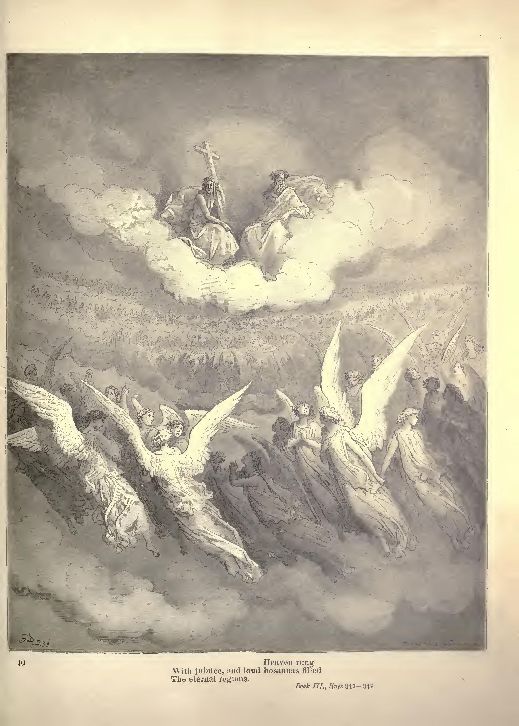
FULL-SIZE--Medium-Size
With Jubilee, and loud Hosanna's fill'd Th' eternal Regions: lowly reverent Towards either Throne they bow, & to the ground 350 With solemn adoration down they cast Thir Crowns inwove with Amarant and Gold, Immortal Amarant, a Flour which once In Paradise, fast by the Tree of Life Began to bloom, but soon for mans offence To Heav'n remov'd where first it grew, there grows, And flours aloft shading the Fount of Life, And where the river of Bliss through midst of Heavn Rowls o're Elisian Flours her Amber stream; With these that never fade the Spirits Elect 360 Bind thir resplendent locks inwreath'd with beams, Now in loose Garlands thick thrown off, the bright Pavement that like a Sea of Jasper shon Impurpl'd with Celestial Roses smil'd. Then Crown'd again thir gold'n Harps they took, Harps ever tun'd, that glittering by their side Like Quivers hung, and with Praeamble sweet Of charming symphonie they introduce Thir sacred Song, and waken raptures high; No voice exempt, no voice but well could joine 370 Melodious part, such concord is in Heav'n. Thee Father first they sung Omnipotent, Immutable, Immortal, Infinite, Eternal King; thee Author of all being, Fountain of Light, thy self invisible Amidst the glorious brightness where thou sit'st Thron'd inaccessible, but when thou shad'st The full blaze of thy beams, and through a cloud Drawn round about thee like a radiant Shrine, Dark with excessive bright thy skirts appeer, 380 Yet dazle Heav'n, that brightest Seraphim Approach not, but with both wings veil thir eyes. Thee next they sang of all Creation first, Begotten Son, Divine Similitude, In whose conspicuous count'nance, without cloud Made visible, th' Almighty Father shines, Whom else no Creature can behold; on thee Impresst the effulgence of his Glorie abides, Transfus'd on thee his ample Spirit rests. Hee Heav'n of Heavens and all the Powers therein 390 By thee created, and by thee threw down Th' aspiring Dominations: thou that day Thy Fathers dreadful Thunder didst not spare, Nor stop thy flaming Chariot wheels, that shook Heav'ns everlasting Frame, while o're the necks Thou drov'st of warring Angels disarraid. Back from pursuit thy Powers with loud acclaime Thee only extold, Son of thy Fathers might, To execute fierce vengeance on his foes, Not so on Man; him through their malice fall'n, 400 Father of Mercie and Grace, thou didst not doome So strictly, but much more to pitie encline: No sooner did thy dear and onely Son Perceive thee purpos'd not to doom frail Man So strictly, but much more to pitie enclin'd, He to appease thy wrauth, and end the strife Of Mercy and Justice in thy face discern'd, Regardless of the Bliss wherein hee sat Second to thee, offerd himself to die For mans offence. O unexampl'd love, 410 Love no where to be found less then Divine! Hail Son of God, Saviour of Men, thy Name Shall be the copious matter of my Song Henceforth, and never shall my Harp thy praise Forget, nor from thy Fathers praise disjoine. Thus they in Heav'n, above the starry Sphear, Thir happie hours in joy and hymning spent. Mean while upon the firm opacous Globe Of this round World, whose first convex divides The luminous inferior Orbs, enclos'd 420 From Chaos and th' inroad of Darkness old, Satan alighted walks: a Globe farr off It seem'd, now seems a boundless Continent Dark, waste, and wild, under the frown of Night Starless expos'd, and ever-threatning storms Of Chaos blustring round, inclement skie; Save on that side which from the wall of Heav'n Though distant farr som small reflection gaines Of glimmering air less vext with tempest loud: Here walk'd the Fiend at large in spacious field. 430 As when a Vultur on Imaus bred, Whose snowie ridge the roving Tartar bounds, Dislodging from a Region scarce of prey To gorge the flesh of Lambs or yeanling Kids On Hills where Flocks are fed, flies toward the Springs Of Ganges or Hydaspes, Indian streams; But in his way lights on the barren plaines Of Sericana, where Chineses drive With Sails and Wind thir canie Waggons light: So on this windie Sea of Land, the Fiend 440 Walk'd up and down alone bent on his prey, Alone, for other Creature in this place Living or liveless to be found was none, None yet, but store hereafter from the earth Up hither like Aereal vapours flew Of all things transitorie and vain, when Sin With vanity had filld the works of men: Both all things vain, and all who in vain things Built thir fond hopes of Glorie or lasting fame, Or happiness in this or th' other life; 450 All who have thir reward on Earth, the fruits Of painful Superstition and blind Zeal, Naught seeking but the praise of men, here find Fit retribution, emptie as thir deeds; All th' unaccomplisht works of Natures hand, Abortive, monstrous, or unkindly mixt, Dissolvd on earth, fleet hither, and in vain, Till final dissolution, wander here, Not in the neighbouring Moon, as some have dreamd; Those argent Fields more likely habitants, 460 Translated Saints, or middle Spirits hold Betwixt th' Angelical and Human kinde: Hither of ill-joynd Sons and Daughters born First from the ancient World those Giants came With many a vain exploit, though then renownd: The builders next of Babel on the Plain Of Sennaar, and still with vain designe New Babels, had they wherewithall, would build: Others came single; hee who to be deemd A God, leap'd fondly into Aetna flames, 470 Empedocles, and hee who to enjoy Plato's Elysium, leap'd into the Sea, Cleombrotus, and many more too long, Embryo's and Idiots, Eremits and Friers
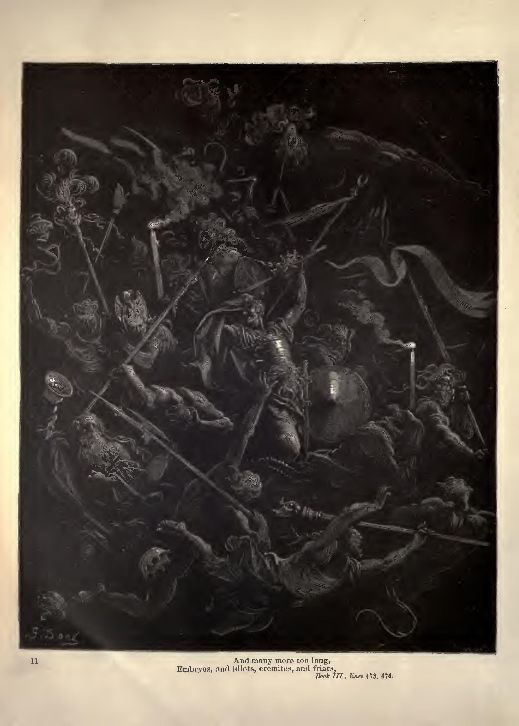
FULL-SIZE--Medium-Size
White, Black and Grey, with all thir trumperie. Here Pilgrims roam, that stray'd so farr to seek In Golgotha him dead, who lives in Heav'n; And they who to be sure of Paradise Dying put on the weeds of Dominic, Or in Franciscan think to pass disguis'd; 480 They pass the Planets seven, and pass the fixt, And that Crystalline Sphear whose ballance weighs The Trepidation talkt, and that first mov'd; And now Saint Peter at Heav'ns Wicket seems To wait them with his Keys, and now at foot Of Heav'ns ascent they lift thir Feet, when loe A violent cross wind from either Coast Blows them transverse ten thousand Leagues awry Into the devious Air; then might ye see Cowles, Hoods and Habits with thir wearers tost 490 And flutterd into Raggs, then Reliques, Beads, Indulgences, Dispenses, Pardons, Bulls, The sport of Winds: all these upwhirld aloft Fly o're the backside of the World farr off Into a Limbo large and broad, since calld The Paradise of Fools, to few unknown Long after, now unpeopl'd, and untrod; All this dark Globe the Fiend found as he pass'd, And long he wanderd, till at last a gleame Of dawning light turnd thither-ward in haste 500 His travell'd steps; farr distant hee descries Ascending by degrees magnificent Up to the wall of Heaven a Structure high, At top whereof, but farr more rich appeerd The work as of a Kingly Palace Gate With Frontispice of Diamond and Gold Imbellisht, thick with sparkling orient Gemmes The Portal shon, inimitable on Earth By Model, or by shading Pencil drawn. The Stairs were such as whereon Jacob saw 510 Angels ascending and descending, bands Of Guardians bright, when he from Esau fled To Padan-aram in the field of Luz, Dreaming by night under the open Skie, And waking cri'd, This is the Gate of Heav'n. Each Stair mysteriously was meant, nor stood There alwaies, but drawn up to Heav'n somtimes Viewless, and underneath a bright Sea flow'd Of Jasper, or of liquid Pearle, whereon Who after came from Earth, sayling arriv'd, 520 Wafted by Angels, or flew o're the Lake Rapt in a Chariot drawn by fiery Steeds. The Stairs were then let down, whether to dare The Fiend by easie ascent, or aggravate His sad exclusion from the dores of Bliss. Direct against which op'nd from beneath, Just o're the blissful seat of Paradise, A passage down to th' Earth, a passage wide, Wider by farr then that of after-times Over Mount Sion, and, though that were large, 530 Over the Promis'd Land to God so dear, By which, to visit oft those happy Tribes, On high behests his Angels to and fro Pass'd frequent, and his eye with choice regard From Paneas the fount of Jordans flood To Beersaba, where the Holy Land Borders on Aegypt and the Arabian shoare; So wide the op'ning seemd, where bounds were set To darkness, such as bound the Ocean wave. Satan from hence now on the lower stair 540 That scal'd by steps of Gold to Heav'n Gate Looks down with wonder at the sudden view Of all this World at once. As when a Scout Through dark and desart wayes with peril gone All night; at last by break of chearful dawne Obtains the brow of some high-climbing Hill, Which to his eye discovers unaware The goodly prospect of some forein land First-seen, or some renownd Metropolis With glistering Spires and Pinnacles adornd, 550 Which now the Rising Sun guilds with his beams. Such wonder seis'd, though after Heaven seen, The Spirit maligne, but much more envy seis'd At sight of all this World beheld so faire. Round he surveys, and well might, where he stood So high above the circling Canopie Of Nights extended shade; from Eastern Point Of Libra to the fleecie Starr that bears Andromeda farr off Atlantick Seas Beyond th' Horizon; then from Pole to Pole 560 He views in bredth, and without longer pause Down right into the Worlds first Region throws His flight precipitant, and windes with ease Through the pure marble Air his oblique way Amongst innumerable Starrs, that shon Stars distant, but nigh hand seemd other Worlds, Or other Worlds they seemd, or happy Iles, Like those Hesperian Gardens fam'd of old, Fortunate Fields, and Groves and flourie Vales, Thrice happy Iles, but who dwelt happy there 570 He stayd not to enquire: above them all The golden Sun in splendor likest Heaven Allur'd his eye: Thither his course he bends Through the calm Firmament; but up or downe By center, or eccentric, hard to tell, Or Longitude, where the great Luminarie Alooff the vulgar Constellations thick, That from his Lordly eye keep distance due, Dispenses Light from farr; they as they move Thir Starry dance in numbers that compute 580 Days, months, and years, towards his all-chearing Lamp Turn swift their various motions, or are turnd By his Magnetic beam, that gently warms The Univers, and to each inward part With gentle penetration, though unseen, Shoots invisible vertue even to the deep: So wondrously was set his Station bright. There lands the Fiend, a spot like which perhaps Astronomer in the Sun's lucent Orbe Through his glaz'd Optic Tube yet never saw. 590 The place he found beyond expression bright, Compar'd with aught on Earth, Medal or Stone; Not all parts like, but all alike informd With radiant light, as glowing Iron with fire; If mettal, part seemd Gold, part Silver cleer; If stone, Carbuncle most or Chrysolite, Rubie or Topaz, to the Twelve that shon In Aarons Brest-plate, and a stone besides Imagind rather oft then elsewhere seen, That stone, or like to that which here below 600 Philosophers in vain so long have sought, In vain, though by thir powerful Art they binde Volatil Hermes, and call up unbound In various shapes old Proteus from the Sea, Draind through a Limbec to his Native forme. What wonder then if fields and regions here Breathe forth Elixir pure, and Rivers run Potable Gold, when with one vertuous touch Th' Arch-chimic Sun so farr from us remote Produces with Terrestrial Humor mixt 610 Here in the dark so many precious things Of colour glorious and effect so rare? Here matter new to gaze the Devil met Undazl'd, farr and wide his eye commands, For sight no obstacle found here, nor shade, But all Sun-shine, as when his Beams at Noon Culminate from th' Aequator, as they now Shot upward still direct, whence no way round Shadow from body opaque can fall, and the Aire, No where so cleer, sharp'nd his visual ray 620 To objects distant farr, whereby he soon Saw within kenn a glorious Angel stand, The same whom John saw also in the Sun: His back was turnd, but not his brightness hid; Of beaming sunnie Raies, a golden tiar Circl'd his Head, nor less his Locks behind Illustrious on his Shoulders fledge with wings Lay waving round; on som great charge imploy'd Hee seemd, or fixt in cogitation deep. Glad was the Spirit impure as now in hope 630 To find who might direct his wandring flight To Paradise the happie seat of Man, His journies end and our beginning woe. But first he casts to change his proper shape, Which else might work him danger or delay: And now a stripling Cherube he appeers, Not of the prime, yet such as in his face Youth smil'd Celestial, and to every Limb Sutable grace diffus'd, so well he feignd; Under a Coronet his flowing haire 640 In curles on either cheek plaid, wings he wore Of many a colourd plume sprinkl'd with Gold, His habit fit for speed succinct, and held Before his decent steps a Silver wand. He drew not nigh unheard, the Angel bright, Ere he drew nigh, his radiant visage turnd, Admonisht by his eare, and strait was known Th' Arch-Angel Uriel, one of the seav'n Who in Gods presence, neerest to his Throne Stand ready at command, and are his Eyes 650 That run through all the Heav'ns, or down to th' Earth Bear his swift errands over moist and dry, O're Sea and Land: him Satan thus accostes; Uriel, for thou of those seav'n Spirits that stand In sight of God's high Throne, gloriously bright, The first art wont his great authentic will Interpreter through highest Heav'n to bring, Where all his Sons thy Embassie attend; And here art likeliest by supream decree Like honour to obtain, and as his Eye 660 To visit oft this new Creation round; Unspeakable desire to see, and know All these his wondrous works, but chiefly Man, His chief delight and favour, him for whom All these his works so wondrous he ordaind, Hath brought me from the Quires of Cherubim Alone thus wandring. Brightest Seraph tell In which of all these shining Orbes hath Man His fixed seat, or fixed seat hath none, But all these shining Orbes his choice to dwell; 670 That I may find him, and with secret gaze, Or open admiration him behold On whom the great Creator hath bestowd Worlds, and on whom hath all these graces powrd; That both in him and all things, as is meet, The Universal Maker we may praise; Who justly hath drivn out his Rebell Foes To deepest Hell, and to repair that loss Created this new happie Race of Men To serve him better: wise are all his wayes. 680 So spake the false dissembler unperceivd; For neither Man nor Angel can discern Hypocrisie, the only evil that walks Invisible, except to God alone, By his permissive will, through Heav'n and Earth: And oft though wisdom wake, suspicion sleeps At wisdoms Gate, and to simplicitie Resigns her charge, while goodness thinks no ill Where no ill seems: Which now for once beguil'd Uriel, though Regent of the Sun, and held 690 The sharpest sighted Spirit of all in Heav'n; Who to the fraudulent Impostor foule In his uprightness answer thus returnd. Faire Angel, thy desire which tends to know The works of God, thereby to glorifie The great Work-Maister, leads to no excess That reaches blame, but rather merits praise The more it seems excess, that led thee hither From thy Empyreal Mansion thus alone, To witness with thine eyes what some perhaps 700 Contented with report heare onely in heav'n: For wonderful indeed are all his works, Pleasant to know, and worthiest to be all Had in remembrance alwayes with delight; But what created mind can comprehend Thir number, or the wisdom infinite That brought them forth, but hid thir causes deep. I saw when at his Word the formless Mass, This worlds material mould, came to a heap: Confusion heard his voice, and wilde uproar 710 Stood rul'd, stood vast infinitude confin'd; Till at his second bidding darkness fled, Light shon, and order from disorder sprung: Swift to thir several Quarters hasted then The cumbrous Elements, Earth, Flood, Aire, Fire, And this Ethereal quintessence of Heav'n Flew upward, spirited with various forms, That rowld orbicular, and turnd to Starrs Numberless, as thou seest, and how they move; Each had his place appointed, each his course, 720 The rest in circuit walles this Universe. Look downward on that Globe whose hither side With light from hence, though but reflected, shines; That place is Earth the seat of Man, that light His day, which else as th' other Hemisphere Night would invade, but there the neighbouring Moon (So call that opposite fair Starr) her aide Timely interposes, and her monthly round Still ending, still renewing, through mid Heav'n; With borrowd light her countenance triform 730 Hence fills and empties to enlighten th' Earth, And in her pale dominion checks the night. That spot to which I point is Paradise, Adams abode, those loftie shades his Bowre. Thy way thou canst not miss, me mine requires. Thus said, he turnd, and Satan bowing low, As to superior Spirits is wont in Heaven, Where honour due and reverence none neglects, Took leave, and toward the coast of Earth beneath, Down from th' Ecliptic, sped with hop'd success, 740 Throws his steep flight with many an Aerie wheele, Nor staid, till on Niphates top he lights.
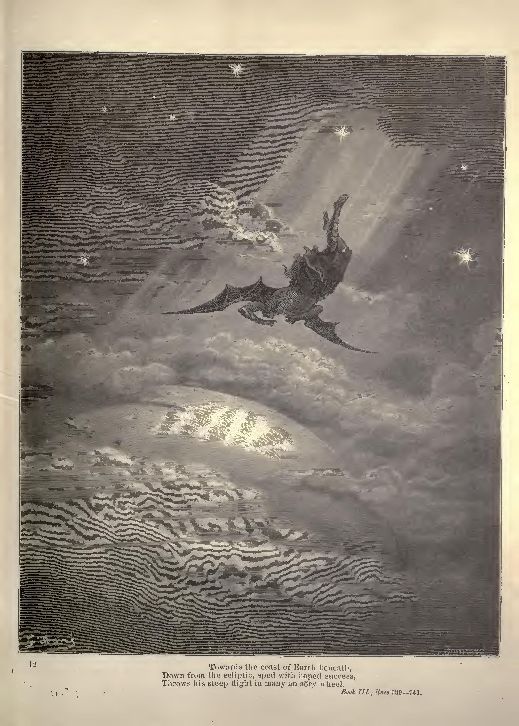
FULL-SIZE--Medium-Size
The End Of The Third Book.
BOOK IV.
O For that warning voice, which he who saw Th' Apocalyps, heard cry in Heaven aloud, Then when the Dragon, put to second rout, Came furious down to be reveng'd on men, Wo To The Inhabitants On Earth! that now, While time was, our first Parents had bin warnd The coming of thir secret foe, and scap'd Haply so scap'd his mortal snare; for now Satan, now first inflam'd with rage, came down, The Tempter ere th' Accuser of man-kind, 10 To wreck on innocent frail man his loss Of that first Battel, and his flight to Hell: Yet not rejoycing in his speed, though bold, Far off and fearless, nor with cause to boast, Begins his dire attempt, which nigh the birth Now rowling, boiles in his tumultuous brest, And like a devillish Engine back recoiles Upon himself; horror and doubt distract His troubl'd thoughts, and from the bottom stirr The Hell within him, for within him Hell 20 He brings, and round about him, nor from Hell One step no more then from himself can fly By change of place: Now conscience wakes despair That slumberd, wakes the bitter memorie Of what he was, what is, and what must be Worse; of worse deeds worse sufferings must ensue. Sometimes towards Eden which now in his view Lay pleasant, his grievd look he fixes sad, Sometimes towards Heav'n and the full-blazing Sun, Which now sat high in his Meridian Towre: 30 Then much revolving, thus in sighs began. O thou that with surpassing Glory crownd, Look'st from thy sole Dominion like the God Of this new World; at whose sight all the Starrs Hide thir diminisht heads; to thee I call, But with no friendly voice, and add thy name O Sun, to tell thee how I hate thy beams That bring to my remembrance from what state I fell, how glorious once above thy Spheare; Till Pride and worse Ambition threw me down 40 Warring in Heav'n against Heav'ns matchless King: Ah wherefore! he deservd no such return From me, whom he created what I was In that bright eminence, and with his good Upbraided none; nor was his service hard. What could be less then to afford him praise, The easiest recompence, and pay him thanks, How due! yet all his good prov'd ill in me, And wrought but malice; lifted up so high I sdeind subjection, and thought one step higher 50 Would set me highest, and in a moment quit The debt immense of endless gratitude, So burthensome, still paying, still to ow; Forgetful what from him I still receivd, And understood not that a grateful mind By owing owes not, but still pays, at once Indebted and dischargd; what burden then? O had his powerful Destiny ordaind Me some inferiour Angel, I had stood Then happie; no unbounded hope had rais'd 60 Ambition. Yet why not? som other Power As great might have aspir'd, and me though mean Drawn to his part; but other Powers as great Fell not, but stand unshak'n, from within Or from without, to all temptations arm'd. Hadst thou the same free Will and Power to stand? Thou hadst: whom hast thou then or what to accuse, But Heav'ns free Love dealt equally to all? Be then his Love accurst, since love or hate, To me alike, it deals eternal woe. 70 Nay curs'd be thou; since against his thy will Chose freely what it now so justly rues. Me miserable! which way shall I flie Infinite wrauth, and infinite despaire?
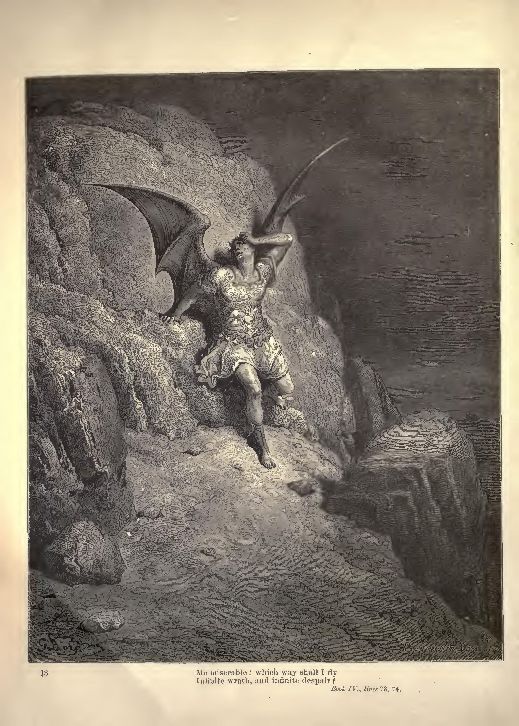
FULL-SIZE--Medium-Size
Which way I flie is Hell; my self am Hell; And in the lowest deep a lower deep Still threatning to devour me opens wide, To which the Hell I suffer seems a Heav'n. O then at last relent: is there no place Left for Repentance, none for Pardon left? 80 None left but by submission; and that word Disdain forbids me, and my dread of shame Among the spirits beneath, whom I seduc'd With other promises and other vaunts Then to submit, boasting I could subdue Th' Omnipotent. Ay me, they little know How dearly I abide that boast so vaine, Under what torments inwardly I groane; While they adore me on the Throne of Hell, With Diadem and Scepter high advanc'd 90 The lower still I fall, onely Supream